
圖示
The same spec questions, over and over
Show the work, let customers design and pick specs, quote automatically, take payment, and track the order. Built for print shops tired of quoting by hand.
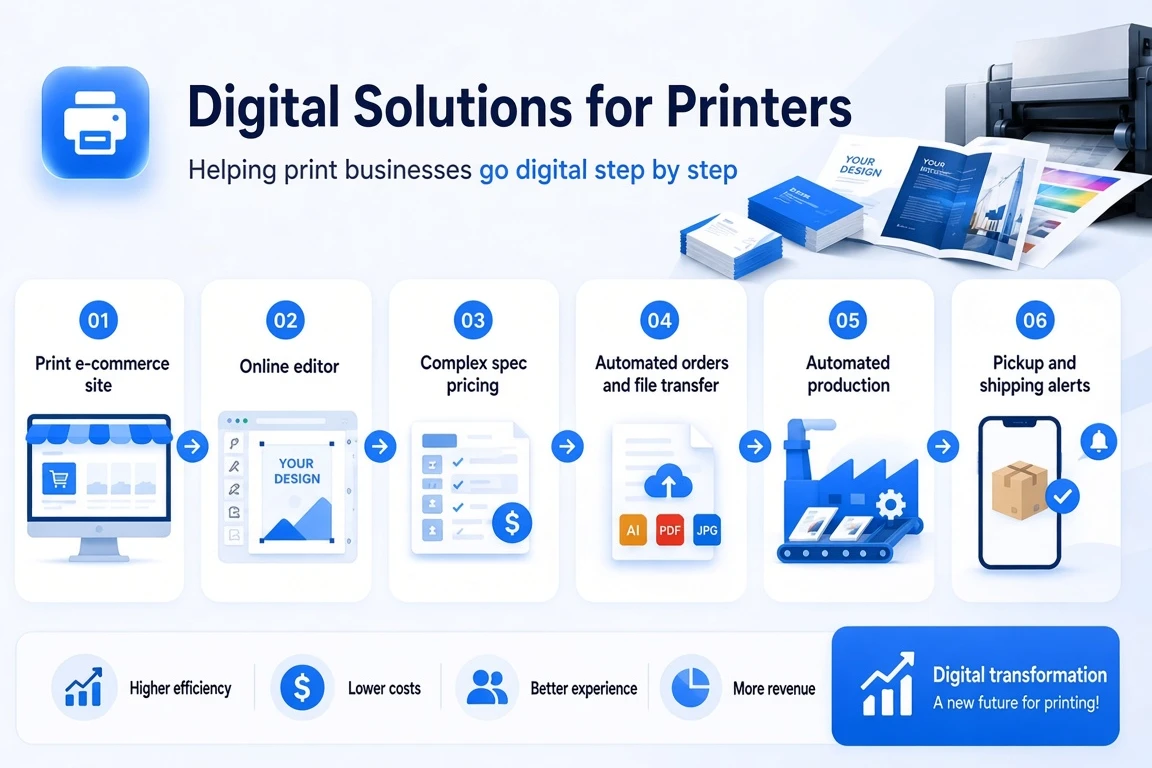
From the quote to the spec, the proof, and the press, every step is a conversation. It costs people, and a wrong fact means the job is done twice. We put that sequence online, so a quote can become an order without the same loop.
The same spec questions, over and over
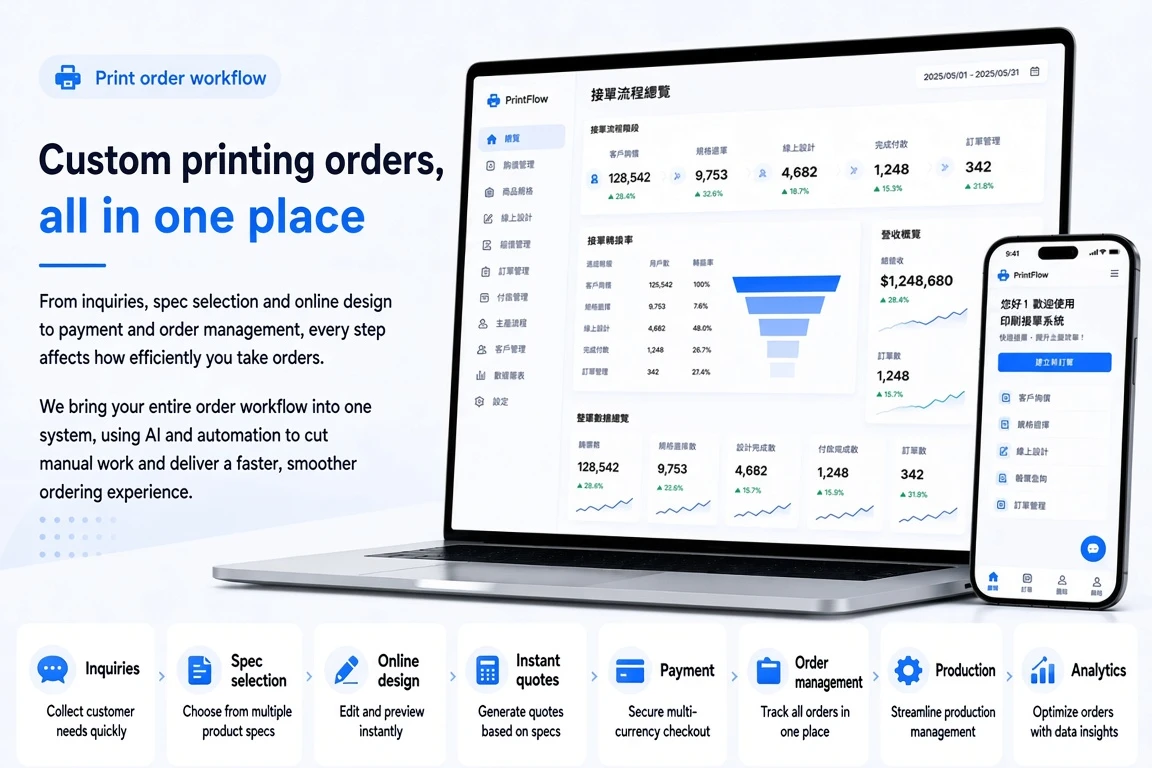
The inquiry, the options, the design, the payment, and the order can each slow the job down. They sit in one system, with AI and automation taking the repetitive parts, so taking an order is faster and less manual.
Phase 1
Stock, size, finish, examples, and how price works. Fewer repeat questions, because the facts are on the page.
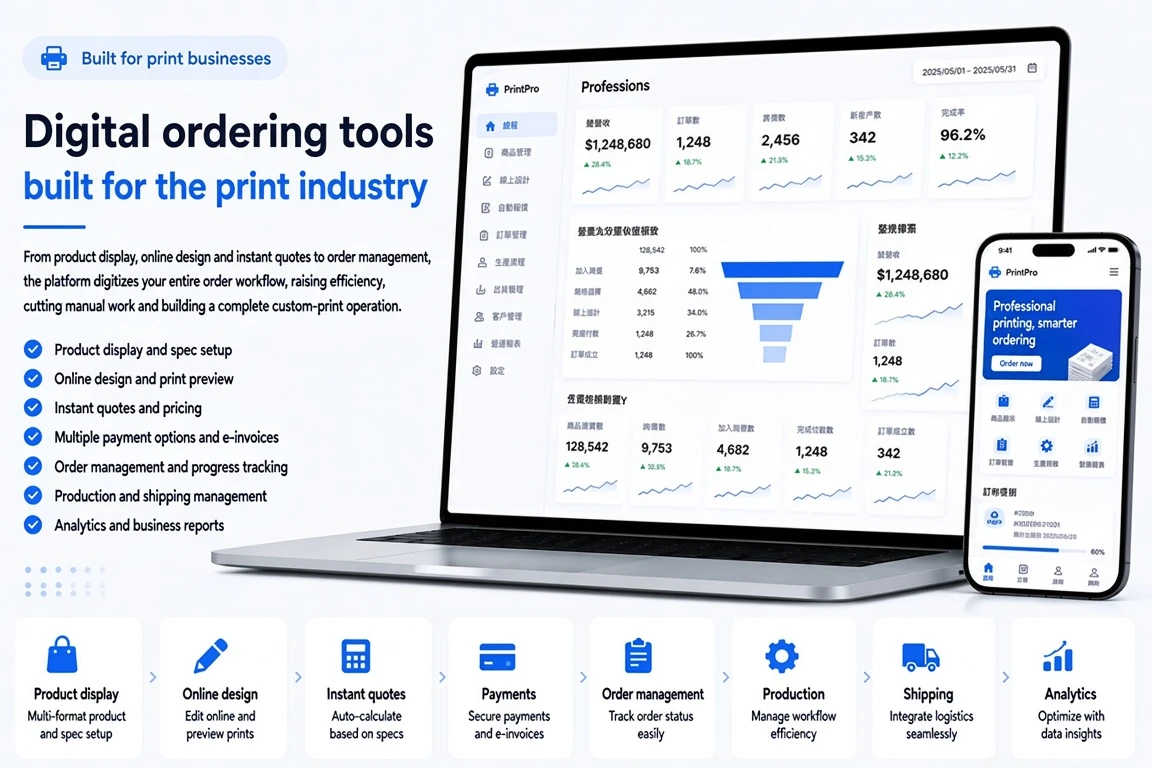
Catalog, an editor, a price that calculates from the spec, and the order. The fiddly path becomes a system the shop can run, with less of it typed by hand.
Design, on the order
・An online editor ・Artwork, kept with the job ・File upload

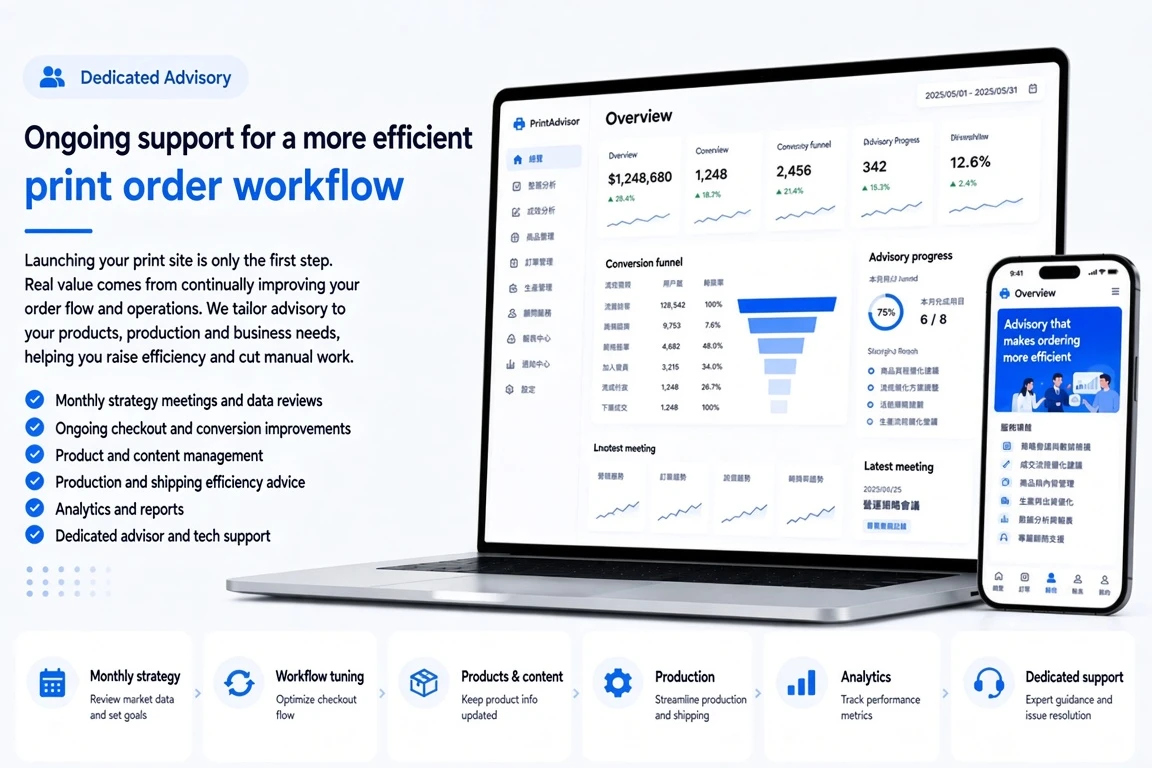
A monthly look at the orders
The site, the order data, and what customers say. The intake and the strategy move with the shop's goals and with demand.
・An order platform in your own brand ・Products, quotes, and online design in one path ・Orders, jobs, and customers handled without a side spreadsheet ・A print operation you can keep extending ・Less of the sale spent on back-and-forth
Shops that sell custom print, packaging, stickers, cards, catalogs, large-format, or made-to-order gifts. B2B or B2C, if the work involves a spec, a design, or an order taken online, the shape can follow the shop.
Yes. Each product can carry its own options: size, stock, finish, quantity, and how price is calculated. More complicated quote logic can be scoped to the product, so a custom job can still be priced and ordered without a person in the middle.
Yes. The editor covers type, images, assets, and layout, with a live preview. A product can also take an upload or a proof-approval step, so the order moves with fewer rounds of email.
Yes. ERP, production, shipping, payment, e-invoices, LINE Official Account, and other APIs can be connected where the shop already works that way. The point is fewer facts typed twice.
You can, or TimTech can run it with you. Catalog, specs, page updates, the intake, and ongoing advice are available so the site keeps taking orders, not just existing.
A store shows products and takes payment. This is built for print: an editor, specs that build the job, a quote that calculates, orders, a path into production, and someone still tending the operation. The fiddly intake becomes digital, and less of it depends on staff time.
Size, stock, finish, and quantity are different on every job. Quoting and confirming them again costs time, and a hand calculation is an easy place to be wrong.
Quotes that wait on a person
Reply, quote, create the order, tell production. Most of it is still manual, so headcount caps how many jobs you can take.
Proofs that never quite fit the press
Type, images, and layout come back again, and often still will not print as specified. Every pass is another conversation and another proof.
A custom job cannot be ordered cleanly
Upload, revise, final proof. Each change waits on a person. The path is slow, and the cost is staff time.
Orders, without a picture of the shop
Without live orders and operating numbers, it is hard to see what sells, what closes, where a job is, or how buyers behave. Later decisions suffer.
Launch, then nobody tends it
After the site goes up, the catalog, the path to an order, the automation, and the way the shop runs are left alone. The site never becomes a way to take work.
Phase 2
Size, paper, quantity, finish. The buyer configures the job. Less of the confirmation is a message thread.
Phase 3
Upload, edit online, preview. The proof happens before the order, so the revision loop is shorter.
Phase 4
Spec, quantity, and finish calculate the price as they go. The quote is visible. Nobody waits on a spreadsheet.
Phase 5
Members, payment, shipping, e-invoices, and the order. The buyer finishes. The shop's intake gets simpler at the same time.
Phase 6
Orders, the production path, and the operating numbers. You can see where each job is, without the tracking living in someone's head.
Taking the order, with less typing
・Options that build the spec ・A quote that calculates ・A chat for the questions that remain
Running the work
・Orders ・Files through to production ・The production path ・Payment, shipping, e-invoices

The intake, kept faster
Product pages, specs, the editor, the quote, and how the buyer moves. The step that slows an order gets found, and the rate at which quotes become jobs can rise.

Production, connected
Orders, the production path, shipping notices, and the other systems you already run. The site is not a side door. The same facts are not typed twice.