A packaging inquiry usually starts with a long list: box style, finished size, paper, hot foil or not, and how many.
Sales has to ask back one question at a time, then check the price sheet. Customers who wait too long for a price ask the next supplier.
Many packaging and box makers decide that with so many specs, a website cannot price automatically. Most of the time, the website is not the problem. The pricing rules simply have not been turned into step-by-step choices yet.
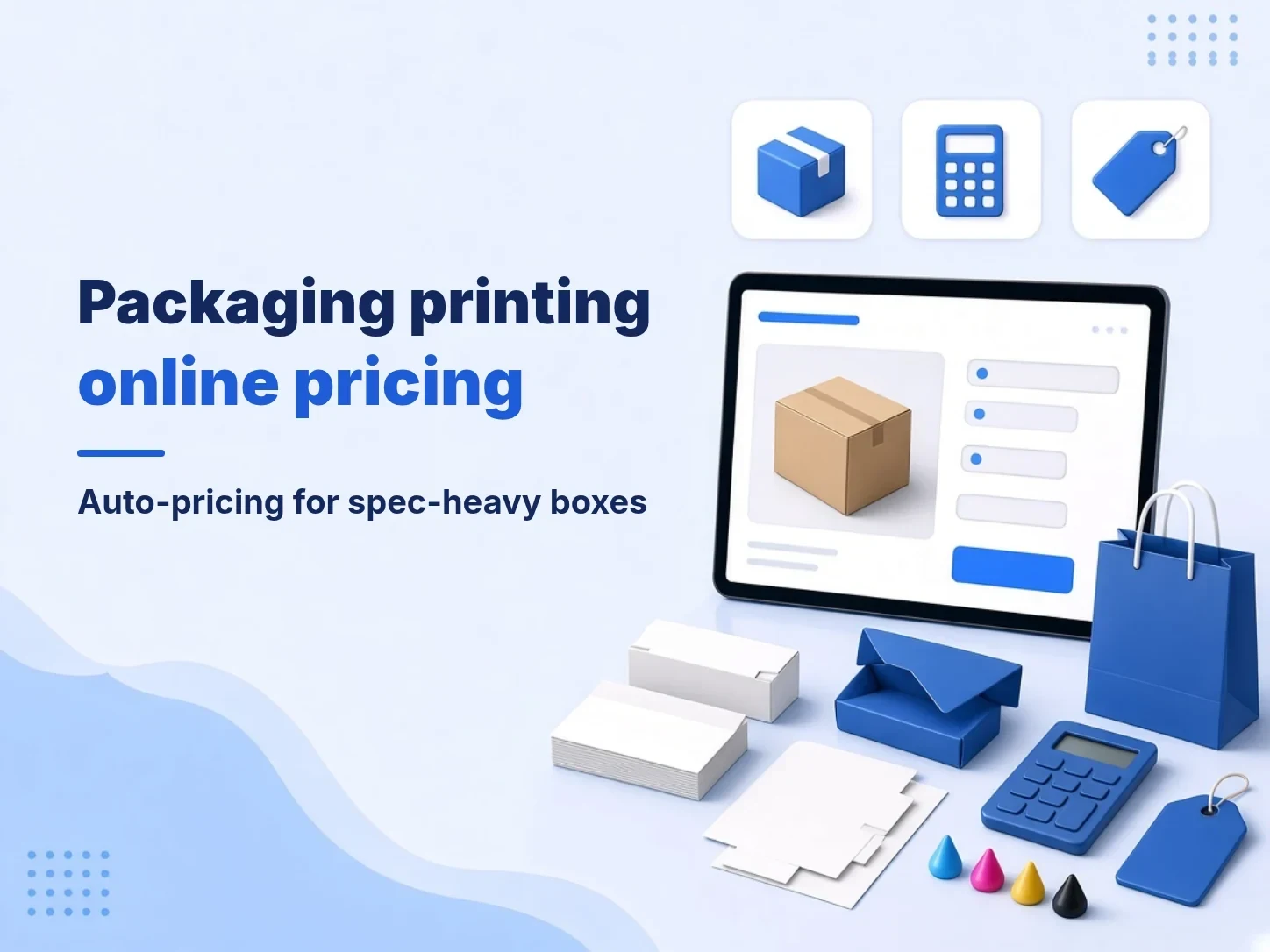
This article explains how packaging printing online pricing works: which specs suit automatic pricing, which should go to an inquiry, and how to break the pricing into steps.
Further reading: How to choose a print quotation system
Key takeaways
- Packaging printing online pricing works by splitting box style, size, paper, finishing, and quantity into steps.
- Many specs do not rule out automatic pricing. Unwritten rules do.
- Price common box styles and fixed combinations automatically; send custom shapes and special finishing to an inquiry.
- Launch with the most-requested items first, then expand based on real inquiries.
- Connect pricing to inquiry and ordering, so customers do not go back to chat after seeing a price.
Why is it hard to give an instant price for boxes and packaging?
Packaging prices come from several conditions that affect each other. For the same printed box, a larger size, thicker board, or an extra hot foil step changes the price.
Common conditions that affect price:
- Box style: tuck-end, rigid lid-and-base, drawer boxes and more, each with different material and finishing
- Finished size: affects the flat layout, imposition, and paper use
- Paper and thickness: white board, kraft, corrugated, or specialty paper vary widely in cost
- Printing: one color or full color, inside and outside or not
- Finishing: lamination, hot foil, spot UV, embossing, die cutting, gluing
- Quantity: fixed costs such as setup and cutting dies are spread over the quantity
These conditions do not simply add up. They interact. When the quantity changes, imposition and paper waste change too.
That is why a single price list rarely works for packaging, and sales ends up calculating every quote again.
Further resources: Folding carton (Wikipedia)
Many specs are not the problem. Pricing rules that live only in someone's head are.
How is packaging printing online pricing different from manual quotes and inquiry forms?

With manual quotes, customers send a message and sales replies with a price. An inquiry form collects the request on your site, but the price still waits for sales. With packaging printing online pricing, customers choose their specs and the site shows a price first, like a printing price calculator on your own website.
| Approach | What customers do on the site | What sales does next | Best for |
|---|---|---|---|
| Manual quote | Describe needs by message or phone | Ask back, check tables, calculate, reply | Few inquiries, or almost every job is a project |
| Inquiry form | Fill in specs and contact details | Price from the form, then reply | Specs that are hard to price in advance |
| Online pricing | Choose specs step by step and see a price | Handle orders, or take over a few special specs | Common box styles and combinations that can be priced in advance |
The three approaches can work together. A practical setup lets common items use online pricing while special requests still go to an inquiry.
Customers already search for prices online. People search for packaging printing, box printing, and online printing services, and many expect an online printing quote. Buyers searching for a box printing quote mostly find estimate tools and price guides from printers. If your own site only shows a phone number, those buyers have little reason to stay.
The features a quotation system needs are covered in our print quotation system article. This article focuses on how to put pricing for spec-heavy packaging and boxes on your own website.
Further resources: Web-to-print (Wikipedia)
Further resources: Print on demand (Wikipedia)
Can a site price automatically with many specs? What should go to an inquiry?

Yes. If the pricing rules can be written down in advance, a site can price automatically no matter how many specs there are. Anything that needs artwork review, a sample, or expert judgment is better handled as an inquiry for sales.
Good candidates for automatic pricing:
- The few box styles customers ask about most
- Fixed paper and thickness options
- Clear quantity tiers, such as common minimum order quantities
- Finishing with clear surcharge rules, such as lamination
Better handled as an inquiry:
- Custom shapes and special structures that need a new cutting die
- Special or mixed materials
- Finishing where area or position changes the price and is hard to list in advance
- Jobs that need artwork or a physical sample first
- Large orders beyond the usual tiers
A simple test: if a senior salesperson prices it with a fixed lookup and surcharge logic, that part can go into the system. If they only know after seeing it, leave it to an inquiry.
Our print automation sales system lets customers choose paper, size, quantity, and finishing on your site and see the price right away. Each product can have its own pricing rules, and more unusual pricing logic is reviewed during the consultation.
How should a box website break pricing into steps?

Follow the production logic of packaging and let customers choose one step at a time instead of showing every field at once. The price updates after each step.
A common order:
Box style → Finished size → Paper and thickness → Printing → Finishing → Quantity
This order helps in several ways:
- Choosing the box style first narrows the later options
- Fixing the size early makes paper use and imposition accurate
- Putting finishing later makes it easier to see how each option affects price
- Putting quantity last lets customers compare unit prices across quantities
Build in safeguards. If a paper cannot take a certain finish, do not let customers select that combination. When customers can pick something you cannot produce, they think the site is wrong, and sales still has to step in.
A small diagram or note beside each step, such as how a box opens or how papers feel, reduces wrong choices.
If customers find midway that their spec is not listed, give them a clear way to carry what they have chosen into an inquiry instead of starting over.
Which pricing rules should you prepare before launch?
The most time-consuming part of packaging printing online pricing is usually not building the site. It is turning sales experience into written rules. Prepare in this order:
- Find the box styles and items asked about most in past inquiries and orders.
- List the size range, paper, printing, and finishing options for each item.
- Mark combinations that cannot be produced or need separate review.
- Put price lists and surcharge rules into tables, such as quantity tiers and finishing surcharges.
- Decide which items use automatic pricing and which keep inquiries.
- Plan the step after pricing: order directly, upload artwork, or send an inquiry.
The first phase does not need to cover every item. Launch a few of the most-requested items, confirm the site's prices match sales' manual calculations, then expand. That is steadier than moving everything at once.
The timeline depends on how many items you have, how complex the pricing rules are, and whether online design and system integration are included. Confirm it during the requirements review.
How does this relate to quotation systems, order systems, and print ecommerce sites?
Packaging printing online pricing answers how to price spec-heavy packaging on your site. Quotation systems, order systems, and print ecommerce sites cover choosing a system, running the workflow, and operating a store. Each article answers a different question:
| Topic | Question it answers | Article |
|---|---|---|
| Packaging printing online pricing | How to put pricing for spec-heavy packaging on your own site | This article |
| Print quotation system | Which features a quotation system needs and how to choose | Print quotation system guide |
| Print order system | How inquiry, ordering, and production flow online | What is a print order system? |
| Print ecommerce website | Whether a printer should run its own ecommerce site | Should printers build an ecommerce website? |
Online pricing is only one part of the sales flow. After seeing a price, customers still need to upload artwork, pay and order, or send special requests as an inquiry. If that part is missing and customers go back to chat after pricing, the time saved is lost.
TimTech insight: pricing on your own site is where the sales flow starts
Among the printers we have worked with, one moved quoting and ordering online and saw ecommerce revenue grow fivefold per month, reached one million NT dollars in cumulative revenue within three months, and cut staffing costs by 50%.
Every business has different products and customers, so results differ. What they share is this: once the most-asked specs go to the website, sales has time for the orders that need real judgment.
To see how pricing rules for packaging and boxes can go on your site, see our printing industry system integration service.
Packaging printing online pricing FAQ
Packaging has so many specs. Can a website really price online?▼
Yes. If the pricing rules can be written in advance, such as box style, size range, paper, finishing, and quantity tiers, the site can price automatically. Parts that need artwork review or expert judgment go to an inquiry.
Is packaging printing online pricing the same as a print quotation system?▼
They are related but focus on different things. A print quotation system covers the features a system needs and how to choose one. Packaging printing online pricing covers how to split pricing steps for spec-heavy packaging. For a feature comparison, see the print quotation system article.
Can all printed boxes be priced automatically, or do some need an inquiry first?▼
Hand the most-asked specs to your website first
The key to packaging printing online pricing is not automating every item at once. Put the specs customers ask about most, with the clearest rules, on your site so customers can choose and see the price themselves.
Start from past inquiry records, pick a few of the most common box styles, and organize the pricing rules for size, paper, finishing, and quantity. Keep inquiries for special requests and expand after launch.
If you want to discuss where to start with your products, book a free consultation. We will suggest which items to include in the first phase based on how you handle inquiries and quotes today.