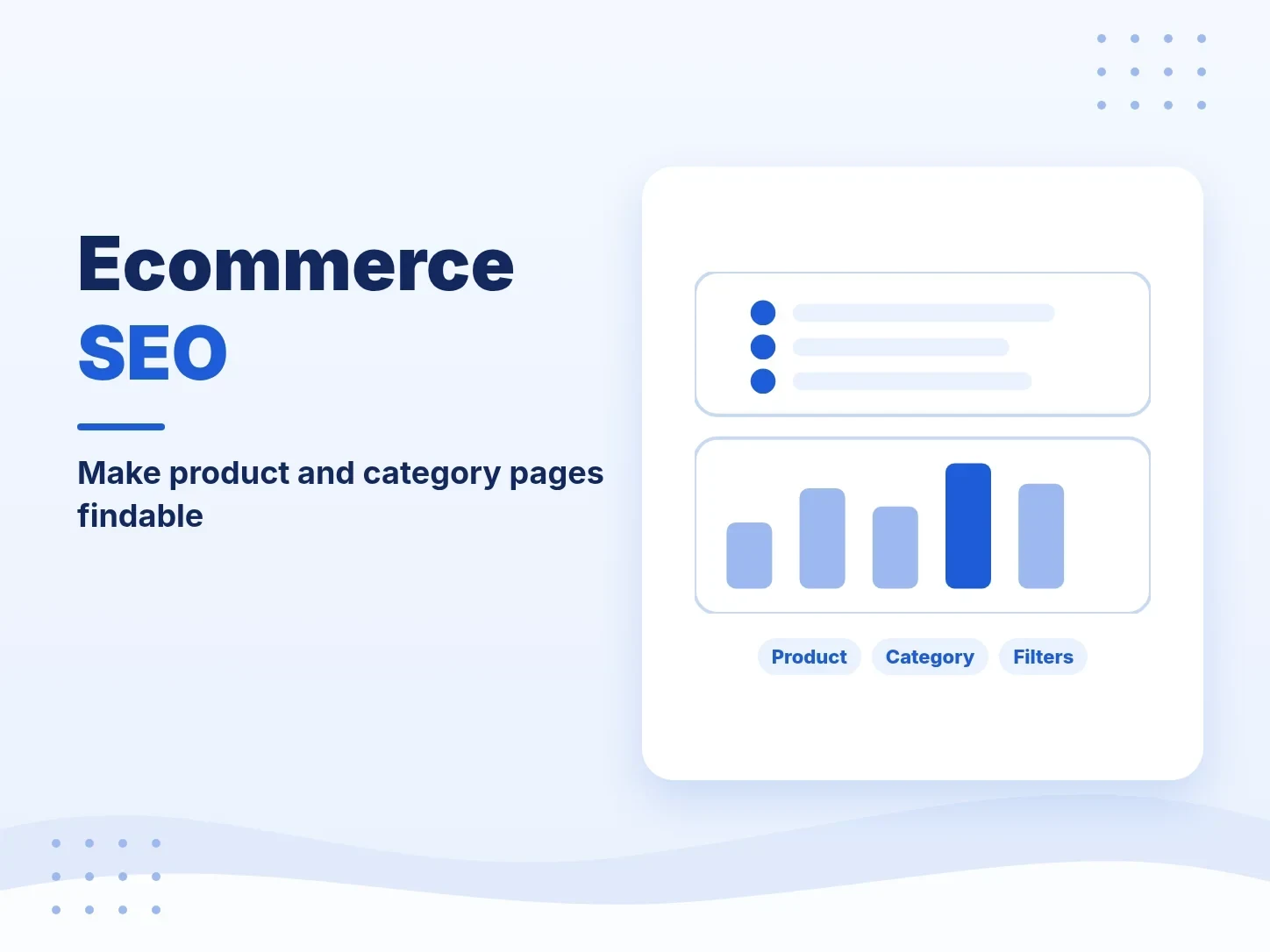
After a store launches, another problem often appears: the site is live, but product pages barely show up in search. Or a category page gets visits that are not looking for those products. The question becomes how Ecommerce SEO can help Google find your product and category pages.
Ecommerce SEO is different from SEO for a small company site. A store has many product and category pages, and filters, sorting, and stock changes can create similar URLs. Putting the same phrase into every product name does not fix that.
This article focuses on page visibility: how product pages, category pages, and filter pages should be planned so they can be found and understood. How to build the store is covered in the ecommerce website guide. Site-wide steps are in the website SEO article.
Further reading: Website SEO: a 10-step guide for company sites
Key takeaways
- Ecommerce SEO is about making each product and category page match real searches and remain discoverable.
- Product pages need unique titles, specs, and descriptions.
- Category pages should answer “this type of product,” not only show a grid of thumbnails.
- Not every filter URL should be found; thin combinations create duplicate content.
- If product data is messy or checkout or inquiry cannot be completed, fix the site before you scale SEO.
How Ecommerce SEO differs from company-site SEO
A company site is usually a set of service, article, and contact pages. Ecommerce website SEO has to handle more pages that change more often: products go up and down, prices change, and variants may create extra URLs.
| Item | Company website | Ecommerce site |
|---|---|---|
| Main landing pages | Service pages, articles, home | Product pages, category pages |
| Number of pages | Usually smaller | Grows with products and categories |
| Change rate | Content and services | Price, stock, and availability |
| Typical issues | Overlapping topics | Duplicate pages, thin categories, variant URLs |
Ecommerce SEO is not only “write a few blog posts.” Articles help, but much of ecommerce search is for a specific product or a type of product. Those searches should land on product and category pages.
Source: Google Search Central: ecommerce
What a product page needs so Google can understand it

Product page SEO starts with a simple rule: one URL for one understandable product, with enough on-page information to explain what it is. The title should use the name a buyer would search for, not only an internal SKU. Specs, materials, use cases, and image text should be on the page.
The most common problem is the same description reused on every product, with only the name changed. Another is a page that disappears when an item goes out of stock. A safer pattern is to keep the page, explain the status, and link to a related product or category. This article does not claim that one handling method will always rank better.
For variants such as color or size, ask whether that combination is searched on its own and whether it has its own price, image, or stock. If it is only an option of the same item, keep the choice on one page and avoid large sets of near-identical URLs. Google’s ecommerce URL guidance is to reduce alternate URLs for the same content, and to give variants a clear URL shape when they need to be understood separately.
See also: Product structured data
Technical details such as structured data and indexing belong in technical SEO. Writing that matches search intent is covered in how to write SEO articles.
Why category pages often get little search traffic
A category page should serve searches for a type of product. If it is only a grid, with no explanation of what the category is, who it is for, and how it differs from nearby categories, it is a list rather than a page that answers a question.
Categories also overlap with filtered results. If every filter combination becomes a page that can be found, many pages will have little unique content. Keep indexable landing pages for categories that have a real search need, enough products, and a short explanation.
Visual design of a store is a separate topic; see shopping website design. For Ecommerce SEO, the question is whether the category page has a reason to exist.
Which filter, sort, and parameter pages should be found?

Sorting by price or newest items is usually the same set of products in a different order, and does not need its own search landing page. Filters should be judged one by one: is this combination searched, and does the page have a short explanation and enough products? If not, the URL can stay a site tool rather than a page you want found.
A useful rule: combinations with a real search need and specific content may be worth finding; the rest should not become a large set of duplicate pages. How to implement this belongs in the technical SEO article.
How structure and internal links help
A clear path from home to category to product helps people and search systems. Product pages should link back to their category and, when useful, to related products. Important items should not exist only inside a site-search box or a campaign landing page. Site structure is also covered in the ecommerce website guide.
Practices that do not help Ecommerce SEO
Some Ecommerce SEO tactics look busy but do not help, and a few can make the site worse. Avoid the practices below, and do not sell a guaranteed ranking.
- Promising a number-one ranking
- Copying the same text across many product pages
- Packing every target keyword into every title
- Deleting a page the moment an item is discontinued, with no alternative
- Letting every filter result be found
No one can guarantee rankings. A more useful goal is to make the product and category pages that should be found actually findable, then measure inquiries or orders.
One anonymized ecommerce site later saw monthly revenue grow five times. That figure is not a promise that the same result will happen on every site, and it was not produced by Ecommerce SEO alone. It is a reminder to measure outcomes, not only impressions.
When to fix the site first

If names are inconsistent, many pages repeat the same text, or a visitor cannot complete an inquiry or checkout, fix the site and the data first. Ecommerce SEO helps the right pages be found; it cannot replace unclear specs or a broken path to a request.
It is usually too early to scale investment when product data is unstable, main pages cannot be crawled, or SEO is treated only as a short-term traffic tactic.
To review SEO scope, see Search Growth. If the issue is the store or the inquiry flow, go back to the ecommerce website guide or the commerce and inquiry system.
Ecommerce SEO FAQ
How is Ecommerce SEO different from regular website SEO?▼
Regular website SEO often deals with fewer, more stable service pages and articles. Ecommerce SEO has to handle large numbers of product and category pages, plus URLs created by filters, variants, and stock changes.
Can we still do SEO if product pages have very little text?▼
You can start, but write the specs, uses, and differences that belong to that item. If the text is short and repeated, fix the data before chasing more keywords.
Do category pages need long articles?▼
Make the product and category pages that should be found actually findable
Ecommerce SEO is not about packing keywords into every page. It is about letting each product and category page say one clear thing, without a mass of duplicate URLs getting in the way. If data and the path to a request are unstable, fix the site first.
If you want to review which product and category pages to improve first, you can book a free consultation.