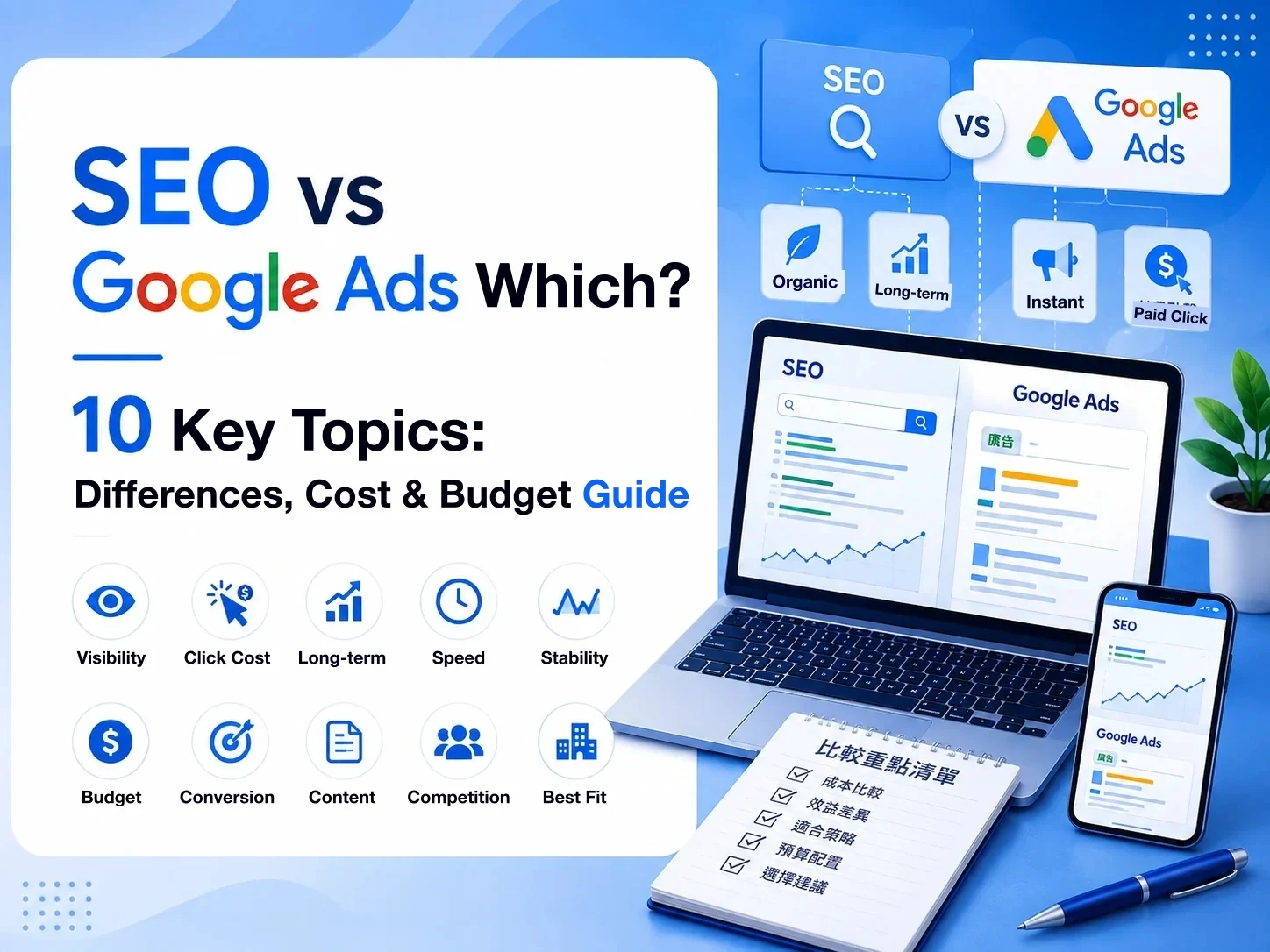
When a company wants more customers through Google, it usually faces two main paths:
SEO, or Google Ads.
Both can meet search demand that people have already expressed, but they work in completely different ways.
Google Ads can buy search visibility quickly through ad auctions. Once a campaign is running, it can reach people who are already searching for a related product or service.
SEO raises organic search visibility over time by improving the site, the content, and the technical setup. It usually takes longer to build, and the site and content can keep working as a search asset.
The question a company actually needs to answer is not: “Which is better, SEO or Google Ads?”
It is: “Given our stage, budget, and business goal, which should we invest in first?”
A company that needs to test the market and get leads quickly, and a company that has already confirmed search demand and wants a long-term organic channel, may need completely different plans.
This article compares SEO and Google Ads on cost, speed, how long the effect lasts, search demand, measurement, and company stage, so a company can decide where the budget should go now.
Key points
- SEO builds organic search visibility. Google Ads buys paid search visibility with an ad budget.
- Google Ads is stronger on speed, control,, and market tests. SEO is stronger at accumulating the site and content as an asset.
- SEO is not free traffic, and Google Ads does not turn ad spend into customers by itself.
- When search demand is not yet proven, Google Ads can come first as a way to read the market.
- Once search demand and commercial value are confirmed, SEO investment can grow.
- SEO and Google Ads do not have to be a choice of one. A mature search plan lets each feed the other with data and market signals.
- Budget should not follow a fixed split. It should shift as the company moves from testing, to growth, to a mature stage.
- Results should not stop at rankings, traffic, or clicks. Follow leads, opportunities, and revenue.
- AI search has changed the search experience. The core of SEO has not stopped working because of that.
- If you do not yet know which search demand works, test it first. Once you know which search demand works, start building it up.
What are SEO and Google Ads?
Both SEO and Google Ads can put a company in front of people who are searching Google for a product, a service, or a related question.
The main difference: SEO earns organic search visibility; Google Ads buys paid search visibility.
Both respond to search demand that already exists. How they get visibility, how the cost works, and how the result accumulates are different.
What is SEO?
SEO (search engine optimization) improves the site, the content, and the technical setup so the site is easier to find in organic results.
Typical work includes:
- Search demand and keyword research
- Site structure
- On-page SEO
- Technical SEO
- SEO content
- Internal links
- Search performance tracking
- Ongoing content updates and optimization
SEO does not charge an ad fee for each organic click. That does not make SEO free.
The company still spends on the site, content, people, tools, or an outside SEO service.
SEO usually needs time to accumulate. Unlike ads, finishing the setup does not produce steady visibility right away.
What is Google Ads?
Google Ads is Google’s advertising platform. The part closest to SEO is search ads.
When someone searches for a product, a service, or a question, a company can run ads against that demand so the ad shows in Google’s results.
A company that builds corporate websites, for example, can target:
- Website setup
- Web agency
- Corporate website design
- Website redesign
and other searches that show commercial intent.
Search ads are usually pay-per-click. After the company sets a budget, keywords, ad copy, and a landing page, it can start getting search impressions and traffic.
Compared with SEO, one of the clearest traits of Google Ads is: it is fast.
Once the campaign is set up and running, search visibility can come quickly. There is no wait for organic rankings to build.
What SEO and Google Ads share is search demand
SEO and Google Ads are different kinds of marketing, and they share one important thing:
Both sit on top of what people are already searching for.
When someone searches:
“web agency”
that person has already stated a need.
The company can buy that impression with Google Ads, or use SEO so its site appears in the organic results.
So SEO and Google Ads are not two unrelated marketing logics.
The real difference is:
How the company reaches that search demand, and how much time and cost it is willing to spend to build that ability.
That is why a comparison of SEO and Google Ads should not stop at which one “works better.” It should also compare speed, cost, how long the effect lasts, and when each one fits.
Further reading: Google Search Central: SEO Starter Guide, Google Ads: About search ads
How do SEO and Google Ads differ?
The biggest difference between SEO and Google Ads is not simply “one is free and one is paid.”
SEO also takes spending on the site, content, people, and ongoing optimization.
The real difference is:
SEO spends resources to build organic search visibility. Google Ads spends an ad budget to buy search visibility directly.
So the two differ clearly in how fast they show, how the cost works, how long the effect lasts, and when each one fits.
| Item | SEO | Google Ads |
|---|---|---|
| How visibility is won | Organic search results | Paid search ads |
| How fast it shows | Usually needs time to build | Can start getting visibility sooner |
| Cost per click | Not charged per click | Ad cost is usually charged per click |
| Main spend | Site, content, technical work, people | Ad budget, campaign management, landing pages |
| After spending stops | Existing content and rankings may keep bringing traffic, and they can still change | When ads stop, ad visibility usually stops too |
| How much you can control |
Google Ads is stronger on speed and control
One of the biggest strengths of Google Ads is that a company can test the market relatively quickly.
For example, a company may want to know:
Can searches such as “web agency” bring useful quote requests?
It can set up search ads, choose related keywords and a budget, and send the traffic to a specific landing page.
Then watch:
- Which search queries get clicks?
- Which keywords cost more?
- Which ad messages work?
- Which landing pages convert?
- Do they turn into real leads in the end?
So Google Ads is not only a way to buy traffic. It can also be how a company tests search demand.
Further reading: Google Ads: About cost-per-click bidding
SEO is stronger at building a search asset over time
SEO works differently.
The company first builds site structure, content, and search visibility, then organic traffic comes gradually.
The early stage is usually slower, but what gets built along the way includes:
- Product and service pages
- SEO articles
- Industry knowledge
- Site structure
- Internal links
- Brand search visibility
all stay on the company’s own site.
Even if SEO spending drops for a while, existing pages may keep getting organic visibility.
That does not mean SEO can be left unmanaged forever once it is done.
Search demand, competitors, site content, and Google’s search systems keep changing, so organic performance also needs long-term tracking and upkeep.
SEO is not actually free, and Google Ads is not only paying for traffic
Treating SEO as “free traffic” makes it easy to underestimate the real cost.
SEO may take spending on strategy, content, the site, technical work, tools, and people.
Google Ads, besides the media budget, also needs ad strategy, keywords, creative, landing pages, conversion tracking, and ongoing optimization.
So what a company should actually compare is not:
free vs paid. It is building a long-term asset vs getting and testing search traffic quickly.
Once that difference is clear, it is easier to judge which approach fits the company’s current stage.
Strengths and limits of SEO
The clearest trait of SEO is that ongoing work on the site and content gradually builds organic visibility.
Unlike Google Ads, it cannot buy search visibility quickly, so the early stage usually takes longer to build. The site and content that result can keep working as the company’s own digital asset.
A strength of SEO: search visibility can keep accumulating
Product pages, service pages, articles, and other content built during SEO stay on the company’s own site.
As those pages start to get search visibility, they can keep meeting related search demand.
So the value of SEO is not one click. It is gradually widening the company’s visibility on the search topics that matter.
For example, a company keeps building:
Core service pages → FAQs → expert articles → case studies → industry content
Once those pieces link to each other, they can become a search-content asset that keeps accumulating.
A strength of SEO: each organic click does not require a direct ad fee
Google Ads usually costs money when an ad is clicked. Organic search does not charge an ad fee to Google for each click.
If the company gradually builds steady organic traffic, it can keep getting visitors without paying a media fee for every click.
That does not mean SEO has no cost.
Site development, content production, SEO tools, people, and outside services can all cost money, so a more accurate way to put it is:
SEO has no direct media fee per click, but it still needs ongoing resources.
A strength of SEO: it can cover a fuller set of search content
Google Ads fits search demand that already shows clear commercial intent.
SEO can also cover questions from different stages of the customer’s path.
A web agency, for example, can publish:
- Website setup cost
- Website setup process
- How to choose a web agency
- What to watch in a website redesign
- How to do SEO
- What features a corporate website needs
Not every search means the person is ready to request a quote. Different pieces of content can still keep the company in front of them while they research and compare.
So SEO is not only traffic. It can also deepen the company’s content and professional standing on a topic.
A limit of SEO: it usually takes longer to build
One of the biggest limits of SEO is that results rarely show immediately.
A new site, new content, and a new search topic usually need crawling, indexing, ranking, and ongoing work before visibility becomes steady.
The actual speed also depends on:
- The site’s current SEO foundation
- How competitive the industry is
- Search demand
- Site content
- Technical condition
- Existing brand and site visibility
and other factors.
SEO is a poor fit for a very short-term need such as “we need a large number of leads next week.”
Further reading: How to measure SEO rankings and results
A limit of SEO: organic rankings cannot be controlled directly
A company can improve SEO. It cannot buy a specific organic ranking.
Even a large investment does not guarantee first place for a given keyword.
Results also move with competitors, search demand, and changes in Google’s search systems.
So SEO is better treated as:
A continuing effort to raise the ability to earn organic visibility.
It is not the purchase of a fixed ranking.
A limit of SEO: it needs skills across several fields
A complete SEO program often involves all of these at once:
Search strategy, content, the site, technical work, and data analysis.
If the company only handles one of those, the rest can cap the result.
Articles can keep going out while the site has indexing problems. Or the technical setup can be solid while nothing on the site actually meets search demand.
SEO can accumulate over the long term, and it also needs a fairly complete ability to execute.
SEO fits companies that want a long-term search channel
Overall, the strength of SEO is not that it is “free.” It is this:
The site and content the company invests in can keep accumulating.
The tradeoff is time, and search results cannot be controlled the way an ad budget can.
SEO fits a company that wants organic visibility for the long term and is willing to keep investing in the site and the content.
Further reading: Google Search Central: Do you need an SEO?
When should SEO come first?
SEO and Google Ads do not have to be a choice of one.
When budget or people are limited and the order has to be chosen, start from whether search demand is already clear, and whether the need now is short-term traffic or long-term search visibility.
The situations below are a better fit for putting SEO first.
Search demand is already known to be steady
If target customers keep searching for certain products, services, or questions, the long-term value of SEO usually rises.
For example:
- Corporate website setup
- Industrial equipment
- Professional services
- Software systems
- Industry knowledge
- Common purchasing questions
These are not short campaigns. Customers may keep looking for answers through search over a long period.
Service pages, product pages, articles, and other content can gradually meet that demand.
Google Ads has already shown that some search demand has commercial value
If Google Ads has been running for a while and some queries steadily produce quote requests, bookings, or other conversions, SEO is worth a closer look.
For example, a keyword with strong commercial intent:
People keep searching for it every month, and it does produce leads.
Besides keeping the ads running, the company can start a matching service page and SEO content.
This is a practical sequence: use ads first to read the market, then turn the important search demand that has already been proven into a long-term SEO asset.
Clicks are expensive, and the demand will last
In some industries, keywords with high commercial value are heavily contested, and steady traffic takes a high ad spend.
If that search demand has long-term value, it is worth asking whether SEO should run alongside the ads.
That does not mean SEO is always cheaper.
SEO also costs money for content, the site, technical work, and people, and organic rankings are not guaranteed.
The real question is:
If this search demand will still matter in three years and in five, should we build our own organic visibility instead of relying only on paid traffic?
The company can keep publishing expert content
SEO fits companies that have a lot of specialist knowledge they can keep accumulating.
For example:
- B2B companies
- Manufacturing
- Software companies
- Professional services
- Consulting
- Companies with complex products and purchasing processes
In these fields, customers often search a large number of questions before they request a quote.
If the company can keep turning product knowledge, customer questions, how to choose, industry experience, and case studies
into site content, it can gradually build search visibility and accumulate content it owns.
The business does not need SEO to produce revenue immediately
This is an important condition.
If cash is tight and the company wants:
“We put money into SEO this month, so next month must produce orders.”
SEO is usually the wrong channel to carry that job.
Search visibility and rankings take time, and the result is uncertain.
Companies that fit SEO usually have enough time and resources to accept:
Build the foundation → keep accumulating → watch the data → keep improving
They are not asking for the whole investment to come back immediately.
The company wants less dependence on a single paid traffic source
If most site traffic comes from Google Ads, cutting the ad budget can also cut traffic sharply.
Building SEO adds another source of search traffic.
The aim is not to replace Google Ads entirely. It is to reach:
paid search + organic search
two different ways to win customers from search.
Once search is a confirmed acquisition channel, this combination is usually more resilient than relying on only one of the two for a long time.
SEO fits companies that have confirmed demand and are ready to accumulate
In short, SEO is a good start when:
Search demand already exists, the commercial value is reasonably clear, and the company is willing to keep investing in the site and the content.
Then it is a good time to start SEO.
If the company is still unsure whether the market will search for the service at all, a large SEO investment does not have to come first.
Google Ads can be the faster way to read the market in that case.
When should Google Ads come first?
If the main goal now is search traffic quickly, a test of market demand, or leads in the short term, Google Ads is usually the better first channel than SEO.
When a product, a service, or a market is still being tested, Google Ads can produce real data sooner, without waiting for SEO rankings to build.
The situations below are a better fit for putting Google Ads first.
A new product or service needs a market test first
When a company launches something new, it usually faces this question:
We think customers will search these keywords. Will they actually bring customers?
A large batch of SEO content at that point may take a while before the company knows whether search demand and conversion match the expectation.
Google Ads can test more quickly:
- Which search queries get clicks?
- Which needs show stronger commercial intent?
- Which ad messages attract the target customer?
- Do people request a quote or book after they reach the site?
- What does it cost to get one real lead?
That information helps the company judge sooner whether the market deserves more investment.
Leads are needed in the short term
If the company has a clear business goal right now, for example:
A new service has just launched, and quote requests need to start coming in over the next few months.
SEO alone may not meet that timeline.
SEO starts with the site and the content, then search visibility builds over time.
Google Ads can get search visibility sooner after the ads start, so it is a better fit for short-term leads.
Search demand is already very clear
Some products and services already have very clear search demand.
For example, someone searches:
- ERP system
- Web agency
- CNC machine shop
- Legal advisor
- Business loan
That is usually closer to an actual purchase or a quote request than reading industry background.
If the company already knows which searches match its product or service closely, Google Ads can take that commercially intent traffic first.
SEO is still building, and the company cannot wait for organic growth
SEO and Google Ads do not have to run one after the other.
The company can build SEO while Google Ads supplies the search traffic it needs now.
For example:
Google Ads covers traffic and leads for now. SEO gradually builds organic visibility for later.
That way the company is not left with no search traffic while SEO has not produced results yet.
As organic search grows, the split of spending can shift with the actual data.
Keywords and market messages need a fast test
Sometimes the company knows what customers need, and does not know which wording moves them to act.
The same service can be searched in different ways:
“web agency,” “corporate website design,” “website production company”
Google Ads can show, relatively quickly, how different queries, ad messages, and landing pages perform.
Those results can improve the ads, and they can also feed back into:
- Service pages
- SEO keyword strategy
- Content topics
- Sales messages
- Landing page design
So the value of Google Ads is not only the customers it brings. It also shortens the time to market feedback.
Google Ads fits companies that need an answer now
If SEO is closer to building a search asset for later, Google Ads is closer to settling uncertainty the company has now.
When the company needs to know:
- Is there demand in the market?
- Which searches bring customers?
- Can the site turn search traffic into quote requests?
- Roughly what does one lead cost?
These questions usually should not wait several months for an answer.
Google Ads can produce real market data sooner, so the next step can be more ads, SEO, or a change to the product and the site.
On a tight budget, which should come first, SEO or Google Ads?
With a limited marketing budget, it is not always wise to run a full SEO program and a full Google Ads program at the same time from day one.
The more important question is whether the biggest problem now is “we do not yet know if the market works” or “we already know it works, and we want a long-term way to win customers.”
That choice decides where the budget should go first.
Search demand is not yet proven: consider Google Ads first
If search marketing is just starting, and the company does not yet know:
- What customers actually search for
- Which searches have commercial value
- Which keywords really produce leads
- Whether the site can turn search traffic into quote requests
- What one lead costs
Google Ads is usually the first option to consider.
The reason is not that Google Ads always beats SEO. It is that market signals come back faster.
The company may have thought keyword A mattered most, then found after the ads ran that quote requests actually came from keyword B.
A large SEO investment in topic A from the start may take months before the company sees that traffic exists and still does not bring the commercial result it expected.
Google Ads can shorten that test.
Further reading: Our Google Keyword Planner guide
Search demand is already proven: start building SEO
If ads, existing site data, customer questions, or other market experience have already confirmed:
Certain searches do keep bringing leads that have value.
Then it is time to look at SEO.
The company already knows which search topics are worth running for the long term, so the next investment can be more directed:
- Service pages
- Product pages
- SEO articles
- Expert content
- Technical SEO
- Site architecture and internal links
At that point, the goal of SEO is no longer only “more site traffic.” It is to build the company’s organic visibility for the searches that matter.
Search already brings customers steadily: SEO and Google Ads can run together
Once the company has confirmed that search is a working way to win customers, it does not have to keep choosing one.
A more mature setup usually gives each one a different job:
Google Ads: capture search demand now, and test the market quickly.
SEO: build organic visibility and a content asset for later.
A new product, service, or keyword can be tested with Google Ads first.
Search topics that already show long-term commercial value can then move into SEO, step by step.
The company is no longer only asking:
“Which is better, SEO or Google Ads?”
It starts to decide how search marketing resources should be split.
Do not choose SEO or Google Ads on cost per click alone
When comparing the two, it is easy to see a high cost per click in Google Ads and conclude that SEO must be the better deal.
That comparison is incomplete.
SEO needs the site, content, technical work, and people, and results take time to build. Google Ads keeps charging media spend, but it can bring traffic and market data sooner.
What should actually be compared is:
How much is invested → how many qualified leads come back → how much commercial result that produces.
If a higher-cost Google Ads keyword keeps bringing high-value customers, it can still be a sound investment.
The other way around: even if SEO brings a lot of organic traffic, that traffic is not a success by itself if it never turns into useful leads.
On a tight budget, fix the biggest problem first
If the company can only pick one direction, a simple rule helps:
You do not yet know which searches work → verify first.
You already know which searches work → start building.
Google Ads is better at getting market signals quickly. SEO is better at turning searches you have already confirmed into a long-term search asset.
What matters is not picking one forever. As the company gets more data, it adjusts how much goes into each.
Further reading: How much does SEO cost? and How do you measure SEO rankings and results?
Can SEO and Google Ads run together?
Yes. Once the company has confirmed that search is an important way to win customers, SEO and Google Ads usually do not replace each other. They can work together.
The point is not “do both.” It is:
Give Google Ads and SEO different jobs.
Google Ads can get search traffic and market data quickly. SEO builds organic visibility and a content asset over time.
Use Google Ads to test new search demand
When the company is entering a new market, launching a new service, or finds a new set of keywords, it does not have to put a large SEO investment in immediately.
Google Ads can test first:
- Which queries actually show up?
- Which keywords get clicks?
- Which needs lead to conversions?
- Which messages make customers act?
- Which landing pages perform better?
If some searches keep bringing useful leads, they can move into the SEO plan.
SEO topics then come from search volume and from real market data.
Use SEO to build search topics you have already verified
Once the company confirms that some searches have long-term commercial value, it can start building the related organic content.
For example:
Google Ads finds that “website production cost” keeps bringing useful leads.
The company can then build:
- A guide to website production cost
- The website production process
- How to choose a web agency
- Features of a corporate website
- Content on website redesign
Step by step, that becomes a full topic cluster.
Google Ads supplies the market signal. SEO turns those verified needs into the company’s own search content.
SEO data can also improve Google Ads
The data does not flow only one way.
If Google Search Console shows that some queries keep getting organic impressions, and even start converting, the company can consider whether Google Ads should buy more exposure for them.
SEO content also helps the company see:
- Which questions customers search for
- Which topics have ongoing demand
- Which pages convert more easily
- Which searches have commercial value
So SEO and Google Ads can each be a source of market intelligence for the other.
Further reading: Google Search Console: the Performance report
The same important search can be covered by SEO and Google Ads at the same time
The company does not have to stop ads just because a keyword already ranks in organic search.
If the search has high commercial value, the company can decide from actual results whether to keep both organic and paid exposure.
Especially when:
- The keyword has high commercial value
- Competition is intense
- Organic rankings are still unstable
- Ads keep producing useful leads
There is no need to stop ads that work just because “SEO is already in place.”
In the end, judge by the commercial result.
SEO and Google Ads should form an ongoing loop
A more mature search strategy is not:
Do Google Ads first → then SEO → then stop Google Ads.
It is an ongoing loop:
Google Ads tests quickly → find searches that work → SEO builds long-term content → read organic search and conversion data → then adjust the ads and the SEO.
As the company gathers more data, it can keep deciding which searches deserve more investment, which should get a smaller budget, and which deserve fuller content.
The best relationship between SEO and Google Ads is not a fight over the same budget. It is:
One helps the company get market signals quickly. The other turns important searches into a long-term asset, step by step.
How should the budget be split between SEO and Google Ads?

There is no fixed SEO-to-Google-Ads budget ratio that fits every company.
Some companies should put most of the budget into Google Ads first. Others have already confirmed search demand and should start increasing the SEO investment.
So instead of deciding up front:
“SEO 50%, Google Ads 50%.”
A sounder approach is to see which stage the company is in.
Stage 1: Search demand is not verified yet. Put the budget first toward market signals
If search marketing is just starting, and the company does not yet know which searches actually bring customers, more of the usable marketing budget can go to Google Ads first.
The goal at this stage is not simply a large volume of traffic. It is to answer a few important questions:
- Which searches actually exist?
- Which queries have commercial value?
- Which keywords produce useful leads?
- How well does the site convert?
- Roughly what does one lead cost?
SEO does not have to stop completely at the same time.
The company can still put the site structure, technical SEO, key service pages, and basic content in place, so a later SEO push does not start by rebuilding the whole site.
In short: Google Ads verifies the market first, and SEO puts the necessary base in place.
Stage 2: Search demand is starting to be verified. Increase the SEO investment step by step
When Google Ads, site data, or actual business results start to show that some searches have commercial value, the SEO budget can increase step by step.
For example, the company has already found:
A few searches keep producing useful quote requests, and those needs will still be there over the long term.
That is the point to invest in:
- SEO keyword and content planning
- Key service and product pages
- Topic clusters
- SEO articles
- Technical SEO
- Internal links
- Improving existing content
Google Ads keeps capturing the searches that already work, and tests new market opportunities.
The two start to complement each other.
Stage 3: Search is already a steady way to win customers. Allocate by commercial results
Once the company has enough SEO and Google Ads data, it no longer needs to split the budget by a fixed ratio.
Compare further:
Investment → leads → qualified leads → opportunities → revenue
A Google Ads keyword can have a high cost per click and still be worth running if the customers it brings are also high value. There is no need to stop it only because “the ads are expensive.”
The same applies the other way. An SEO topic can bring a lot of organic traffic and still not deserve more investment if it never produces useful leads. Traffic that looks good is not enough.
At this stage, the company should move from “splitting traffic” to “splitting by commercial results.”
SEO budget and Google Ads budget cannot be compared on media spend alone
There is another common problem when splitting the budget:
The company counts all of the Google Ads media spend as cost, and treats SEO as “free traffic.”
That comparison is distorted.
- The full Google Ads investment can include: media spend + ad management + landing pages + conversion tracking + optimization
- The full SEO investment can include: strategy + content + the site + technical work + tools + people
What should be compared is the total investment and the final commercial result of each channel, not only whether there is a cost per click.
The split should change as market information changes
At the start, the company does not know the market answer, so resources go toward “getting information.”
Once the market is being verified, more resources can go toward “building an asset.”
Later, when search as a way to win customers is mature, the two can keep being adjusted from actual commercial results.
The SEO and Google Ads budget split can be read as:
- Verification: Google Ads gets market signals first, and SEO builds the base.
- Growth: keep the ads that work, and increase the SEO investment at the same time.
- Maturity: allocate both from leads, opportunities, and revenue.
That fits how a company actually operates better than a fixed SEO-to-Google-Ads ratio.
How do you measure SEO and Google Ads?
SEO and Google Ads are run differently, so the metrics watched along the way are different too.
Common SEO metrics include organic impressions, clicks, keywords, and organic traffic. Google Ads watches ad impressions, clicks, cost per click, and cost per conversion.
If the company wants to know whether either is worth continuing, it cannot stop at those marketing metrics.
The question that has to be answered is:
Did this search traffic turn into leads, opportunities, and revenue?
Which metrics can show SEO results?
SEO can be watched starting from search visibility:
- Organic impressions
- Organic clicks
- Search queries
- Performance of important keywords
- Organic traffic
- Landing page performance
- Key events
- Leads
Those numbers help the company see whether SEO is gaining more search visibility, and whether traffic does anything further after it reaches the site.
Rankings and traffic themselves are still not the final result.
If organic traffic keeps rising and still does not produce useful quote requests, bookings, or other commercial results, look further at search intent, the content, and the path from visit to conversion.
Further reading: Google Search Console: the Performance report
Which metrics can show Google Ads results?
Common Google Ads metrics include:
- Ad impressions
- Clicks
- Click-through rate
- Cost per click
- Conversions
- Conversion rate
- Cost per conversion
- Search queries
- Leads
Those numbers help the company judge whether the ads are reaching the searches it wants, and what one conversion costs.
They still should not stop at the conversion numbers inside the ad platform.
Two ad groups can each produce 10 leads. If one later becomes 3 real opportunities and the other never enters the sales process, their commercial value is not the same.
Further reading: Google Analytics: the Traffic acquisition report
B2B companies should keep tracking lead quality
For a B2B company, a form submission is usually only the start of the sales process.
Where the company can, it should keep tracking:
Search visibility → site traffic → leads → qualified leads → opportunities → closed deals
Only then can the company tell:
Which SEO topics actually bring opportunities?
Which Google Ads keywords only produce a lot of low-quality inquiries?
Which searches deserve more investment?
Which traffic looks large and still has little commercial value?
Budget decisions get a firmer base once SEO and Google Ads can both be tied to later sales results.
Do not compare SEO and Google Ads with different standards
It is easy to judge the two channels in different ways:
SEO is judged by whether rankings rose. Google Ads is judged by whether the ads converted.
That is hard to compare fairly.
SEO rankings and organic traffic are important along the way. The end point is still conversion and commercial result.
Click-through rate and cost per click matter for Google Ads too, and they are also only metrics along the way.
To compare what each is worth to the company, come back to the same path:
Search visibility → traffic → conversion → commercial result
The earlier metrics help diagnose problems. The commercial result decides whether the investment is worth continuing.
What you measure in the end is acquisition efficiency, not SEO or Google Ads
Once the company has enough data, the comparison is no longer only:
- How much traffic did SEO bring?
- What is the Google Ads cost per click?
It is:
How much did the company invest, and how many customers of real value did that produce?
SEO and Google Ads are both ways for the company to reach search demand.
Real measurement should run from search data through to leads, opportunities, and revenue, so the company can see what role each channel plays in growth.
Has AI search changed the roles of SEO and Google Ads?
As AI Overviews, AI Mode, and other generative AI search experiences appear, the way people get information is changing.
People used to search, then pick a site from the results and read further. For some searches, AI now pulls several sources together and answers more fully on the spot.
That does not mean SEO has stopped working.
In its 2026 guide to optimizing for generative AI search, Google says existing SEO best practices still apply, because its generative AI search features still sit on the core ranking and quality systems.
For a company, AI search looks more like the search experience evolving than like SEO being replaced by a wholly different kind of marketing.
Further reading: Google Search Central: Optimizing for generative AI search
SEO is extending from traditional rankings into visibility in AI search
When companies talked about SEO, they usually cared most about:
- Keyword rankings
- Organic impressions
- Organic clicks
- Site traffic
After AI search, there is another question:
Does our site and brand have a chance to be a source that AI search understands and cites?
SEO’s role starts to stretch from winning traditional rankings toward a wider kind of search visibility.
The foundation has not been replaced.
Google still stresses:
- A clear site structure that can be crawled
- Content that is useful and original
- Information that shows real experience and expert judgment
- A good experience for the user
- Content that matches what the user needs
A company does not need to throw out its SEO and start over because AI search exists.
AEO and GEO do not mean a wholly different search strategy
Names such as AEO (answer engine optimization) and GEO (generative engine optimization) have started to appear.
Those ideas mainly describe how to raise the visibility of a brand and its content inside AI search experiences.
From Google Search’s own position, the official line is clear:
Optimizing for generative AI search is still SEO.
What the company should care about is not chasing a new acronym or so-called AI search tricks. It is keeping the site and the content themselves more valuable.
Once many sites can use AI to produce similar content quickly, what belongs to the company itself matters more:
Industry experience, real cases, original material, expert judgment, and a point of view that is its own.
Those become more important, not less.
Further reading: What are AEO and GEO?
Google Ads still captures commercial search demand quickly
AI search does not remove the role Google Ads already had.
For a company, Google Ads is still a way to buy search exposure quickly, test the market, and capture commercial searches.
The split set out earlier in this article still holds:
Google Ads: get and verify search demand quickly.
SEO: keep building organic search and a content asset.
What changes is the search environment SEO has to account for. It is no longer only the traditional results page. It also includes generative AI search.
AI search makes content that is actually valuable matter more
Once AI can quickly reorganize a large amount of information already on the web, content that only restates what other sites have said is likely to be worth less over time.
What is more worth investing in is information AI cannot easily pull out of a pile of similar pages, for example:
- First-hand project experience
- Real customer cases
- Original research and data
- Industry expertise
- Real test results
- The company’s own methods and point of view
AI search does not make a content asset less important.
It pushes the company to ask a sharper question:
Can we offer information the web did not already have, or that others would find hard to replace?
That is a base for whether SEO and visibility in AI search can keep compounding.
The core way to decide between SEO and Google Ads has not changed
Even as AI keeps changing search, a company splitting resources between SEO and Google Ads can still come back to the core of this article:
- If you do not yet know which searches work, verify first.
- If you already know which searches have long-term value, start building.
AI search changes how people get information and how results are shown.
The problem the company still has to solve has not changed:
How to be found when a customer has a need, earn trust, and turn search visibility into a commercial result.
SEO vs Google Ads: frequently asked questions
Which works better, SEO or Google Ads?▼
There is no fixed answer. It depends on the company’s goal right now.
If the company needs search traffic quickly, a market test, or leads in the short term, Google Ads is usually the better fit.
If the search demand and its commercial value are already fairly clear, and the company wants organic visibility and a content asset over the long term, SEO matters more.
The comparison is not which one “works better” in the abstract. It is which one fits the company’s stage and commercial goal now.
Which is cheaper, SEO or Google Ads?▼
They cannot be compared directly.
Google Ads usually has media spend, and it can also include ad management, landing pages, and tracking results.
SEO does not charge an ad fee for each organic click, but it still needs the site, content, technical work, tools, and people.
Compare the total investment of each, and how many leads, opportunities, and how much revenue come back. Cost per click alone is not the comparison.
Conclusion
SEO and Google Ads are not absolutely better or worse, and the company does not have to pick only one.
Both meet search demand that already exists. They solve problems on different time scales.
Google Ads fits getting search traffic quickly, testing the market, and winning leads. SEO fits building organic visibility and a long-term content asset, step by step.
What the company has to decide is not: “Which is better, SEO or Google Ads?”
It is: “Do we need to verify the market quickly now, or start building a long-term search asset?”
If search demand is not verified yet, Google Ads can get the market signal first, while the necessary SEO base is put in place.
As the company confirms which searches have long-term commercial value, it can increase the SEO investment and turn those topics into its own site and content.
Once search is already a steady way to win customers, SEO and Google Ads do not have to stay a choice of one.
What matters more is adjusting both from leads, opportunities, and revenue.
In the end, SEO and Google Ads are both ways for the company to reach search demand.
What matters is whether search visibility can become traffic, and whether that traffic can become a real commercial result.