Search for “SEO company” and you will find plenty of SEO consultants, digital marketing agencies, and SEO packages.
The hard part is usually not finding an SEO company. It is how to tell which one fits your own company.
Some companies lead with keyword rankings. Some lead with SEO articles. Some focus on technical SEO. Others cover the whole path, from search strategy and site work through to content.
The price can run from tens of thousands of NT dollars a month to much more, and what is included can be completely different.
Choosing an SEO company is not only about “a guaranteed set of keywords,” “how many articles a month,” or “who is cheapest.”
What matters more is whether they can understand the company’s real commercial goal, find the SEO problems that exist now, and propose a way of working that is reasonable, open, and can be measured over time.
This article is not a “top 10 SEO companies” list written by an SEO company. It is a way for a business to judge for itself which kind of SEO company fits what it needs now.
The short version
- Before you choose an SEO company, be clear about the problem you actually want SEO to solve.
- An SEO company is not only chasing keyword rankings. The work can also cover search strategy, the site, technical work, content, and tracking results.
- SEO companies work in different ways. What matters is whether they can fill the capability the company is missing now.
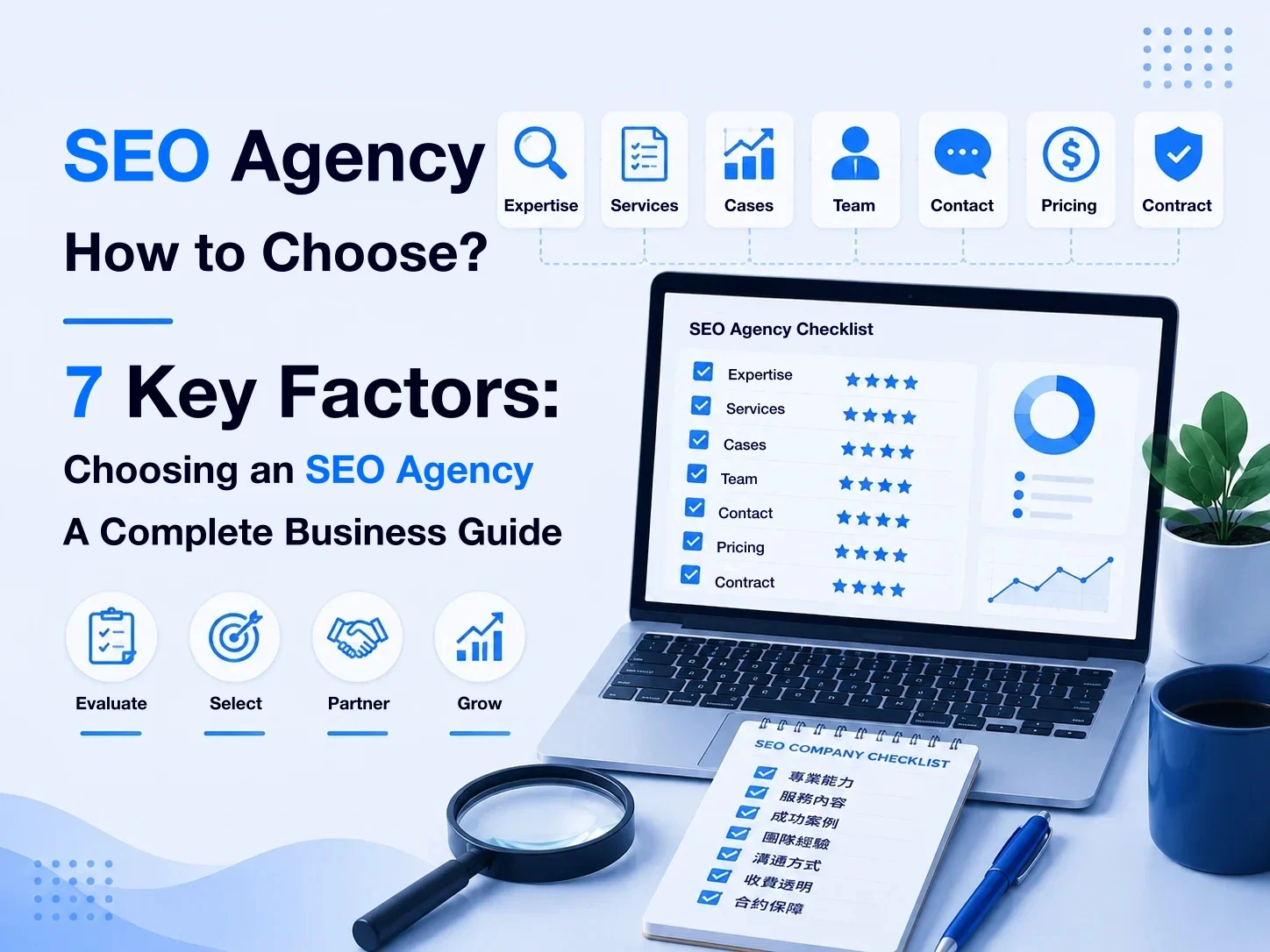
- When you assess an SEO company, look at how well they understand the business, the strategy, how open the work is, technical skill, content skill, case studies, and how results are measured.
- Be careful with guaranteed rankings, opaque external links, and a large volume of low-quality content.
- When you compare SEO quotes, compare the scope of work first. The monthly fee alone is not the comparison.
- Before you sign, confirm the term, how the work can end, and who owns the site, the content, the data, and the accounts.
- AI search is worth watching, but the basics of SEO still matter: the site, the content, the technical work, and search demand.
- The best SEO company is not necessarily the one the market calls the strongest. It is the partner that can solve the problem the company has now.
What does an SEO company actually do?
An SEO company helps a business become easier to find in search, so people who already have a related need can reach the company’s site, products, and services through organic search.
SEO is not simply “getting a few keywords onto the first page.”
A full SEO engagement usually starts from search demand, then works through the site, the content, the technical side, and how results are tracked.
Further reading: Google Search Central: SEO Starter Guide
Search strategy and keyword research
An SEO company first needs to understand:
- What products or services does the company offer?
- Who is the target customer?
- What questions will those customers search for?
- Which of those searches have commercial value?
- Which competitors are already getting search exposure?
From there, keyword research, search intent, and the search results themselves decide which searches the site should go after.
This step matters, because more traffic is not automatically better.
A large amount of search traffic that has nothing to do with the company’s real customers still rarely turns into a commercial result.
The site and on-page SEO
Once the search strategy is clear, the site and its pages need to be adjusted so search engines and people can understand the content more easily.
For example:
- Site structure
- The topic of each page
- SEO title
- Meta description
- The H1, H2, and H3 structure
- URL structure
- Internal links
- Image alt text
- Content already on the pages
An SEO company should not just stuff keywords into a page. Each important page needs a clear search purpose, and it needs to answer what the person searched for.
Technical SEO
The technical condition of the site can also decide whether search engines can crawl, understand, and index the content.
SEO work may therefore need to cover:
- Crawling and indexing
- The sitemap
- robots.txt
- Canonical tags
- Redirects
- Structured data
- Site performance
- The mobile experience
- Duplicate content
- A site redesign and URL changes
Some SEO companies mainly point out technical problems and recommend fixes, and the company’s own engineers carry them out. Others can build or change the site themselves.
When you choose an SEO company, be clear about who owns this part of the work. Otherwise you can find out later that the company can only name the problem, and nobody is there to fix it.
Further reading: What is technical SEO?
SEO content strategy and production
When the content already on the site does not cover what target customers search for, new content has to be built.
An SEO company may help with:
- Research into search topics
- Content strategy
- Topic-cluster planning
- Planning SEO articles
- Writing and editing
- Updating content that already exists
- Internal links
- Tracking results after publication
Good SEO content is not a race to publish more articles. It is a content asset the company builds, step by step, around the search topics that matter.
For B2B and professional-service companies, content that is actually valuable usually also needs the company’s own industry knowledge, real cases, and professional experience.
Further reading: How do you write an SEO article?
Tracking SEO data and keeping the work going
After the work starts, keep watching it in Google Search Console, GA4, and similar tools, and assess SEO results:
- Search impressions
- Clicks
- Search queries
- Organic search traffic
- How important pages perform
- Leads
- Conversions
- Commercial results
The data then decides which content is worth more investment, which pages need work, and what should come first in the next stage.
A full SEO engagement is usually a loop that keeps going:
Research → plan → do the work → measure → improve
It does not end after one site setup, or after a few articles go live.
What an SEO company should actually solve is the company’s search problem
SEO companies cover different scopes of work. What the company needs is not “buying SEO” as a product.
It is to solve the problem of target customers searching, and the company not being found.
Before you choose an SEO company, understand what they can actually do. That is more useful than comparing keyword counts, article counts, or ranking promises.
When does it make sense to hire an SEO company?
SEO does not have to be outsourced.
If the company already has search strategy, content, site engineering, and data analysis in house, it can run SEO itself.
When the company already knows organic search has commercial value, but lacks the skill or the people to do the work, an outside SEO company is usually more efficient.
These are situations where an SEO company is worth considering.
The site exists, but organic search traffic is almost none
Some company sites have been live for years, with a fairly complete set of products and services, and Google still barely finds the important pages.
The cause may be:
- Site structure
- Keywords and search demand were never planned
- Pages do not have enough content
- Technical SEO problems
- No ongoing content
- Search engines cannot understand the site correctly
If the company does not know where the problem is, an SEO company can diagnose the site and the search data first, then decide the order of fixes.
Content keeps being produced, but SEO results stay weak
Another common case is a company that has already put a lot into content.
For example, it keeps publishing:
- Blog posts
- Industry knowledge
- Frequently asked questions
- News
- Product information
Organic search traffic still does not grow in any clear way.
The problem is not necessarily “not enough articles.” The content may not have been planned around search demand. Topics may repeat each other. The site may lack a full content structure. Or the articles may not match search intent.
What the SEO company needs to do then is not publish more articles. It is to look again at the search strategy and the content that already exists.
You want SEO to become a long-term way to win customers
If the company already knows customers search Google for the product, the service, or the solution, SEO is more than a site-tuning task. It can be a long-term way to win customers.
That usually means keeping this going:
Research search demand → plan the site → build content → improve SEO → track results → keep improving
If nobody inside the company owns that work, an SEO company can fill the gap.
For a B2B company, the search volume does not have to be very large.
If one useful quote request is worth a lot commercially, even a small amount of high-quality organic traffic each month can justify the SEO investment.
The site is about to be redesigned or rebuilt
A redesign is a good time to bring SEO in early.
A redesign usually involves:
- Site structure
- URL changes
- Pages removed and pages added
- Redirects
- Moving content
- Internal links
- The sitemap
- Search-engine indexing
If those are not handled, the search exposure and traffic already built up can be affected.
Bringing SEO in while the site is being planned and redesigned is usually better than calling an SEO company to repair the damage after launch.
There is a team to do the work, but not the SEO skill
The company does not have to outsource all of SEO.
If the company already has:
- Marketers
- Content editors
- Industry specialists
- Designers
- An engineering team
but does not know which SEO work should come first, an SEO company or consultant can own the strategy, the analysis, and the direction of the work.
People inside the company then own the content and the site changes.
That split joins SEO skill with what the company already has, and it helps the related skill build up inside over time.
When an SEO company may not be needed
If the target customers almost never look for the product or service through search, SEO is not necessarily the marketing channel to do first.
If the need right now is only a few clear problems, such as a one-time SEO audit of the site or a technical issue, a long-term SEO engagement is not necessarily the next step.
Before you look for an SEO company, answer this first: Do our customers create demand through search?
If the answer is yes, ask the next question: What is missing now: strategy, technical work, content, or people to keep the work going?
Define the problem first, then look for an SEO company that can fill those gaps. That is usually more efficient than comparing packages and prices straight away.
What kinds of SEO companies are there?
The market calls many of them “SEO companies,” but the way they actually work can differ a lot.
Some lead with strategy and advice. Some run the SEO work end to end. Some are strong on content. Some can also build and change the site.
Before you compare SEO companies, it helps to know the common types of service.
The advisory type
An advisory SEO service mainly does the analysis, the strategy, and the recommendations. The company’s own team usually carries out the work.
Common work includes:
- An SEO audit of the site
- Research into keywords and search demand
- Competitor analysis
- SEO strategy
- Technical SEO recommendations
- Content strategy
- Data analysis
- Regular advisory meetings
This fits a company that already has marketing, content, and engineering, and is missing the SEO skill.
The advantage is that SEO skill can be folded into the company’s own team over time. If there are not enough people inside to act on the advice, the company can know the problem and still never do the work.
The done-for-you type
Another common model is an SEO company that carries out a fairly complete SEO program itself.
Beyond strategy, it may also include:
- On-page SEO
- Fixing technical problems
- Producing SEO articles
- Improving content that already exists
- Internal links
- Tracking results
- Ongoing improvement
This fits a company that does not have people to run SEO, and wants an outside team to move the work forward.
Even with a full done-for-you engagement, the company still has to take part.
In professional services, manufacturing, and B2B, product knowledge, customer problems, and real experience usually sit inside the company. The better arrangement is still for both sides to supply what is needed, rather than handing SEO entirely to an outside company.
The content-led SEO company
Some SEO companies focus on content and on growing organic search traffic.
The main work may include:
- Keyword research
- Content strategy
- Topic clusters
- SEO articles
- Editing
- Updating articles that already exist
- Internal links
- Tracking how the content performs
If the technical base of the site is already sound, and the main gap is content that can meet search demand, this type can fit well.
The company still has to check that the content sits on a real search strategy and on industry knowledge, and is not just a monthly quota of articles produced in volume.
The technical SEO company
A technical SEO service focuses more on the search-related technical problems of the site itself.
For example:
- Crawling and indexing
- Site structure
- SEO for large sites
- JavaScript SEO
- Site performance
- Structured data
- Canonical tags
- URLs and redirects
- A site move
- Ecommerce sites and problems that come with a large number of pages
If the company runs a large site, an ecommerce site, or a platform, or is about to redesign the site at scale, technical SEO matters more.
Also check whether they can only recommend technical fixes, or whether they can actually build and change the site.
The integrated SEO company
Some companies put search strategy, content, site engineering, and data analysis in one service.
For example:
Search strategy → site SEO → technical SEO → content → tracking results → ongoing improvement
This fits a company that wants a full SEO capability, and does not have a team inside that can join the different pieces of work.
A wider scope of work usually also means a higher budget.
The company does not have to pick the SEO company that offers the most services. It should pick:
The SEO company that can fill the capability that is actually missing now.
Do not spend too much time on what the SEO company calls itself
In the actual market, these types do not have a sharp boundary.
One SEO company may offer advice, content, and technical work at the same time, and it may change the arrangement for different clients.
The company does not need to spend a long time deciding which type the other side belongs to.
What matters more is to confirm:
What we need → what they own → what we own
Once both sides are clear about capability and who owns what, the name of the service is not the most important test.
What should you look for when choosing an SEO company?

When choosing an SEO company, you do not have to judge only by company size, keyword-ranking case studies, or the price.
What matters more is whether they can understand the company’s business goals, find the real search problem, and carry the strategy through to the site, the content, and how results are tracked.
You can evaluate them on the points below.
1. Do they understand the company’s business goals first?
The purpose of SEO should not be only more traffic, or higher rankings for a few keywords.
Before they propose a strategy, an SEO company should first understand:
- What are the company’s main products or services?
- Who is the target customer?
- Which products or services are most worth promoting?
- How do customers usually find the company?
- What role does the site play now?
- Should SEO bring visibility, quote requests, bookings, or some other result?
If they decide which keywords to target, or how many articles to write each month, before they understand the product, the customers, and the goals, the SEO strategy can drift away from the real business need.
A good SEO strategy starts from the business problem, then looks for the search opportunity.
2. Is the SEO strategy complete?
SEO is more than keywords and articles.
The company can check whether the other side looks at the whole path:
Search demand → site structure → page SEO → technical SEO → content → tracking results
Not every company needs every item done at once. An SEO company should at least be able to judge:
What is actually limiting search results right now?
If the site has a serious indexing problem and they only keep adding articles, or the site already has a lot of content and they never deal with duplication and search intent, the work may miss the real priority.
3. Is the way they work transparent?
The company should know what the SEO company will actually do.
For example:
- What work happens each month?
- How are keywords chosen?
- How are content topics planned?
- Which parts of the site will change?
- Who handles technical problems?
- How are external links obtained?
- What is delivered each month?
- How are the results of the work tracked?
SEO has a real professional threshold, but the way the work is done should not stay a black box.
The company does not need to understand every technical detail. It should at least know:
What is being done now, why it is being done, and how the result will be judged afterward.
4. Do they have technical SEO capability?
SEO still happens on the site, so technical capability is an important part of the work.
The company can check whether the SEO company can handle or judge:
- Crawling and indexing
- Sitemap
- robots.txt
- Canonical
- Structured data
- Site performance
- URLs and redirects
- A site redesign
- JavaScript and crawling problems
- Technical SEO for a large number of pages
Not every SEO company needs its own engineering team. They should at least be able to name the problem clearly, propose a change that can actually be made, and talk effectively with the people who build the site.
If the company itself has no engineering team, confirm this in advance:
After the SEO company raises a technical problem, who is responsible for making the change?
Further reading: Google Search Central: SEO Starter Guide
5. Do they have real content capability?
Content is an important part of many SEO projects, but “being able to write articles” is not the same as a complete SEN content capability.
The company can look further at:
- Do they research search demand first?
- Do they understand search intent?
- Do they build content topics and a structure?
- Do they look for reliable sources?
- Do they need the company’s specialist knowledge?
- Do they check facts?
- Do they update content that already exists?
- Do they plan internal links?
- After publishing, do they track how the content performs?
AI has already cut the cost of producing ordinary written content by a lot. Simply being able to produce a large number of articles quickly is no longer a high bar.
What matters is whether the content has real value, specialist information, and the company’s own experience, rather than only adding more articles to the site.
6. Do the case studies offer anything useful to compare?
Case studies are worth reading. A single line is not enough:
“A keyword reached number one on Google.”
What is more useful to understand:
- What problem did the client have at the start?
- What work did the SEO company do?
- How long did the work run?
- How did search visibility and traffic change?
- Did it produce quote requests, leads, or other business results?
- Can the case be compared with our industry or our problem?
If a case study is only a ranking screenshot, with no account of the background or the actual result, there is little the company can judge from it.
The real value of a case study is helping the company judge:
Has this company solved a problem like ours before?
7. Is there a reasonable way to measure results?
An SEO company should be able to explain how results will be measured after the work starts.
For example:
- Search visibility
- Clicks
- Search queries
- Organic search traffic
- How important pages perform
- Leads
- Conversions
- Business results
Keyword rankings can still be tracked, but they should not be the only KPI.
If the real goal is to get quote requests, the company still needs to know:
Did the traffic from SEO go on to create real business opportunities?
A sound way to track SEO results should be built, step by step, from:
Search visibility → traffic → conversions → business results
into a complete way to measure them.
Choosing an SEO company is choosing the ability to solve the problem
The company does not need an SEO company that is the strongest at every SEO skill.
What it needs to find is:
A partner that understands the current problem and has the matching ability to solve it.
If the biggest problem is technical, technical SEO matters more. If the biggest problem is content, look harder at content strategy and specialist depth. If the goal is a full path for winning customers through organic search, check whether they can join strategy, the site, content, and measurement.
So rather than asking “Which SEO company is the best?”
A better question is: “Which SEO company is the best fit for the problem we have now?”
Common warning signs at an SEO company

SEO takes time to build up, and search rankings are decided by the search engine in the end. No SEO company can fully control the result.
When you evaluate an SEO company, if you meet the situations below, check how they work and the terms of the engagement.
1. Guaranteeing number one on Google, or a specific ranking
“Guaranteed number one” and “guaranteed first page of search results” are among the signals that need the most attention.
An SEO company can improve search performance through the site, content, and technical work. It cannot directly control how Google ranks the results.
Google’s own guide to choosing an SEO service says this clearly:
No one can guarantee a number-one ranking in Google Search results.
If an SEO company offers a ranking guarantee, check further:
- Which keywords are guaranteed?
- Do those keywords have search demand?
- How is the ranking calculated?
- How long must it hold to count as met?
- What happens if it is not met?
- Do they use methods that may break Google’s policies?
What is worth watching is not how many keywords are guaranteed, but whether that search visibility can bring valuable traffic and business results.
Further reading: Google Search Central: Do you need an SEO service?
2. They will not explain how the SEO work is done
SEO has a professional threshold, but that does not mean every detail of the work should stay secret.
If, after the work starts, the company only receives:
- SEO optimization completed this month
- Keyword rankings improved
- External links built
- SEO articles published
and still does not know which pages changed, which content was created, where the external links came from, or what comes next, it is hard to judge what the SEO project actually did.
A normal SEO engagement does not have to expose every operational detail. The company should at least know:
What was done, why it was done, and what result it produced.
3. Large numbers of opaque external links
External links can be an important signal for how search engines understand a site. More links are not automatically better.
Pay special attention if the SEO company emphasizes:
- Hundreds of external links built each month
- Buying links in volume
- Links from a large number of unrelated sites
- They cannot say where the links come from
- Sites exchanging links with each other at scale
The company needs to look closely.
Google has a clear policy on link spam. Buying, exchanging, or building large numbers of low-quality links, mainly to manipulate rankings, can violate Google’s spam policies.
So rather than asking “How many external links can you build each month?”
ask “Where do these links come from, and why are they worth building?”
Further reading: Google Search Central: Spam policies for Google web search
4. Producing a large volume of low-quality SEO content
AI has made content much faster to produce, and it has also made it very easy to produce generic content in volume.
If an SEO package mainly emphasizes:
“We can produce dozens, or even hundreds, of articles every month.”
The company should check that content further:
- How are the topics chosen?
- Is there real search demand?
- Where do the sources come from?
- Is there human editing and fact-checking?
- Does it include the company’s own specialist knowledge?
- Does it duplicate content that already exists?
- After publishing, is performance tracked?
Using AI is not itself the problem.
The problem is building a large amount of content that has no real value and no original information, and that exists mainly to manipulate search rankings.
Article count can be a measure of workload, but it should not be treated as the same thing as SEO results.
5. Talking only about rankings, and not about business results
If an SEO report is made up only of:
- Keyword rankings
- How many rankings went up
- How many keywords are on the first page
and it never discusses search traffic, important pages, conversions, or leads, it is hard to judge how much value SEO actually created for the company.
Rankings are still an important SEO measure, but they belong in a fuller frame:
Search visibility → traffic → conversions → business results
If the company’s reason for investing in SEO is quote requests or customers, the work cannot stop at a ranking report.
6. A very low quote, with an unclear scope of work
A low price is not itself the problem.
What needs attention is this:
The company does not know what it is actually buying.
A monthly SEO service might only include ranking tracking and advice. Another might include content production. Another might include site changes and technical SEO. The work behind them is not the same.
If the quote only says:
SEO optimization service: NT$XX,XXX per month
and does not say what the work actually covers, it is hard to compare it usefully with other SEO companies.
So the company should not compare only which monthly fee is the lowest. It should first compare what each company will do, and what each one is responsible for.
Further reading: How much does SEO cost?
A warning sign does not mean you cannot work with them
Seeing one of these does not mean the SEO company is necessarily a problem.
Using keyword rankings as part of the KPIs, offering a large amount of content production, or pricing below the market can all be a reasonable way to run the business.
What needs attention is whether they can explain clearly why they do it this way, how they do it, the risks, and how results are measured.
If the company cannot understand what the SEO company is actually doing, and cannot judge whether that work fits its business goals, that is the risk to deal with before the engagement starts.
How should you compare SEO company quotes?
Quotes from different SEO companies can differ a lot.
Some charge several tens of thousands of NT dollars a month. Some price by project. Some charge by advisory hours, by the number of pieces of content, or in another way.
The easiest mistake when comparing SEO quotes is this:
Comparing the total price before comparing the scope of work.
Two monthly SEO services can contain completely different work.
First confirm what the quote includes
After you receive an SEO quote, check whether it includes:
- Research into keywords and search demand
- SEO strategy
- An SEO audit of the site
- Page SEO
- Technical SEO
- SEO articles and content production
- Improving content that already exists
- External links
- Actual changes to the site
- Tracking data
- An SEO results report
- Regular advisory meetings
- Ongoing improvement
Two companies may both charge NT$30,000 a month. One may mainly provide keyword tracking, articles, and reports. The other may include site changes, technical SEO, content strategy, and ongoing improvement.
Looking only at the monthly fee makes the real difference hard to see.
Separate “advice” from “doing the work”
This is a point that needs a close look in an SEO quote.
The quote may say: “Technical SEO optimization”
In practice that can mean two very different services:
In the first, the SEO company audits the site, lists the problems and the recommended changes, and the company’s own engineering team carries them out.
In the second, the SEO company finds the problems and also makes the code and configuration changes itself.
Both can be reasonable. The amount of work, and the price, are not the same.
So the company should confirm:
Which work will the SEO company finish itself, and which work will it only advise on?
If the company has no one who builds the site, this difference matters even more.
Check how the content is produced
If the package includes SEO articles, do not compare only this:
“How many articles a month?”
You also need to understand:
- Who writes them?
- How are the topics chosen?
- Is there research into search demand?
- Does the company need to supply specialist material?
- Is there human editing?
- Is there fact-checking?
- Are images included?
- Who publishes them?
- After publishing, are they tracked and updated?
Two companies can both offer four articles a month, and the quality of the content and the way the work is done can still differ a lot.
Confirm which work is not included in the quote
Look at what is included, and also at what is not.
For example:
- A site redesign
- Software development
- A multilingual site
- A large number of product pages
- Professional photography
- In-depth industry content
- Extra landing pages
- Fees for third-party tools
If you only find later that this work needs a separate quote, a package that looked cheaper at the start is not necessarily cheaper in total.
Saying the boundary of the service clearly before the work starts helps both the company and the SEO company.
Do not compare price only by the number of keywords
Some SEO packages use:
- 10 keyword groups
- 30 keyword groups
- 50 keyword groups
as the difference between packages.
The number of keywords can be one part of the scope. It should not be the only way the company judges the value of SEO.
Search demand, competition, and business value differ a lot from one keyword to another. SEO now is also usually more than optimizing a few single keywords.
The company should check: Why are these search topics worth the investment?
And: How do they relate to the company’s products, services, and what customers need?
Compare different SEO quotes on the same basis
When you compare SEO companies, you can line the main items up:
Strategy, technical work, content, work on the site, tracking results, how you communicate, the length of the engagement, and the total cost.
Put each company’s scope on the same basis first, then judge whether the price is reasonable.
This is more useful than simply comparing:
Company A charges 20,000 元 a month, and Company B charges 30,000 元 a month
on its own.
The real question an SEO quote needs to answer is not: “Which one is the cheapest?”
It is: “What work does this price cover, and is that the work we actually need now?”
Further reading: How much does SEO cost?
What should you watch in an SEO contract?
After you have checked the SEO company’s capability and the quote, check the contract before the work starts.
SEO is usually not a one-time service. The work may run for half a year, a year, or longer. Besides the price, confirm the scope, the length of the engagement, the conditions for ending it, and who owns the digital assets built during the work.
Is the scope written clearly?
First confirm whether the contract or the quote states the actual work clearly.
For example:
- SEO strategy and keyword research
- An SEO audit of the site
- Page SEO
- Technical SEO
- SEO content production
- Changes to the site
- External links
- Tracking results and reports
- Advisory meetings
- Ongoing improvement
If it only says “SEO optimization service” and does not define the scope further, the two sides can easily understand the work differently after it starts.
In particular, confirm again which work includes doing it, and which work is only advice.
Are the length of the engagement and the conditions for ending it reasonable?
SEO usually needs time to build up, so setting a period of cooperation is not unreasonable in itself.
The company should still understand:
- How long is the contract?
- Does it renew automatically?
- How much notice is required to end it early?
- Is there a penalty for ending it early?
- In which situations can the engagement end?
- What fees remain after the contract ends?
Do not look only at the monthly fee and miss the total money and time the whole contract actually requires.
The monthly fee may look modest, but if the contract must be signed for a full year, what the company is taking on is a year of cost.
Who owns the site, the content, and the accounts?
This is easy to miss in an SEO engagement.
The work may create:
- SEO articles
- Images and other content
- Site pages
- Google Analytics
- Google Search Console
- Google Tag Manager
- Accounts for other analytics or SEO tools
The company should confirm which assets it can keep using after the engagement ends.
For the company’s own site and its core analytics accounts, it is better for the company to keep the admin access, rather than having everything sit only under the outside company’s accounts.
SEO is a digital asset that builds up over time. If changing partners means losing past data, content, or control of the accounts, the cost of moving later can be high.
How will the work be handed over when the engagement ends?
Besides ownership, you can also confirm in advance how the handover works if the engagement ends.
For example:
- Will the site changes stay?
- Will the SEO articles stay?
- Will related documents be provided?
- Will access to the analytics tools stay?
- Do accounts need to be transferred?
- How is unfinished work handled?
Ending the engagement in the ordinary way should not mean the company has to start SEO over.
The site, content, data, and search results built up during the engagement should, in principle, remain a base the company can keep using.
Are there unreasonable ranking guarantees?
If the contract includes a “ranking guarantee,” check the conditions carefully.
For example:
- Which keywords are covered by the guarantee?
- How is ranking defined?
- How long must the ranking be held?
- What happens if it is not reached?
- Does it restrict the company from changing the site?
- What methods are used to get the ranking?
Google states clearly that nobody can guarantee the number-one search result, so a ranking guarantee in a contract is not, by itself, proof of an SEO company’s skill.
More important than a ranking guarantee is confirming what both sides agreed:
The work, who is responsible for doing it, and how results are measured.
The point of the contract is to make both sides’ responsibilities clear
A good SEO contract does not only protect the SEO company. It should also make clear to the business:
What the SEO company is responsible for, what the business needs to provide, how results are measured, and how the end of the engagement is handled.
If these points are clear before signing, the work that follows is usually smoother.
So do not only check “How much is it per month?”
Also check “What does this engagement actually include?”
Further reading: Google Search Central: Do you need an SEO?
What should you ask before hiring an SEO company?

The first time a company talks with an SEO company, it may not have enough SEO skill to judge every technical detail.
A few key questions can still show how the other side thinks, what the service covers, and whether they can do the work.
The eight questions below can be a checklist for the actual conversation.
1. How will you assess our current SEO problems?
A good SEO company usually does not apply a fixed package before it understands the site and what the business needs.
Watch whether they first try to understand:
- The company’s products and services
- Target customers
- The current state of the site
- Search demand
- The competitive situation
- Existing content
- Technical problems
- Past search data
The point is not whether they can give a complete answer in the first meeting. It is whether they can explain how they will find the problems next.
2. How will you choose SEO keywords and content topics?
Ask the SEO company to explain how it chooses keywords and content topics.
If the main basis is only search volume, that may not be enough.
You usually also need to consider:
- Search intent
- Business value
- Competition in the search results
- The company’s products and services
- The content the site already has
- The problem the user actually wants solved
A keyword worth the investment is not necessarily the one with the highest search volume. It is the search demand that connects to the company’s target customers and business results.
3. Which work will you do, and which do we need to do ourselves?
This question matters a lot.
The company can ask directly:
Who is responsible for strategy, articles, site changes, technical SEO, images, publishing content, and tracking data?
If the SEO company only gives recommendations and the business has no engineering or content team, much of the work may never actually get done.
So the split of responsibility should be clear before signing.
4. How will SEO content be produced?
If the package includes SEO articles, you can ask further:
- How are topics chosen?
- Where does the material come from?
- Who writes it?
- Is AI used?
- Does someone edit it and check the facts?
- What specialist material does the company need to provide?
- After publishing, is it tracked and updated?
Whether AI is used is not the most important test.
What matters more is whether the content that is finally published is accurate, useful, and truly represents the company’s expertise.
5. After a technical SEO issue is found, who fixes it?
Finding problems in an SEO audit is only the first step.
What actually decides whether the project can move forward is:
Whether someone actually handles the problem in the end.
So the company can ask directly:
- Can the SEO company change the site?
- If not, what technical documents will they provide?
- Can they talk with the company’s engineering team?
- After the change is done, will they check again?
If the company has no engineering team of its own, this needs to be confirmed in advance.
6. How will you measure SEO results?
Do not only ask: “How soon can we reach the first page?”
A better question is: “After we start, which metrics will you use to judge whether SEO is working?”
A reasonable answer usually should not be keyword rankings alone. It may also include:
- Search impressions
- Clicks
- Organic search traffic
- Performance of important pages
- Conversions
- Leads
- Business results
Different stages can use different metrics, but the company should know how these numbers connect to its business goals.
7. Can we see case studies close to what we need?
Rather than simply asking: “Show me your most successful case.”
A better question is: “Have you handled a case close to the problem we have now?”
If the company’s biggest problem is that traffic fell after a site redesign, ask whether they have experience with site moves and technical SEO.
If the company wants content to bring in B2B quote requests, look at whether they have handled a similar problem of winning customers through search.
Whether a case is comparable to your own problem matters more than whether one keyword in the case ranks first.
8. If the engagement ends, what can we keep?
Finally, you can ask directly: if the engagement stops later, what happens to the site, the content, the data, and the accounts?
Confirm:
- Whether the SEO articles stay
- Whether the site changes stay
- Whether the analytics data stays
- Who holds the Google accounts
- Whether access needs to be transferred
- Whether the necessary handover documents are provided
The content, site, and data built with the company’s SEO investment should, as far as possible, become a digital asset that can keep accumulating, rather than something that starts over every time the partner changes.
Do not only listen to the answer. Watch how they answer
These questions do not have one standard answer.
Different SEO companies may work in different ways and split the work differently. If they can explain their method clearly, that can still be a reasonable way to work together.
What is worth watching is whether they can explain why they do it this way, and whether that way fits what the company needs now.
If, after one round of talks, the company still does not know what the other side will actually do, what it needs to provide itself, and how results will be judged, then even a package that looks complete should wait until these points are clear before signing.
Does an SEO company have to understand AI search, AEO, and GEO?
As AI Overviews, AI Mode, and other generative AI search tools appear, companies choosing an SEO company also meet a new question: does the SEO company also need to understand AEO, GEO, or AI search optimization?
The answer is: they should understand it, but a new name does not mean the existing SEO method has to be thrown out.
Further reading: What are AEO and GEO?
AI is changing how people search
In the past, after someone searched, they usually picked a site from the results and read further.
Generative AI can now pull information from different sources and answer more complex questions. A company’s search visibility is no longer only a traditional ranking in the results.
So an SEO company does need to keep up with how search behavior and search products change. It should not stay with the old habit of only tracking keyword rankings.
The foundations of SEO still matter a great deal
After AI search appeared, the market started using names and methods such as AEO and GEO.
At least for Google Search, that does not mean a company needs a completely different optimization method.
Google’s own guidance says generative AI search features are still built on Google’s existing ranking and quality systems, so existing SEO best practices still apply.
For example:
- Whether the site can be crawled and indexed
- Whether the site structure is clear
- Whether the content actually answers the user’s question
- Whether it offers information that is distinct and useful
- Whether the site is usable
- Whether the content is credible and shows expertise
These were already important foundations of SEO, and they still matter in an AI search environment.
Do not chase a new “SEO trick” just because there is a new name
Companies should watch another point: do not assume a company is more advanced just because the service name includes AEO, GEO, or AI SEO.
The new search environment is worth attention, but the company should ask:
- How do you see AI search affecting our industry?
- Which parts of the existing SEO strategy need to change?
- What changes in the content strategy?
- How do you measure visibility and traffic from AI search?
- Which practices have a clear basis, and which are still experiments?
A good SEO company does not have to claim a brand-new “secret GEO technique.”
It should be able to tell which changes in the search environment are real, and which are only new names in the market.
Treat AI search skill as a plus, not the only test
In 2026, understanding AI search is gradually becoming a skill worth assessing when a company chooses an SEO company.
At this stage, it is still not reasonable to decide a company is unskilled only because it does not emphasize AEO or GEO.
The company should first confirm the basic skills:
Search strategy → site technology → content → data → business results
On top of those foundations, check whether the SEO company keeps up with changes in AI search and search behavior.
So the company worth choosing is not the one that uses the newest names. It is the SEO company that understands what is changing in search, and also knows which basic principles have not changed.
Further reading: Google Search Central: Generative AI search optimization guide
FAQ: common questions about SEO companies
How do SEO companies usually charge?▼
Common ways an SEO company charges include a fixed monthly fee, a project fee, an advisory fee, and pricing by work such as producing content.
Packages differ a lot in what they include, so it is not useful to compare the monthly price alone. Check together whether strategy, technical SEO, content production, site changes, and tracking results are included in the quote.
For market prices and the different ways companies charge, see “How much does SEO cost? A 2026 guide to SEO prices and how companies charge.”
How long until an SEO company shows results?▼
There is no fixed answer.
SEO results depend on the site’s foundation, how competitive the industry is, search demand, the amount of content, technical problems, and the resources actually put in.
If an SEO company promises a specific ranking by a specific date before it has looked at the site, ask what that promise is based on.
A more reasonable approach than chasing one fixed date is to set metrics for each stage, and keep watching search visibility, traffic, conversions, and business results.
Conclusion: how to choose an SEO company
Choosing an SEO company should not be only a comparison of price, the number of keywords, the number of articles, or ranking case studies.
What matters more is whether they understand the company’s business goals, find the problems that actually affect search results, and propose a strategy that is clear and can be carried out.
The company can check, in this order:
Business goals → SEO strategy → how the work is done → skill → case studies → how results are measured → the quote → the contract
It does not have to be the largest SEO company, the one with the most services, or the most expensive one.
A partner that fits should be able to answer clearly:
What is the company’s search problem now? Why do this work? How will it be done? And how will results be judged?
SEO is work that has to keep accumulating.
More important than chasing a few keyword rankings in the short term is building the site, the content, and search visibility step by step, so organic search becomes a customer-acquisition asset the company can keep accumulating.