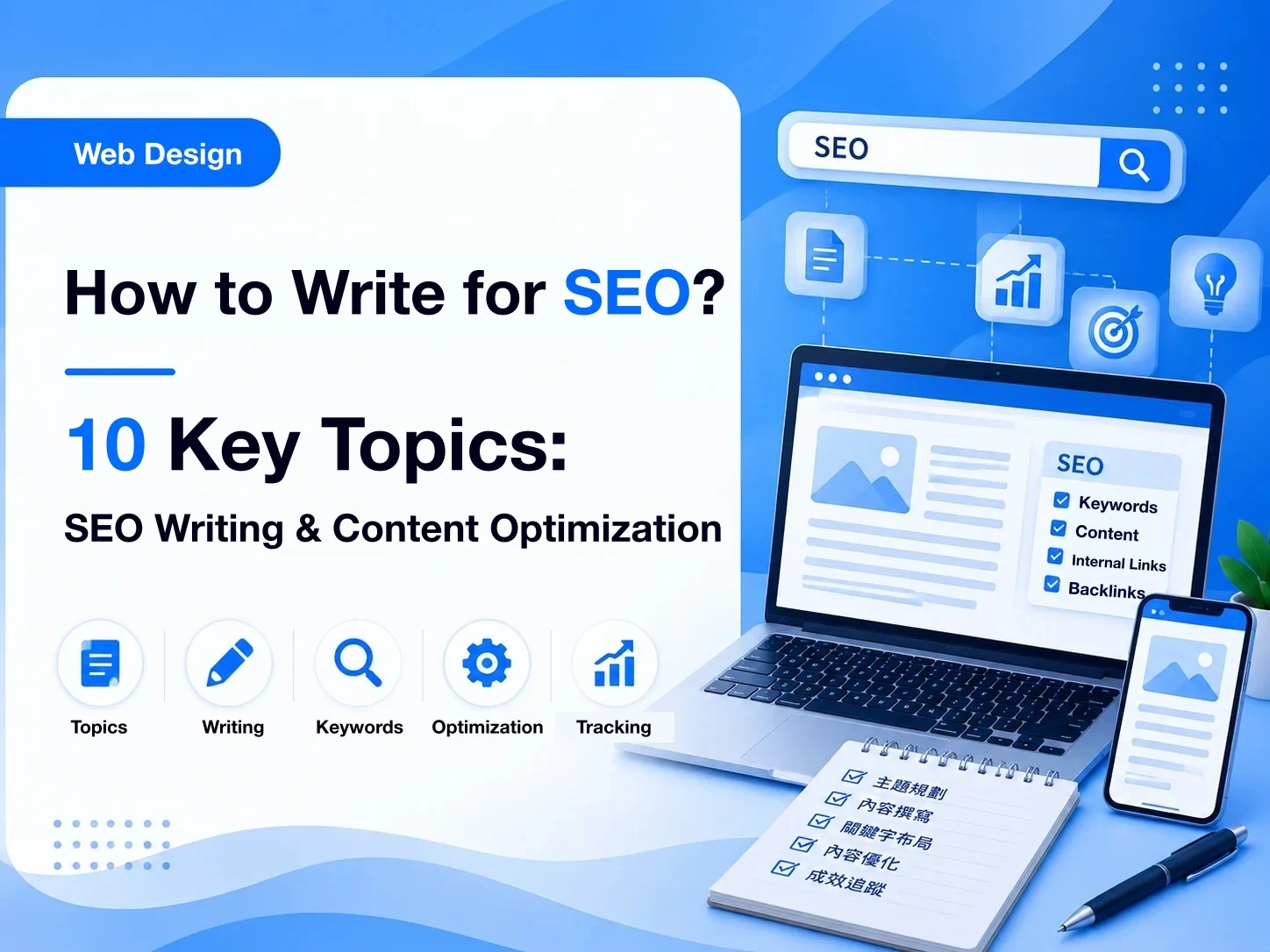
Once a business starts doing SEO, it often hears one piece of advice: "Keep writing SEO articles."
So many businesses start a blog, research keywords, and even use AI to produce articles in bulk, hoping the content will lift their Google rankings and site traffic.
But the real question is: what actually makes a good SEO article?
Below, we start with how SEO articles differ from ordinary articles, then walk through keyword research, search intent, SERP analysis, article structure, titles, keyword placement, internal links, AI writing, and post-publication optimization, building an SEO content workflow a business can use for the long term.
Key takeaways
- SEO articles should start from search demand and search intent, not from keyword placement.
- Finish keyword research, search intent analysis, and SERP analysis before you write.
- The SEO Title, H1, H2, and H3 should prioritize clearly expressing the content and its information architecture.
- Use keywords naturally; there's no need to chase a fixed keyword density.
- SEO articles have no fixed ideal length; the principle is to fully answer the search need.
- Content should be People-first Content, with the business's first-hand experience, expertise, and case studies.
- Internal links build relationships between content; external links should favor official and first-hand sources.
- AI can help with SEO writing, but it can't replace professional judgment, fact-checking, and human review.
- After publishing, keep monitoring and optimizing SEO articles with Google Search Console.
- The core principles of SEO content are: Search-first, People-first, Business-relevant.
What is an SEO article?
An SEO article is content created for a specific search need and optimized for search engines.
Its purpose isn't just to appear in Google search results, but to do all of the following:
- Answer what users are actually searching for
- Help search engines understand the topic
- Provide complete, trustworthy information
- Establish the business's expertise on a specific topic
- Guide readers to related content
- Help generate business results where appropriate
So an SEO article really serves two audiences: users and search engines.
But the two aren't equal priorities.
Content should first be valuable to real readers, and then sensible SEO settings help search engines understand and discover it.
An SEO article isn't a special article format
Many people imagine SEO articles as a fixed template:
Put the keyword in the title
↓
Put the keyword in the first paragraph
↓
Put the keyword in the H2s
↓
Write more than 2,000 words
↓
Repeat the keyword a set number of times
↓
SEO article done
But in SEO there's no fixed article format that works for every search need.
For example, a search for:
"What is SEO"
may call for a complete guide.
A search for: "How to submit a sitemap in Google Search Console"
may only need a clear how-to tutorial.
A search for: "SEO vs Google Ads"
is better served by comparing the two approaches in terms of:
- Cost
- Time
- Pros and cons
- When each fits
So what should really determine the article structure is:
What answer does the user need?
not:
What should an SEO article look like?
An SEO article isn't the same as a blog post
When businesses do SEO, it's also easy to treat:
SEO Content = Blog Article
as the same thing.
But search demand can be met by many different kinds of pages, such as:
- Knowledge articles
- Complete guides
- FAQ
- Product pages
- Service pages
- Solution pages
- Industry pages
- Case studies
- Comparison pages
- Tool or data pages
For example: "What is SEO" suits a complete guide.
Whereas "SEO company" may be better served by an SEO service or solution page.
So before deciding to "write an SEO article," you should first confirm:
Is this search need really best answered with an article?
If searchers clearly want a product, service, or tool, forcing out a blog post isn't necessarily the most sensible approach.
What does an SEO article actually optimize?
SEO content optimization can be broken down into several layers.
Search demand
Does the article truly answer the question users are searching for?
Content quality
Is the content complete, clear, trustworthy, and genuinely valuable?
Content structure
Do the title, H1, H2, and H3 make it easy for readers and search engines to understand?
On-page SEO
Are elements such as the title, meta description, URL, images, and internal links set up sensibly?
Site relationships
Does this article have sensible internal links to related content elsewhere on the site?
Technical foundation
Can search engines properly:
discover → crawl → understand → index
Together, these factors form the foundation of SEO content.
So an SEO article isn't:
"An ordinary article + a few more keywords"
It's content designed from the search need onward, in a way users and search engines can understand.
A good SEO article should answer three questions
Before a business starts creating SEO content, it can ask three questions:
1. Who is searching?
Who do we want to reach:
- Everyday consumers?
- Business decision-makers?
- Marketers?
- Technical staff?
- People comparing suppliers?
Different audiences may need entirely different depths of information and angles.
2. Why are they searching?
Is the searcher right now:
- Trying to learn?
- Facing a problem?
- Comparing options?
- Weighing prices?
- Ready to buy?
That's search intent.
3. What more valuable answer can we provide?
Only then do we come back to the content itself.
A business can consider:
- What first-hand experience do we have?
- Do we have real case studies?
- Do we have our own data?
- Can we offer a clearer decision framework?
- Can we answer questions the current search results leave incomplete?
This kind of content is usually more valuable than simply adding word count.
SEO articles don't exist just to rank
Rankings are of course one of the important results of SEO.
But if an article:
ranks → gets traffic → users read and leave → delivers no further value to the business
the business still needs to rethink that content's role.
So before creating an SEO article, it's best to know what it's meant to accomplish:
Build search visibility
↓
Answer customer questions
↓
Build expertise and trust
↓
Guide readers to related content
↓
Help customers make decisions
↓
Generate inquiries or conversions at the right stage
Not every article needs to close a sale directly, but every piece of content should play a clear role in the overall customer journey.
Once that idea is in place, the next question is:
How exactly do SEO articles differ from ordinary business articles?
How do SEO articles differ from ordinary articles?
The biggest difference between SEO articles and ordinary articles isn't whether there are keywords, but:
what need the content is built from.
An ordinary business article might start from:
- Information the company wants to share
- Brand perspectives
- Company news
- Event recaps
- Product launches
- Industry observations
Even without a clear search need, this content can still have brand, communication, or PR value.
SEO articles are different.
SEO articles are usually planned starting from "search demand that already exists in the market."
That means first confirming: "What are people searching for?"
and then deciding: "What content should we provide?"
Ordinary articles can start from "what the business wants to say"
For example, a business that just exhibited at a trade show wants to publish:
"Our exhibit at the 2026 Taipei International Industrial Automation Exhibition"
The main purposes of this article might be:
- Sharing company updates
- Showcasing brand activities
- Giving customers the latest news
- Building the business's credibility
Even if few people search for "Company X's automation trade show recap"
this article still has a reason to exist.
Because its main goal was never to win organic search traffic in the first place.
SEO articles start from "what users are looking for"
Suppose the same automation equipment business finds that people in the market are searching for:
"How to choose automation equipment"
Now the content planning is completely different.
The article first needs to understand:
Searchers may be comparing:
- Different automation solutions
- Implementation costs
- Suitable production scale
- Equipment specifications
- System integration approaches
- Supplier selection
So the article should be built around:
"How can we help businesses choose the right automation equipment?"
as its content.
That's the biggest difference between SEO content and ordinary business content:
SEO content has a clear, existing search need to answer.
SEO articles need to validate search intent first
Ordinary articles can follow the author's own content logic.
SEO articles add one important step:
Confirming what searchers actually want to see.
For example, if you're about to write about "SEO articles"
you can't just start writing because the business knows SEO well.
You also need to look at the search results to confirm what searchers mainly want to learn:
- What is an SEO article?
- How do you write an SEO article?
- How should keywords be placed?
- How should the article structure be designed?
- What SEO writing techniques are there?
- Can AI write SEO articles?
If the search results show that users are mainly looking for "practical writing methods," then writing only:
"Why SEO Articles Matter"
may not fully match the search intent.
So SEO writing comes with one important constraint:
You can't only write what we want to say; you also have to answer what searchers really want to know.
SEO articles need to consider the competing content in search results
SEO articles also need to understand:
What answers can searchers already find?
For example, if you're about to create: "Website development cost"
you can first check whether the currently ranking content already covers:
- Prices for different types of websites
- Ways to build a website
- Domain and hosting costs
- Maintenance fees
- Feature costs
- Why quotes differ
- Common hidden costs
This isn't about: "rewriting every competitor's article all over again.
It's about understanding: "What baseline of information have the current search results already set?"
and then considering: "Can we offer a more complete, clearer, or more first-hand answer?"
For example, by adding:
- Real project experience
- Your own pricing logic
- Real case studies
- Original data
- Decision frameworks
- Expert perspectives
These are where a business can truly set itself apart.
SEO articles also need On-page SEO
Once the content is done, an SEO article still needs its page elements tidied up, for example:
- SEO Title
- Meta Description
- Slug
- H1
- H2 / H3
- Images and Alt
- Internal links
- External links
These settings help search engines understand: what this page is about, and how its content relates to other content.
But they belong to: SEO optimization after the content is done.
They can't replace the content itself.
If an article doesn't truly answer the search need, it won't become good SEO content even if the Title, H1, Alt, and keywords are all set.
SEO articles need ongoing updates
Some ordinary business articles are records of events.
For example: "2026 annual events recap"
Once published, it may not need ongoing edits.
SEO articles are different.
Because:
- Search demand can change
- Search results can change
- Industry information can be updated
- Competing content can become more complete
- Search Console can reveal new search queries
- The business itself may accumulate new cases and experience
So SEO content should usually be treated as "a content asset that's continuously maintained."
rather than an article you never touch again once it's published.
SEO articles and ordinary articles aren't an either-or choice
This doesn't mean all of a business's content should become SEO articles.
For example:
- Company awards
- Major partnerships
- Brand story
- Event recaps
- Company perspectives
This content may have no clear search volume, but it still has important brand and business value.
So a business's content strategy shouldn't become: "If there's no search volume, don't write it."
Instead, first understand the purpose of each piece of content.
You can roughly divide it into:
- SEO content → mainly meets search demand in the market
- Brand content → builds awareness of the business and its values
- Commercial content → helps customers understand products and make decisions
- Company information → provides information about the company, events, and operations
Different kinds of content can support each other, rather than having search volume alone decide whether they're worth having.
So a good SEO article has actually already completed part of its important work before the first word is written.
Next, let's get into that groundwork: "What should you do before writing an SEO article?"
What should you do before writing an SEO article?

Many SEO articles underperform not because they're badly written, but because:
they were headed in the wrong direction before writing even began.
For example, after finding the keyword: "SEO articles"
if you start writing straight from your own understanding of SEO without further research, you may well end up with an article that's rich in content but doesn't actually match the search need.
So before you formally write an SEO article, we recommend completing the following tasks.
1. Finish keyword research first
The first step is to confirm: "Which search need are we going to meet?"
For example, a business preparing SEO content can first discover through keyword research:
- SEO articles
- How to write SEO articles
- SEO writing
- SEO content
- SEO copywriting
- SEO content optimization
Then assess whether these keywords:
- Have search demand
- Are relevant to the business
- Share the same search intent
- Are worth separate content
- Can be covered by the same page
Only after this step will you know what topic this article is really responsible for.
If you're not sure how to do this step, see: "How to Find SEO Keywords: A Complete Guide to Keyword Research for Businesses"
The purpose of keyword research isn't to find a word to stuff into an article, but to:
first confirm what search demand actually exists in the market.
2. Confirm the search intent
Once you've found a keyword, the next step is to ask:
What do people searching for this term actually want?
For example:
"How to write SEO articles"
Searchers probably don't just want the definition of an SEO article; they want to actually understand:
- What to prepare before writing
- How to plan the article structure
- How to use keywords
- How to write the title
- How to arrange H1 and H2
- How long the article should be
- Where to put internal links
- Whether AI can help with writing
So if you only write:
"Five Benefits of SEO Articles for Businesses"
even though the topic is closely related to SEO articles, it may not match the main search intent.
So before you start writing, first turn:
"the keyword" into "the questions users actually need answered."
3. Look at the actual Google search results
You can't judge search intent from your own imagination alone.
Search for the target keyword directly and look at the current SERP (Search Engine Results Page).
Observe:
- What types of pages rank at the top?
- Are they complete guides, tutorials, product pages, or service pages?
- Which questions do the articles mainly answer?
- What do the titles usually emphasize?
- Are there multiple search intents in the results?
- What related questions or search features does Google show?
For example, a search for: "How to write SEO articles"
If most of the ranking results are tutorials + practical guides
it means searchers most likely expect methods they can actually put into practice.
So when we create content, we should at least meet this basic need.
4. Don't turn SERP analysis into "copying the top ten"
There's one problem that easily creeps into SERP analysis:
opening all of the top ten articles and compiling everyone's H2s into your own article.
This may quickly produce content that looks complete, but in the end it's often just:
a rearrangement of what's already in the search results.
What SERP analysis should really answer is:
What basic answer do searchers expect right now?
Once the basic need is confirmed, a business still needs to think further:
What value can we add that's genuinely our own?
For example:
- Hands-on experience
- Customer case studies
- First-hand data
- Methods you use yourself
- Decision frameworks
- Common mistakes
- Expert judgment
- Original images or research
This is the kind of content that makes an article more likely to be more than just another SEO article that "compiles information from the web."
5. Confirm the target reader for this content
Even for the same keyword, different businesses may serve different audiences.
For example: "How to write SEO articles"
could be written for: individual bloggers
or for: in-house marketers
or: SEO professionals.
Different readers need different depths and angles.
If a business mainly serves B2B customers, it doesn't necessarily need to frame the article as:
"How to Become an SEO Writer"
Instead, it can focus more on:
- How to choose content worth investing in
- How to establish the business's expertise
- How to connect articles to business goals
- How to manage the business's content assets
- How to measure the results of SEO content
So before writing, it's best to answer clearly:
Who is this article mainly written for?
6. Confirm the article's role in the Topic Cluster
SEO articles shouldn't be treated as standalone pieces.
For example, an SEO Topic Cluster might include:
↓
↓
↓
↓
↓
Within this cluster, "How to Write an SEO Article?"
is mainly responsible for turning search needs you've already found into content that can actually be published and rank.
So it doesn't need to spend a lot of space re-explaining what SEO is.
Nor does it need to teach again, in full, how to do keyword research.
Those topics can be covered briefly and then handed off to more complete articles through internal links.
That way each piece of content has a clear responsibility, and you avoid large amounts of duplicate content.
7. Decide what this article should accomplish
Finally, beyond search rankings, you should also define the role this article plays in the business's content strategy.
For example, this content might aim to:
- Build visibility for a particular search topic
- Answer common questions from potential customers
- Establish the business's expertise
- Guide readers to other related content
- Help users compare options
- Encourage readers to learn more about the service
Not every SEO article needs to generate an inquiry right away.
For example, someone searching "what is SEO" may still be at a very early research stage.
At that point, a more reasonable next step might be:
Read about SEO keyword research
↓
Learn how to write SEO articles
↓
Learn how to measure SEO performance
↓
Evaluate SEO services in more depth
So SEO articles should be placed within the customer's complete search and decision journey, rather than having every article push users to buy immediately.
Basic checks before writing an SEO article
Before you actually start writing, you can confirm:
What is the target search need?
↓
What is the main search intent?
↓
What answers does the SERP currently provide?
↓
What unique value can we add?
↓
Who is the main reader?
↓
What is this article responsible for in the Topic Cluster?
↓
After reading, what do we want the user to do next?
If these questions don't have answers yet, we don't recommend rushing to produce lots of content.
Only after these preparations are done do you truly move on to the next stage:
turning the search need into a complete SEO article.
How to write an SEO article: 10 complete steps

Only once the keyword research and search intent checks above are done do you really get into producing the SEO article.
An SEO article can be built by following this process:
Choose the search need → Analyze the search intent → Research the SERP → Build the article structure → Write the content → Optimize the title and headings → Use keywords naturally → Build links → Optimize images → Publish and track
Each step is explained below.
Step 1: Choose the main search need
The first step isn't deciding: "Which keyword should this article target?"
It's confirming: "Which search need is this article mainly meant to solve?"
For example, say we're preparing to create: "How to Write an SEO Article: A Complete Guide to SEO Content Optimization"
What it mainly aims to answer is: How should a business create an SEO article that matches search needs?
Only then do you gather related search terms, such as:
- SEO articles
- How to write SEO articles
- SEO writing
- SEO content
- SEO content optimization
- SEO copywriting
If the search needs behind these keywords overlap heavily, a single piece of content can cover them, rather than creating a separate article for each keyword.
So before you start writing, you should settle on one main search need + a set of closely related search terms.
Not a dozen-plus keywords that you then try to cram into the article.
Step 2: Analyze the search intent
Next, confirm: Why are searchers looking up this topic?
For example, a search for: "How to write SEO articles"
clearly has a hands-on need behind it.
Searchers usually want to know:
- What to prepare before writing
- How to plan an SEO article's structure
- How to use keywords
- How to write the title
- How long the article should be
- Where to put internal links
- How to optimize after publishing
So the main format of this article should be:
A complete guide + practical, hands-on methods
rather than just an introduction to:
"The Top 10 Benefits of SEO Articles."
Search intent directly determines the direction of the content.
Step 3: Research the search results (SERP)
Once the search intent is clear, actually search for the main keyword.
Look at the pages that currently rank:
- What content format they use
- Which main questions they answer
- How the article structure is arranged
- Which information almost every result includes
- Which questions aren't fully answered
- Whether the search results contain different intents
The purpose of this step is to understand:
the baseline content standard in the current search market.
But don't compile all the H2s from the top ten ranking articles and then generate another similar piece of content.
What you really still need to ask is:
"What value can we offer that the existing results don't?"
Step 4: Build the article structure
Once the search need is confirmed, build the article outline first, then start writing the body.
For example:
- H1: How to Write an SEO Article? A Complete Guide to SEO Content Optimization
Underneath, you can arrange:
- H2: What is an SEO article?
- H2: How are SEO articles different from ordinary articles?
- H2: What should you do before writing an SEO article?
- H2: How do you write an SEO article?
Then use H3s to break down the different questions further.
The purpose of the article structure isn't to show search engines more headings, but to:
organize a complex question into an easy-to-understand hierarchy of information.
A good outline should let readers roughly understand, just from the headings:
which questions this article will answer.
Step 5: Write genuinely valuable content
Only now do you formally start writing.
At this stage, what matters most isn't the word count, but:
whether the content truly answers the search need.
For example, if searchers want to know:
"How long should an SEO article be?"
Rather than answering:
"SEO articles should ideally be over 2,000 words."
more valuable content should explain:
- Google has no minimum word count for SEO articles
- Different search needs call for different depths of content
- Simple questions don't need to be forced into long articles
- Complex topics may need a full explanation
- The test should be whether the content fully satisfies the search need
Beyond that, a business can also add:
- First-hand experience
- Real case studies
- Its own data
- Expert judgment
- Original images
- Methods it uses itself
- Decision frameworks
so the article is more than just a rearrangement of information from the web.
Step 6: Set the SEO Title, H1, and headings
Once the content structure is settled, go on to optimize the titles.
SEO Title
This mainly affects the title users see in search results, and it's also one of the important signals search engines use to understand a page's topic.
For example:
How to Write an SEO Article? A Complete Guide to SEO Writing and Content Optimization
When users see it, they should be able to quickly tell:
Can this content answer my question?
H1
The H1 is the page's main heading.
For example:
How to Write an SEO Article? A Complete Guide to SEO Content Optimization
The SEO Title and H1 can be similar, but they don't have to be identical.
H2 / H3
These organize the article's information hierarchy.
For example:
H2: How do you write an SEO article?
↓
H3: Step 1: Choose the search need
H3: Step 2: Analyze the search intent
H3: Step 3: Research the search results
Headings should serve reading and content structure first, not exist to cram in more keywords.
Step 7: Use main and related keywords naturally
Once the content is done, you can check again:
Can search engines clearly understand the article's topic?
The main keyword can usually appear naturally in:
- The SEO Title
- The H1
- The introduction
- Some H2s / H3s
- The body text
- The URL
- Image Alt text (when the image really is related to the topic)
But there's no need for a rule that:
the main keyword must appear 10 times, 20 times, or reach a certain percentage.
For example, if the article's topic is "how to write SEO articles" to begin with, simply writing complete content will naturally bring in
- SEO articles
- SEO writing
- SEO content
- Search intent
- Keywords
- Content optimization
and other related concepts.
So the order of priority should be: natural, clear, and semantically appropriate.
rather than chasing a specific keyword density.
Step 8: Add internal links and any necessary external links
Once the main content is done, check:
Where might readers need to learn more about other questions?
For example, when you discuss: SEO keyword research
When you discuss basic SEO concepts, you can also link to: "What Is SEO? A Complete Guide to Search Engine Optimization for Businesses"
These are internal links.
External links, on the other hand, are suited to:
- Official documentation
- Original research
- Statistics
- Technical specifications
- Authoritative sources
For example, when citing Google's official guidance on search content, you can link straight to Google Search Central, rather than citing another SEO blog that paraphrases Google's rules.
The purpose of links should be: to give readers more complete information and sources.
not simply to increase your "number of SEO external links."
Step 9: Optimize images and Alt Text
Images are part of the content too.
SEO articles can use:
- Flowcharts
- Comparison graphics
- Real screenshots
- Data charts
- Step-by-step illustrations
- Original infographics
to help readers understand the content faster.
An image's Alt Text should describe: what the image actually shows.
For example, if an image really does explain the SEO keyword research process, you can use: Diagram of the SEO keyword research process
rather than: SEO SEO keywords SEO optimization SEO rankings
The main purpose of Alt Text isn't to stuff in keywords, but to provide a text alternative for the image.
If an image is purely decorative, there's no need to force in a keyword description for SEO.
Step 10: Publish, get indexed, and keep tracking
Publishing the article isn't the end point of SEO content.
After publishing, you still need to confirm:
- Search engines can access the page normally
- There's no mistaken
noindexsetting - Search engines can discover the sitemap normally
- Whether Google Search Console has started collecting data
- Which search queries are generating impressions
- How the CTR is performing
- Which keyword rankings are gradually improving
- Which content users actually read
As data accumulates, you may find that:
search queries you hadn't researched start generating impressions.
At that point, you can go further:
Add content → Improve the title → Add an FAQ → Update information → Strengthen internal links
So the life cycle of an SEO article should be:
Research
↓
Create
↓
Publish
↓
Gather search data
↓
Keep updating
rather than:
Publish → Done.
If the search need and the content itself aren't done well up front, later settings like the Title, keywords, and Alt Text can hardly turn a piece of content into a truly valuable SEO article on their own.
How to write an SEO Title

The SEO Title (one of the sources for the title link) is important information that search engines use to understand a page's topic, and that users use to decide whether a search result is worth clicking.
For example, this article's SEO Title:
How to Write an SEO Article? A Complete Guide to SEO Writing and Content Optimization
Users can quickly understand:
- The topic is SEO articles
- It will answer how to write them
- It covers SEO writing and content optimization
- It's a complete-guide type of content
So the most important purpose of an SEO Title isn't: fitting in as many keywords as possible.
It's: clearly describing the page's content, and making the people who truly need it want to click.
1. Let the main search need appear naturally in the Title
If the article mainly covers:
"How to write SEO articles"
the SEO Title can naturally use:
How to Write an SEO Article? A Complete Guide to SEO Writing and Content Optimization
rather than being deliberately written as:
SEO articles | SEO writing | SEO content | SEO copywriting | SEO article optimization
Although the latter contains more keywords, it:
- Is hard to read
- Has an unclear topic
- Looks like keyword stuffing
- Can't clearly tell searchers what problem the article solves
So rather than "how many keywords you include," what matters more is:
whether the Title clearly expresses the main search need.
2. The SEO Title should tell users "what this page offers"
A good Title usually includes more than just the topic; it also offers some clues about the content's value.
For example: "SEO keywords" carries very little information.
Change it to: "How to Find SEO Keywords: A Complete Guide to Keyword Research for Businesses"
and users can more quickly understand that this article:
will teach me how to find SEO keywords, and the content is a complete guide.
Other common approaches include:
- Question → How do you write an SEO article?
- Guide → The complete guide to writing SEO articles
- Comparison → SEO vs Google Ads: Which should a business choose?
- Cost → How much does SEO cost? A complete breakdown of business SEO pricing
The form of the Title should match the search intent, rather than applying the same pattern to every article:
"The Complete Guide to XXX"
3. You don't need to cram every secondary keyword into the Title
Suppose keyword research turns up:
- SEO articles
- SEO writing
- SEO content
- SEO copywriting
- SEO content optimization
- How to write SEO articles
That doesn't mean the SEO Title has to include all of them.
What you really need to confirm first is:
Which search need does this page mainly cover?
Then just add one or two naturally related concepts.
For example:
How to Write an SEO Article? A Complete Guide to SEO Writing and Content Optimization
already naturally covers the main content.
Other related search terms can be brought in through:
- H2s / H3s
- The body text
- The FAQ
- The overall semantics
so that they appear naturally in the article.
4. The SEO Title and H1 don't have to be identical
The SEO Title and the page's H1 can be very close, but they don't need to be exactly the same.
For example, in this article:
SEO Title: How to Write an SEO Article? A Complete Guide to SEO Writing and Content Optimization
H1: How to Write an SEO Article? A Complete Guide to SEO Content Optimization
Both clearly describe the same topic, just phrased slightly differently.
The SEO Title can give more thought to how it appears in search results, while the H1 is mainly responsible for:
helping readers who land on the page understand the main topic of the content.
So there's no need to force the two to match exactly for SEO.
5. The SEO Title should avoid overpromising
To boost click-through rates, some titles use
"Guaranteed #1"
"100% effective"
"Rank #1 on SEO in 3 days"
and similar strong promises.
Even if this brings in some extra clicks, if the article can't actually deliver matching content, it creates a gap between the search result and the content.
An SEO Title should be:
appealing, but still an accurate description of the page's content.
For example:
How to Write an SEO Article? 10 Steps to Create Search-Friendly Content
If the article really does provide all ten steps, this is a reasonable description.
But adding numbers or promises unrelated to the content just to get more clicks isn't necessary.
6. How long should the SEO Title be?
This is a very common SEO question.
Rather than chasing an absolute character count, a more practical principle is:
Put the most important information first, and keep the title concise and clear.
Because the title actually shown in search results is affected by factors such as:
- Device
- Character width
- Search context
- How Google displays it
and more.
Google may also generate a different title link based on the page content and search context, rather than always using the site's <title> exactly as set.
So there's no need, just because of a rule like:
"It must never exceed a certain character count,"
to rewrite an otherwise clear title into something unnatural.
What you should really check first is:
Is the most important topic clear enough, and does it appear near the start of the title?
7. Avoid using the same or vague Titles across pages
For example, if a business website has 100 articles that all use:
TimTech | Expert Knowledge Sharing
both search engines and users will struggle to quickly tell the pages apart.
Every important page should have a Title that describes its own content.
For example: How to Find SEO Keywords: A Complete Guide to Keyword Research for Businesses
and: How to Write an SEO Article? A Complete Guide to SEO Writing and Content Optimization
Even though both belong to the same SEO Topic Cluster, each should clearly express a different search need.
SEO Title basic checklist
Once it's set, you can quickly confirm:
- Is the main search need clear?
- Do users know what this page can answer?
- Is the important information placed first?
- Have keywords been stacked for SEO's sake?
- Does it accurately describe the page's content?
- Is it clearly different from the Titles of other pages on the site?
If all of these are met, there's usually no need, just because some SEO tool shows:
"Title Score: only 78"
to deliberately rewrite the title into something unnatural.
How to plan H1, H2, and H3
Headings (heading tags) such as H1, H2, and H3 are mainly used to build a page's content hierarchy.
For readers, they help to quickly understand:
what this article is about, and how the content is organized.
For search engines, a clear heading structure also helps them understand the page's content and how its sections relate to each other.
So the most important principle when planning headings isn't:
"Every H2 must contain an SEO keyword."
It's: "Build a clear, easy-to-understand content structure."
H1: Define the main topic of the whole page
The H1 usually describes the most important content of the whole page.
For example, in this article:
H1: How to Write an SEO Article? A Complete Guide to SEO Content Optimization
Once readers land on the page, they can immediately tell:
This is a complete piece teaching businesses how to create and optimize SEO articles.
So what matters most for the H1 is that it:
- Clearly describes the page's topic
- Matches the main search need
- Is easy for readers to understand
- Matches the page's actual content
The main keyword will usually appear naturally in the H1, but there's no need to cram every related keyword into it for SEO.
For example, there's no need to write:
SEO Articles, SEO Writing, SEO Copywriting, SEO Content Optimization: The Complete Guide
That actually makes it harder to read.
H2: Break down the article's main questions
If the H1 is the topic of the whole article, the H2s break that big question down into several main parts.
For example:
- H1: How to Write an SEO Article? A Complete Guide to SEO Content Optimization
Underneath, you might have:
- H2: What is an SEO article?
- H2: How are SEO articles different from ordinary articles?
- H2: What should you do before writing an SEO article?
- H2: How do you write an SEO article?
- H2: How do you write an SEO Title?
- H2: Where should SEO keywords go?
- H2: Can AI write SEO articles?
Even if readers only skim the H2s, they can roughly understand which questions the whole article will answer.
So good H2s should carry informational value in their own right.
H3: Break down the content under an H2 further
When an H2 contains several sub-questions, you can use H3s.
For example:
- H2: How do you write an SEO article?
can be broken down into:
- H3: Step 1: Choose the main search need
- H3: Step 2: Analyze the search intent
- H3: Step 3: Research the search results
- H3: Step 4: Build the article structure
This creates an information hierarchy of:
H1
↓
H2
↓
H3
in that order.
If there really is content under an H3 that needs to be broken down further, you can also use an H4.
But there's no need to add extra levels just for the sake of a "complete SEO structure."
Headings should follow the content hierarchy
One problem that often comes up is:
choosing H1, H2, or H3 based on font size.
For example:
Thinking the H2 looks too big, so changing it to an H4.
Or:
Thinking the H3 looks better, so jumping straight from H1 to H3.
This mixes up "content structure" with "visual style."
A more sensible approach is:
- HTML headings handle content semantics and hierarchy
- CSS handles font size and visual design
For example:
This way, both readers and search engines find it easier to understand the content structure.
Do headings need keywords?
They can have them, but it should be natural.
For example, if the section is genuinely answering: "How do you write an SEO Title?"
then using: H2: How do you write an SEO Title?
makes perfect sense.
But if you change every H2 just to increase how often the keyword appears, like:
- Search intent for SEO articles
- Article structure for SEO articles
- Internal links for SEO articles
- Image optimization for SEO articles
it can start to feel unnatural.
So there's no need to aim for: "Every heading contains the main keyword."
What really matters is: "Does the heading accurately describe the content that follows?"
Does there have to be only one H1?
This is a common SEO question.
From a modern HTML perspective, a page can technically have multiple H1s, and Google has also stated clearly that multiple H1s on their own don't cause an SEO problem.
But for typical business websites and content management, we still recommend:
keeping one clear main H1 on each main content page.
The reason isn't that "Google only allows one H1."
It's that this usually means:
- A clearer information architecture
- Simpler CMS management
- More consistent team standards
- Less chance of creating a broken structure
So it's more of a "best practice for content and website management"
than a hard rule from search engines.
You don't need to force a heading onto every paragraph for SEO
The other extreme is:
chopping the article into tiny pieces just to increase the number of H2s and H3s.
For example, creating a new heading every two or three sentences.
A heading should signal: "The content has genuinely moved on to a new topic or sub-question."
If it's just a continuation of the same idea, there's no need for a separate heading.
So there's no fixed standard for the number of headings.
The more complex the article, the more levels it may need; simple content may only need a few headings.
How to quickly check an article's headings
Once the article is finished, you can pull out just the H1, H2s, and H3s and look at them on their own.
For example:
- H1: How do you write an SEO article?
- H2: What is an SEO article?
- H2: How are SEO articles different from ordinary articles?
- H2: What should you do before writing an SEO article?
- H2: How do you write an SEO article?
- H2: How do you write an SEO Title?
- H2: How do you plan H1, H2, and H3?
If you can roughly understand the article's content and reading order from these headings alone, it usually means the information architecture is already fairly clear.
You can also check:
- Does the H1 clearly define the topic?
- Do the H2s break down the main questions?
- Do the H3s really belong to the H2 above them?
- Do the headings accurately describe the content?
Are keywords being repeated unnaturally for SEO?
This is more meaningful than simply counting "How many H2s does the article have?"
as a measure.
Where should SEO keywords go?

Once keyword research is done, the next question many people have is:
"Where exactly should SEO keywords go?"
Common approaches might include:
- Once in the Title
- Once in the H1
- Once in the first paragraph
- Once in every H2
- Once every 300 words
- Once more in the Alt Text
Some people even end up calculating: "Keyword Density"
But this approach easily turns SEO writing into filling in keywords according to a formula.
A more sensible principle is:
Let the main search topic appear where it genuinely helps people understand the page, and use it naturally elsewhere as the content calls for.
1. SEO Title
The SEO Title is a very good place to clearly express the main search topic.
For example, if the main search need is: "How to write SEO articles"
you can set it to "How to Write an SEO Article? A Complete Guide to SEO Writing and Content Optimization"
Both users and search engines can quickly understand the page's topic.
But there's no need to write:
SEO articles | How to write SEO articles | SEO writing | SEO content | SEO content optimization
More keywords don't make a better Title.
2. H1
The H1 should likewise clearly describe the page's main topic.
For example: "How to Write an SEO Article? A Complete Guide to SEO Content Optimization"
The main keyword will usually appear naturally in the H1.
But that's not because: "SEO rules require an Exact Match Keyword in the H1."
It's because if the page really is answering "how to write SEO articles," the H1 should naturally express that topic clearly.
3. Introduction
The opening of the article should let readers quickly confirm:
"Did I find the right article?"
So it can naturally mention the main question.
For example:
After starting on SEO, many businesses run into the same question: How exactly should you write an SEO article?
This is perfectly natural.
But there's no need to write:
SEO articles are important. If you want to know how to write SEO articles, you need to understand SEO article writing to do SEO article optimization well.
This is a classic example of sacrificing readability for the sake of keywords.
4. H2s and H3s
Headings can naturally include:
- The main keyword
- Secondary keywords
- Related questions
- Subtopics
For example:
- How do you write an SEO Title?
- How long should an SEO article be?
- Can AI write SEO articles?
These headings are each answering a different search need in their own right.
There's no need to change them all for the sake of the main keyword, like:
- How do you write the SEO Title for SEO articles?
- SEO article length for SEO articles
- How SEO articles use AI to write SEO articles
Natural semantics still come first.
5. Body text
The body text is the place where you least need to deliberately count keywords.
If the article really does fully discuss: "How to write SEO articles"
the body text will naturally include:
- SEO articles
- SEO writing
- SEO content
- Search intent
- Keyword research
- Content structure
- On-page SEO
- Internal links
Search engines don't understand content just by counting how many times a single Exact Match Keyword is repeated.
So the body text should focus on: "answering the question completely."
6. URL / Slug
A URL can stay: "short, clear, and easy to understand."
For example, this article uses: /seo-content-writing
That's already enough to reasonably describe the page's topic.
There's no need to turn it into: /seo-article-seo-writing-seo-content-optimization
The main purpose of a URL is still to give the page a clear, stable identity and support the site's structure.
7. Image Alt Text
If an image is itself related to the main search topic, you can describe what it shows naturally.
For example: "SEO article writing process diagram"
But if the image is a "screenshot of a Google Search Console performance report",
the Alt Text should describe what it actually shows, rather than being forced into "SEO article SEO optimization keyword ranking"
Alt Text should first and foremost provide "a text alternative that describes the image."
It isn't an extra place to stuff keywords.
8. Anchor Text
The Anchor Text of internal links also helps users understand:
what they'll see after clicking the link.
For example:
If you haven't finished your groundwork yet, start by learning how to find SEO keywords.
gives more information than:
If you haven't finished your groundwork yet, click here.
gives more information.
But again, there's no need for every link on your site that points to the same article to use exactly the same Anchor Text.
Just describe the linked content naturally.
How much Keyword Density do you need?
Keyword Density usually refers to: "the proportion of an article made up by a particular keyword."
For example, if a keyword appears 20 times in a 1,000-word article, you can calculate the corresponding keyword density.
But businesses don't need to set a rule like "SEO keyword density must be 1%, 2%, or 3%."
Google doesn't provide any standard saying that "reaching a certain Keyword Density makes ranking easier."
If you start repeating search terms unnaturally to hit a specific ratio, you may actually lower the quality of your content.
So rather than Keyword Density, it's more worth checking:
- Is the search topic clear?
- Are the important questions fully answered?
- Are related concepts covered naturally?
- Is the article easy to read?
What is Keyword Stuffing?
Keyword Stuffing means unnaturally repeating keywords or related terms in large numbers in an attempt to manipulate search rankings.
For example:
Looking for an SEO company? We're a professional SEO company. If you need SEO company services, our SEO company offers the best SEO company packages.
Content like this has almost no value for real readers.
Google's Spam Policies also explicitly list Keyword Stuffing as one of the practices covered by its spam policies.
So keywords should help content express its topic, not damage the content.
Further reading: Google Search Central:Spam policies-Keyword stuffing
Don't optimize only for the Exact Match Keyword
Suppose the main keyword is "SEO article",
that doesn't mean the whole article can only keep using "SEO article".
The actual content will naturally also cover:
- SEO writing
- Content optimization
- Search needs
- Search intent
- SEO Title
- Heading
- Keyword research
- Internal links
- Search Console
These are all related concepts you need to understand the topic of "SEO articles."
So good SEO content should build "complete topical semantics"
rather than "repeating a single keyword over and over."
How long should an SEO article be?
When businesses start creating SEO content, they often run into one question:
"How many words should an SEO article actually be?"
Online, you may come across all kinds of advice:
- At least 1,000 words
- Ideally more than 2,000 words
- Long articles rank more easily
- Pillar Content should be 3,000–5,000 words
But in reality, SEO has no ideal word count that applies to all content.
What you really need to consider is: "How much content does this search need require to be answered completely and effectively?"
Different search needs call for different content lengths
Suppose a user searches for "What is SEO?"
That's a very broad topic.
A complete answer might need to cover:
- SEO basics
- How search engines work
- On-page SEO
- Off-page SEO
- Technical SEO
- Keyword research
- Content strategy
- Measuring results
So building a longer, comprehensive guide makes sense.
But if someone searches for "Are the SEO Title and H1 the same?"
the question is very specific.
If a few hundred words can:
- Answer the question clearly
- Explain the difference between the two
- Provide practical examples
then there's no need to add lots of unrelated content just to reach 2,000 words.
So the more complex the topic, the more content it usually needs; the more specific the question, the better suited it may be to a direct answer.
Long articles ranking doesn't mean they rank "because they're long"
This is an important question of cause and effect.
Some high-ranking articles in search results really are very long.
But you can't jump straight to the conclusion that:
Longer article → Google likes it more → higher ranking.
Another possibility is:
Complex search need → requires a complete answer → quality content naturally ends up longer.
What actually creates value is how complete the content is and how useful it is to users,
not the word count itself.
So if 1,500 words already answer the question completely, deliberately stretching it to 3,000 words won't necessarily improve your SEO.
It may instead make it harder for readers to find the answer they actually need.
Don't add "content fluff" just to increase the word count
One of the most common problems with long SEO articles is Content Fluff.
For example, the user just wants to know "How should I write an SEO Title?"
Yet the article first spends 1,000 words introducing:
- What online marketing is
- What Google is
- The history of SEO
- Why businesses need a website
- The importance of digital transformation
and only then starts answering the real question.
This content may be related to SEO, but that doesn't mean it's necessary for this search need.
So complete content doesn't mean more content is always better.
A good SEO article should go deep where depth is needed, and answer directly where a direct answer will do.
The SERP can be a reference for content depth, but not a word-count standard
When doing SERP analysis, you can look at the content currently ranking:
- Which questions it usually covers
- Roughly how deep the content goes
- Whether it's a short answer or a complete guide
- Whether it needs lots of examples or explanations
This helps you judge what level of content searchers are likely to expect.
But don't let it turn into:
No. 1: 3,500 words No. 2: 2,800 words No. 3: 3,200 words
So I'll write 4,000 words.
That just tries to beat competitors on word count, without answering: Is the content we provide more valuable?
Long content also needs to let readers find answers quickly
Some topics really do need long-form content.
For example:
- The Complete SEO Guide
- The Complete Website Building Guide
- The Complete Business Website Design Guide
In these cases, what really needs improving is the information architecture.
You can use:
- Clear H2s / H3s
- A table of contents
- Key-point summaries
- Tables
- Bullet points
- Images and flowcharts
- FAQ
so that readers can quickly find the information they need without reading from the first word to the last.
So long articles aren't the problem; long articles that are hard to use are.
Short content can also have high search value
On the other hand, don't assume just because a piece of content is short that:
"This article will never work for SEO."
If a search need can be answered completely with concise content, for example:
- The definition of a term
- How to configure a specific setting
- A clear-cut FAQ
- A simple calculation method
- Specific operating steps
then giving the answer directly may actually offer a better user experience.
So content length should be determined by the question itself,
not by the word-count suggestions of SEO tools.
So how should a business decide on article length?
You can ask four questions:
- What do searchers really want to know?
- What content is needed to answer these questions completely?
- Which information is truly necessary?
- Which content is there only to make the article look longer?
After finishing the article, check it the other way around:
If this section were deleted, could users still fully understand the issue?
If the answer is it makes no difference at all,
then that section may not need to exist.
What is Helpful Content?
In the past, SEO was easily understood as:
Research what Google likes → create content according to ranking factors → get rankings
But Google's official direction on content quality actually places more emphasis on:
creating content primarily for users, rather than to manipulate search rankings.
Google Search Central calls this concept:
People-first content
In other words, SEO can help search engines understand content, but the content itself should first be created for real users.
Helpful Content doesn't mean "you can't do SEO"
This is easy to misunderstand.
Since Google wants businesses to create people-first content, does that mean:
- Don't research keywords?
- Don't work on the SEO Title?
- Don't analyze the SERP?
- Just focus on writing a good article?
No.
Google also makes it clear that SEO itself is a helpful activity, as long as it's applied to:
people-first content
So a sensible process can still include:
Keyword research
↓
Search intent analysis
↓
SERP analysis
↓
Content structure
↓
Title / Heading
↓
Internal links
↓
Technical SEO
The question isn't "whether you do SEO."
The real difference is: is the main purpose of the content to help users, or to manipulate search rankings?
Search-first doesn't mean Search-engine-first
This is also the idea we've been building throughout this article.
SEO content can be Search-first,
meaning it starts from search needs that genuinely exist in the market.
For example, you notice businesses often search for:
"website development cost"
So you create a complete piece that answers:
- How much a website costs
- What makes up the cost
- Price differences between types of websites
- Which factors affect the quote
- What ongoing costs there are
That's completely reasonable.
But if it becomes Search-engine-first,
the thinking may turn into:
This keyword gets 3,000 searches, so let's quickly have AI write an article.
Or even:
The No. 1 result has 3,000 words, so we'll write 4,000.
The SEO tool says the keyword should appear 25 times, so let's add 10 more.
At that point, the core of content creation has shifted from:
"What do users need?" to "How do we get the algorithm to like it?"
That's the biggest difference between the two.
Which questions does Google suggest using to check content?
Google provides an official set of self-assessment questions you can use to evaluate whether content is truly helpful.
Some of the directions especially worth businesses' attention include:
Is there a clear existing or intended audience?
In other words: if these people came directly to our site, would they still find this content valuable?
If the only reason an article exists is "this keyword has search volume,"
it's worth rethinking.
Does it demonstrate first-hand expertise and in-depth knowledge?
For example:
- Experience actually using a product
- Experience actually carrying out a project
- Visiting a place in person
- Actually testing a method
- Judgment from a professional field
This is also a very important advantage of business content.
Because people who have actually done the thing can usually provide:
details that simply compiling online information can't.
Does the site have a clear primary purpose?
If a business website publishes large amounts of content on SEO, travel, stocks, pets, weight loss, AI, credit cards, and games all at once,
just because those keywords have search volume, it will struggle to establish a clear professional positioning.
So a content strategy should revolve around topics where the business has real expertise, products, and commercial relevance.
This is also why, when we build a Topic Cluster, we first ask: "Is this topic related to the business's core operations?
After reading, have users got a sufficient answer?
This is a very practical yardstick.
For example, a user searches for "How do I find SEO keywords?"
If, after reading the article, they still don't know:
- Where to start
- Which tools to use
- How to read search volume
- How to judge search intent
- How to choose keywords worth targeting
then even if the article is 5,000 words long, it can't be said to have truly answered the question completely.
So content quality can't be judged only by how long the article is.
You also have to look at: whether the problem was actually solved.
Which practices lean toward Search-engine-first Content?
Google also points out some situations to watch out for.
For example:
Producing lots of content on many different topics
with the only goal being that some of it might attract search traffic.
Using extensive automation to produce content
mainly to gain search rankings rather than to provide value to users.
Mainly summarizing what others have said
without adding much value of your own.
Writing about a topic just because it's trending
even though it has little to do with your existing audience.
Writing to hit a word count "Google likes"
This point deserves particular attention.
Google even states directly: "Google doesn't have a preferred word count."
So when we said earlier that SEO articles have no fixed ideal word count it was the very same logic.
Helpful doesn't mean an article has to be "never seen before"
Businesses also don't need to take on another source of pressure: "Every article has to present a viewpoint nobody in the world has ever expressed."
For example: "How to write an SEO Title"
There's already a lot of consensus on the basic principles.
What businesses can really add is:
- Clearer explanations
- Better information architecture
- Practical how-to steps
- First-hand experience
- Real cases
- Their own decision-making frameworks
- Scenarios that better fit their target customers
So original value doesn't necessarily mean inventing a brand-new SEO theory.
It can also mean offering users what the business genuinely knows, has done, and has verified, in a more valuable way.
SEO tool scores can't replace content judgment
Many SEO tools now provide:
- Content Score
- SEO Score
- Keyword Score
- Readability Score
and even tell you:
- Which keywords are still missing
- How many words the article should be
- What H2s should be added
This data can be a helpful aid.
But if, in order to raise a score from 78 to 95,
you start adding content that wasn't needed, repeating keywords, or ruining headings that were already clear, you've got your priorities backwards.
Tools should help people make judgments.
They shouldn't decide how the article should be written.
What is E-E-A-T?
E-E-A-T is an important concept used in the Google Search Quality Rater Guidelines to evaluate content quality. It stands for:
- Experience→ Does the content demonstrate first-hand experience related to the topic?
- Expertise→ Does the content creator have sufficient knowledge and expertise?
- Authoritativeness→ Is the content creator or site regarded as an important source in this field?
- Trust→ Are the site and its content trustworthy?
Of these, Google particularly emphasizes that Trust is the most important core.
Because even if content looks experienced, expert, or authoritative, if the information itself isn't trustworthy, the content as a whole may still have problems.
Is E-E-A-T a Google ranking factor?
This needs clarifying first.
E-E-A-T isn't something like a site speed score of 80 or a Domain Authority of 50
— an SEO metric you can obtain directly.
Google's search quality raters use the Search Quality Rater Guidelines to evaluate the quality of search results, but these evaluations themselves:
don't directly determine any page's search ranking.
So E-E-A-T shouldn't be understood as:
Experience 25 points + Expertise 25 points + Authority 25 points + Trust 25 points = SEO 100 points.
A more reasonable way to understand it is:
E-E-A-T provides a framework for thinking about high-quality, trustworthy content.
Experience: first-hand experience
This is a part of SEO content that businesses should take very seriously.
For example, suppose two articles both discuss "website development cost".
The first just compiles information from the web:
Website prices can range from tens of thousands to hundreds of thousands of NT dollars, depending on features and needs.
The second comes from a team that actually delivers website projects, and can go on to explain:
- Which requirements most often affect the quote
- Why custom features increase costs
- Which items businesses often underestimate
- How requirements change in real projects
- Which features look simple but actually cost more
- How different businesses should allocate their website budget
What the latter offers is first-hand delivery experience.
This kind of content is usually hard to get just by compiling search results.
How can first-hand experience be shown in an SEO article?
Businesses can add:
- Real project cases
- Photos they took themselves
- Real screenshots of the process
- Actual test results
- Their own data
- Common customer questions
- Problems encountered in projects
- The methods actually used
- Successes and failures
- Their own decision-making framework
For example, rather than only writing "Back up your data before redesigning a website."
if the business has actually done website redesigns, it can go further and explain which data, URLs, and SEO settings we confirm need to be kept first in real redesign projects, and which situations most often cause traffic loss.
That's where real practical value starts.
Expertise: showing real expertise
Expertise doesn't mean an article has to be written in a very difficult way.
On the contrary, people who truly understand a problem are usually better able to explain complex things clearly.
For example, expert SEO content can:
- Correctly distinguish Google Ads Competition from SEO difficulty
- Not treat Keyword Density as a ranking formula
- Not describe E-E-A-T as a direct ranking score
- Explain when different SEO methods apply
- Cite accurate primary sources
- Clearly state the limits of the information
So expertise also includes knowing what can't be oversimplified.
This is very important for building long-term content credibility for a business.
Authoritativeness: building topical authority
Authority doesn't come from writing in an article: "We're the most professional company in the industry."
It won't appear on its own just from that.
A more reasonable approach is to accumulate complete and consistent expert content over the long term.
For example, a business might build up over time:
↓
↓
↓
↓
↓
and uses Topic Clusters and internal links to build complete relationships between pieces of content.
As:
- Expert articles
- Case studies
- Original data
- Business services
- External mentions
gradually accumulate, the site gets a chance to build a more complete image of topical expertise.
So Authority is more like the result of long-term accumulation,
not an SEO element that a single article can quickly add.
Trust: making content and the site trustworthy
Trust covers even more ground.
For example:
- Whether the author's or business's identity is clear
- Whether contact information is complete
- Whether data sources are credible
- Whether necessary information is clearly labeled
- Whether there is any misleading content
- Whether the site is secure
- Whether the content is accurate
- Whether business information is transparent
- Whether it's clear who is responsible for the content
Especially for content involving health, finance, safety, and law,
which may affect users' major decisions, trustworthiness matters even more.
So business content shouldn't just aim to "look professional."
It also needs to let users judge: why is this information worth trusting?
Don't treat "author bios" as E-E-A-T optimization
The SEO market easily oversimplifies E-E-A-T into:
Add an author name to every article.
Create author pages.
Add LinkedIn.
Add "expert reviewed."
In the right circumstances, this information does help users understand who created the content.
But if the article itself:
- Has no first-hand experience
- Contains incorrect information
- Has no reliable sources
- Just rehashes other people's content
- Was written by an author with no relevant expertise
simply adding an "expert reviewed" label won't make the content genuinely more trustworthy.
So E-E-A-T should be built from the content and the site themselves, not just through surface-level settings.
In the AI era, first-hand experience matters even more
With AI, you can now very quickly pull together "How do you write an SEO article?"
and produce an article that looks well structured.
But if every site does:
Search for information → let AI organize it → publish
you can easily end up with a large amount of highly similar content.
What truly differentiates a business is the things AI doesn't already know.
For example:
- Projects you've done yourself
- Questions customers have actually asked
- Results you've tested yourself
- Your own product data
- Real business decisions
- Failure cases
- Industry know-how
AI can help organize and express this information.
But the first-hand experience itself still has to come from the business.
That's also why, in an environment where AI generates huge amounts of content, business content is an increasingly valuable asset to build up.
So E-E-A-T shouldn't just be a question asked right before publishing: "Did we add the author bio?"
It should be asked during content planning: "Why are we the right ones to answer this?"
How should you place internal and external links?
Once the main content of an SEO article is done, the next step is to check: where would links fit?
Links in an SEO article fall roughly into two types:
- Internal Link→ Links to other pages on your own site.
- External Link→ Links to relevant information on other sites.
They serve different purposes, but share a common principle: links should offer real value to readers.
What is an internal link?
An internal link is a link between different pages within a site.
For example, when this article discusses: SEO keyword research
When discussing the overall framework of SEO, it can link to: "What Is SEO? A Complete Guide to Search Engine Optimization for Businesses"
These links help readers move from the question they're currently reading about to the next related question.
At the same time, they also help search engines understand how the different pages on the site relate to each other.
Where should internal links go?
The most natural way to decide is to ask: "When readers get to this point, will they need to learn about another question?"
For example:
Before you start SEO writing, you should finish keyword research to confirm the market's search needs and search intent. If you haven't completed this stage yet, start by reading "How to Find SEO Keywords: A Complete Guide to Keyword Research for Businesses".
This link has a clear reason to be read.
Conversely, if a section is only about how long an article should be
and suddenly inserts a complete guide to website development costs,
there's no need to force the link, even if both articles are hoping for SEO traffic.
So being related in topic doesn't necessarily mean a link is needed.
There also has to be a reasonable reading relationship.
Topic Clusters should build relationships through internal links
Internal links are also a very important part of a Topic Cluster.
For example:
The complete SEO guide (Pillar)
↓
- SEO keyword research
- SEO article writing
- Technical SEO
- Measuring SEO performance
- SEO costs
- Choosing an SEO company
And Cluster Content can also link back to the Pillar Content where appropriate,
and link to other genuinely related Cluster Content.
For example:
SEO keyword research
↓
Read next:
How to write an SEO article
This forms Pillar ↔ Cluster ↔ Related Cluster
instead of every article being isolated from the others.
Don't turn a Topic Cluster into "every article linking to every other article"
This is another very common misconception.
Suppose your SEO Cluster ends up with 10 articles. That doesn't mean every article has to link to the other 9.
That can easily turn into a fixed block at the bottom of each article:
- Further reading 1
- Further reading 2
- Further reading 3
……
that actually has no direct relationship with the content at hand.
The more reasonable approach is still to create contextual internal links in the paragraphs that genuinely need further explanation.
In other words, let links live within the context of related content.
How should you write Anchor Text?
Anchor Text is the clickable text of a link.
For example:
You can start by learning how to find SEO keywords.
Here,
"how to find SEO keywords"
is the Anchor Text.
Good Anchor Text should give users a rough idea of what content they'll see after clicking.
For example:
compared with click here,
usually gives readers more information.
But there's also no need for all Anchor Text pointing to the same page to be exactly the same.
For example, you can naturally use:
- how to find SEO keywords
- keyword research methods
- SEO keyword research
as long as it fits the context.
What is an external link?
An external link points to information on another site.
Common uses in SEO articles include:
- Official documentation
- Original research
- Government data
- Statistics
- Technical specifications
- Academic research
- First-hand sources
For example, when we explain how Google views people-first content,
the best source to cite usually isn't "The Complete Guide to Google Helpful Content" written by another SEO company,
That way, readers can check the original source themselves.
Do external links "leak" SEO authority?
Some businesses worry: "Does linking to other sites give our SEO authority away to them?"
So they refuse to add any external links at all.
That isn't necessary.
If an external source can:
- Support an important point in the article
- Provide original data
- Let users verify the information further
- Supplement content the article doesn't need to cover in full
then it's reasonable to link to it.
What you really need to avoid is links created only to manipulate rankings, with no value to users,
not all external links.
Are more external links always better?
No.
There's no need for a rule like: "At least 3 external links per 1,000 words."
For example, if a point in the article comes entirely from the business's own project experience, there's no need to hunt for a third-party site to prove: "We really do have this experience."
But if the article says:
Google recommends that businesses adopt people-first content.
that's a description of Google's official position, so it's a good idea to provide the official source directly.
So it can be simplified to:
- Needs a source → cite the best source
- Doesn't need a source → don't force a link for SEO
Which external sources should you cite first?
If several sources exist for the same thing, you can usually go by:
Primary sources > high-quality secondary sources > general roundup content
For example:
- Google Search rules→ Google Search Central first
- Government statistics→ original government data first
- Research findings→ the original research first
- Product features→ official documentation first
This reduces the chance of errors creeping in after information has been retold several times.
When should you use nofollow, sponsored, or ugc?
Not all external links are exactly the same.
When you're simply citing a trustworthy site in the normal way, you usually don't need to add nofollow.
But some special kinds of links need additional labeling.
Paid, advertising, or sponsored links
You can use: rel="sponsored"
Links in user-generated content
For example, forum comments can use: rel="ugc"
When you don't want Google to associate a link with your site in the usual way
You can use: rel="nofollow"
Google also provides official guidance on the different rel attributes:
For typical business SEO articles, when you cite Google, government bodies, research institutions, or other trustworthy sources in the normal way:
there's no need to set nofollow on every external link you see.
Don't buy or exchange links to manipulate rankings
Finally, you need to distinguish between normal links within content and links created to manipulate search rankings.
For example:
- Buying links for ranking purposes
- Exchanging links on a large scale
- Automatically creating large numbers of low-quality links
- Building link networks to manipulate rankings
None of these is the kind of normal content citation strategy we're talking about here.
Google's Spam Policies also include rules specifically about Link Spam
So businesses don't need to be afraid of building valuable links in the normal way, but they also shouldn't make "building more links" a goal in itself.
How do you keep optimizing an SEO article after it's published?

Finishing and publishing an SEO article doesn't mean the work is over.
Because before the article is published, many of the judgments we make are still research and assumptions.
For example:
- What we think the main search intent is
- Which questions we think matter most
- Which keywords we think users will search for
- Whether we think the Title will attract the target searchers
- Whether we think the content is already complete enough
Only once the article actually appears in Google's search results do we start getting real search data.
So SEO content should run on a continuous cycle of publish → observe → analyze → optimize → observe again .
1. First confirm the article can be indexed by Google
After an article is published, the first thing to do isn't to immediately check "What position is it ranking?"
It's to confirm that search engines can properly discover and index the page.
You can start by checking:
- Whether the page is properly public
- Whether
noindexhas been set by mistake - Whether robots.txt is blocking search engines
- Whether the Canonical is set correctly
- Whether the Sitemap includes the page
- Whether Google has already discovered or indexed the page
You can use Google Search Console's URL Inspection to check the indexing status of a specific URL.
If search engines can't access the page properly in the first place, optimizing the content later won't mean much.
2. Use Search Console to see actual search queries
Once the article starts getting impressions, you can use Google Search Console to see which search queries users actually used when they saw this article.
This is very important.
Because keyword research tools provide market research data.
Search Console, on the other hand, provides the search data your site actually receives.
For example, this article was originally planned mainly around how to write an SEO article,
but after publishing, you may find it starts getting impressions for:
- SEO articles
- SEO writing
- SEO article structure
- Where to put SEO keywords
- SEO article word count
- AI SEO articles
and other Queries.
This data helps us understand how Google and real searchers are interpreting this content.
3. Don't look only at average position
Common Search Console metrics include:
- Clicks → How many clicks the search results bring.
- Impressions → How many times the page appears in search results.
- CTR → What proportion of impressions lead to clicks.
- Average Position → The average ranking position in search results.
All of this data is worth looking at, but don't fixate only on Average Position.
Because the same article may get impressions for many different Queries at the same time, and each search term ranks differently.
For example:
- how to write an SEO article: position 8
- SEO writing: position 15
- SEO content optimization: position 22
The average position you end up seeing is just a summary figure.
So the more valuable analysis usually looks at Query × Page together.
4. Impressions but no clicks: check the Title and search intent
Suppose an article's impressions keep rising,
but its CTR is very low.
At this point, you can look further into:
- Which Queries are generating impressions
- Roughly where it currently ranks
- Whether the SEO Title matches the search need
- How other pages in the search results are presented
- Whether the article is actually getting impressions for unrelated Queries
For example:
The article already ranks relatively high, but its Title is: The Importance of Business Content Strategy | TimTech
while users are searching for: how to write an SEO article
Searchers may then find it hard to tell from the Title: Is this the answer I'm looking for?
In that case, optimizing the Title may make more sense than adding 2,000 words of content.
But you also can't just change the Title as soon as you see a low CTR.
Because if the average position is still very low, a low CTR may be perfectly normal.
So you have to judge using ranking + Query + SERP together.
5. Ranking but stalled: review the content again
Another situation is when an article has started ranking but stays on page two or further back for a long time.
At this point, you can review again:
- Whether the search intent was judged correctly
- Whether the content fully answers the question
- Whether important subtopics are missing
- Whether the SERP has changed
- Whether competing content offers better answers
- Whether first-hand experience is missing
- Whether the article's information is outdated
- Whether there aren't enough internal links
For example, a year after publishing you find that AI SEO articles have become an important search need, while the original article doesn't discuss AI writing at all.
Then adding "Can AI write SEO articles?" may be a sensible update.
This isn't about making the article longer.
It's because the search need has changed.
6. Find new content opportunities in Search Console
Search Console has another very important use:
discovering needs your original keyword research didn't notice.
For example, an article starts getting lots of impressions for "the difference between SEO copywriting and regular copywriting."
At this point, you can judge:
Case A: highly related to the original article's search intent
→ Add a related section to the original article.
Case B: it's actually a different, sufficiently large search need
→ Consider creating new Cluster Content.
So Search Console itself is also a tool for ongoing Keyword Research.
It's not just something you check for rankings after an article is published.
7. Updating content doesn't mean changing the date every few months
Another common practice in the SEO market is changing 2025 to 2026 in the title every year,
then updating the publish date.
But the body text barely changes.
That isn't a real content update.
Things genuinely worth updating may include:
- Outdated information
- External links that no longer work
- New official guidelines
- New products or technologies
- New search needs
- New case studies
- New data
- Better images
- A clearer content structure
- First-hand delivery experience
The purpose of an update should be to make the content a better answer again,
not simply to make the article look newer.
8. Don't rush to overhaul an article as soon as rankings drop
SEO rankings naturally fluctuate.
They may be affected by factors such as:
- Changes in search results
- Competitors updating their content
- Google system updates
- Seasonality in search demand
- Changes to SERP features
among others.
So if an article moves from position 5 → position 8 today,
that doesn't mean you should rewrite the whole thing tomorrow.
A more reasonable approach is to watch the trend over a period of time, then judge whether there's really a problem.
Business content strategies in particular should avoid checking rankings every day → editing articles every day.
Otherwise it's hard to know which change actually made a difference.
Build an SEO Content Refresh process
Businesses can group SEO articles into several states:
Growing steadily → Leave it for now and keep watching.
High impressions, low CTR → Check the Query, ranking, Title, and search intent.
Ranking stalled → Check content quality, search intent, and competing results.
Traffic declining steadily → Check whether the content is outdated and whether the SERP has changed.
New Queries appearing → Decide whether to expand the original article or create new Cluster Content.
No longer has commercial value → Assess whether it's still worth maintaining.
That way, the basis for maintaining content shifts from: "This one hasn't been updated in a long time."
to: "The data tells us what this one needs right now."
A truly mature SEO content strategy isn't just about continually adding more articles. It's about:
continually making existing content better in line with search data, business experience, and market changes.
Can AI write SEO articles?
Yes.
AI can already help businesses with many tasks in SEO content production, such as:
- Brainstorming article topics
- Organizing keywords
- Analyzing search intent
- Building an article Outline
- Drafting articles
- Rewriting content
- Organizing information
- Creating FAQs
- Optimizing the Title and Meta Description
- Suggesting internal links
So the question is no longer: "Can SEO articles use AI?"
It's: "How should businesses use AI to genuinely improve content quality and production efficiency?"
Does Google penalize AI-generated content?
It shouldn't be oversimplified as:
Content written by AI = Google will penalize it.
Google's official guidance on generative AI content still comes back to: content quality and the purpose behind it.
Google says that appropriate use of AI or automation doesn't in itself violate its guidelines; but if the main purpose is to manipulate search rankings by generating large amounts of content, it may fall under its spam policies.
So what really needs distinguishing is: using AI to help create valuable content versus using AI to mass-produce search content to manipulate rankings.
What is AI best suited for?
AI is very well suited to organizing large amounts of information and producing initial content.
For example, once keyword research is done and you're about to write "How do you write an SEO article?",
you can have AI help with:
Building the article structure
Organizing, based on search intent:
- What an SEO article is
- What to prepare before writing
- The SEO article process
- Title
- Heading
- Keywords
- Article length
- Internal links
- AI writing
- Post-publication optimization
Organizing large amounts of information
For example, providing:
- Keyword Planner reports
- Search Console data
- Official Google documentation
- Your own internal knowledge
and let AI help categorize and organize it.
Drafting content
AI can create a first draft, which people who truly understand the business then supplement, correct, judge, and review.
This can greatly reduce the time it takes to produce long-form content from scratch.
What problems does AI most commonly run into?
Although AI can quickly produce a complete article, it still has some clear limitations.
1. Producing incorrect information
AI may:
- Confuse concepts
- Cite sources that don't exist
- Use outdated information
- Present industry conventions as official Google rules
- Oversimplify complex issues
For example: "An SEO article must be at least 2,000 words."
If AI presents this kind of common SEO advice as one of Google's ranking rules, it produces incorrect information.
So important facts still need to be verified.
2. Very complete content with no real value
AI can easily produce articles that seem to cover everything, yet leave you with little new information after reading .
For example:
SEO is important and can help businesses improve their search rankings. Businesses should take SEO content seriously and keep creating high-quality articles to increase their website's visibility.
None of this is wrong.
But the real question is what can users do after reading it?
If an article is filled with this kind of correct but empty content, its informational value stays low even at 5,000 words.
3. Lacking first-hand experience
AI can summarize what people usually do.
But it doesn't know what your business actually does.
For example, AI can say:
When redesigning a website, you should pay attention to SEO Redirects.
But a team that has actually redesigned websites can go further and share:
- Which URLs are most often missed
- How to actually build a Redirect Mapping
- Which pages should be kept
- Which projects have run into problems
- How to track search traffic after the redesign
This is the Experience we discussed earlier.
AI can help organize experience, but it can't invent first-hand experience your business has never had.
Avoid "keywords → AI → publish directly"
The workflow most worth avoiding is:
Find 1,000 keywords
↓
Generate one AI article per keyword
↓
Automatically publish 1,000 pieces of content
↓
Wait for SEO traffic
The problem with this approach isn't just AI.
The real problem is that the main purpose of producing content has become covering search results at scale, rather than meeting users' needs.
Google's Spam Policies define Scaled content abuse as creating large numbers of pages whose main purpose is to manipulate search rankings rather than help users.
And whether the content is:
- AI-generated
- Created by people
- Created by a mix of both
it can fall into this problem.
So what really needs to be avoided isn't "using AI at scale."
It's "mass-producing content that has no value for users and exists mainly for rankings."
A more sensible AI SEO Content Workflow
Businesses can fit AI into a process like this:
1. Keywords and market data
↓
2. Search intent and SERP research
↓
3. AI helps organize the Outline
↓
4. AI creates a first draft
↓
5. Add the business's first-hand experience
↓
6. Verify important facts and sources
↓
7. Human judgment and editing
↓
8. Optimize for SEO and reading experience
↓
9. Publish
↓
10. Keep optimizing with Search Console data
Here, AI plays the role of a Content Production Accelerator
rather than a substitute for content strategy and professional judgment.
Does AI content need human review?
For business content, my recommendation is: yes.
Especially when an article involves:
- Business expertise
- Technical information
- Business advice
- Law
- Finance
- Health
- Statistics
- Official Google rules
you should make even more sure the information is correct.
Human review also isn't just "checking for typos."
It's about confirming:
- Is this content we genuinely agree with?
- Does this match our actual experience?
- Is anything wrong or oversimplified?
- Does it actually answer the question?
- Is there a point of view of our own worth adding?
That is the editing work that truly matters.
Should you label an article as using AI?
This can't be simplified to all AI-assisted content must be labeled "This article was written by AI."
Google's guidance on AI content leans more toward considering providing background when readers would reasonably want to know how the content was produced.
For example, for some content produced largely through automation, explaining how it was automated may help users understand the content.
But if AI only helped organize the Outline, polish the wording, or summarize information
and the content has been fully edited and reviewed by the business, there's no need to make "AI" itself the article's main label.
What really matters is still whether the content is accurate and trustworthy, and who is responsible for it.
Common SEO article mistakes
The truly hard part of SEO articles usually isn't not knowing how to write an article.
It's that once businesses start chasing rankings, their attention easily shifts from "What do users need?" to "What does Google like?"
They end up producing lots of articles that look SEO-compliant on the surface but actually have little content value.
Here are some common problems.
1. Starting to write as soon as you find a keyword
For example, you discover that "SEO articles" has search demand and start writing right away.
But without first confirming:
- Search intent
- SERP
- Target readers
- Commercial value
- Whether another page already covers it
- The article's role in the Topic Cluster
You may end up with an article that is related to the topic but doesn't actually answer the search need.
So the real first step of SEO writing should be understanding the search need, not opening a document and starting to write.
2. Writing one article per keyword
For example:
- SEO articles
- SEO writing
- SEO copywriting
- SEO content
- SEO content optimization
each gets its own article.
If these search terms share highly similar search intent, you may end up with a lot of duplicate content.
A more sensible approach is to start with Keyword Clustering
and decide which search terms should be covered by the same page.
If you're not yet familiar with this process, see: "How to Find SEO Keywords: A Complete Guide to Keyword Research for Businesses"
3. Making articles very long for SEO
You see a competitor write 3,000 words and decide: "We'll write 5,000."
You end up adding lots of:
- Background knowledge
- Repeated explanations
- Unnecessary examples
- Empty paragraphs
- Content only weakly related to the search intent
Article length isn't an SEO goal in itself.
What you should really aim for is: complete, but not long-winded.
If 1,000 words can already fully answer the question, there's no need to force it up to 3,000 words for SEO.
4. Chasing Keyword Density too hard
For example, setting a rule: the main keyword density must be 2%.
Then repeating the same keyword in:
- Title
- H1
- Every H2
- Every paragraph
- Alt Text
over and over.
This can easily make the article read unnaturally.
Keywords should help search engines and readers understand what the content is about, not become a mathematical formula for writing.
5. Stuffing the main keyword into every H2
For example, an article about "SEO articles" written like this:
- Keyword research for SEO articles
- SEO Titles for SEO articles
- Headings for SEO articles
- Internal links for SEO articles
- Image optimization for SEO articles
There's no need to do this.
The main purpose of Headings is to build a clear information architecture for the content.
The main keyword only needs to appear naturally where it makes sense.
6. Only reorganizing the top ten results
SERP analysis is important, but the wrong approach is:
collecting all the H2s from the top ten articles and rewriting them.
You can easily end up with an article that's longer than the competitors' but adds no new value.
The SERP should be used to understand which basic answers searchers expect.
Then the business still needs to add:
- First-hand experience
- Professional judgment
- Real case studies
- Original data
- Its own methods
- Better explanations
to answer why users still need yet another article.
7. Writing about popular topics unrelated to the business for SEO
Deciding to create content because a keyword has high search volume.
For example, a B2B manufacturer starts publishing lots of AI tool recommendation articles simply because "AI tools " has huge search demand.
Even if it eventually gets traffic, that traffic may have nothing to do with the market the business actually wants to reach.
So SEO content still needs to start by confirming: is this search need related to our business, our expertise, and our target customers?
Traffic in itself isn't a business result.
8. Requiring every article to convert immediately
Another mistake is: every article must generate inquiries right away.
For example, a user is simply searching "What is SEO?"
yet the article keeps pushing:
- Book an SEO consultation now
- Get a quote now
- Buy the service now
This may not match the user's current stage of decision-making.
A more sensible approach is to design the next step based on the content's role:
What is SEO→ SEO keyword research
↓
SEO keyword research→ SEO article writing
↓
SEO article writing→ Measuring SEO performance
↓
Learn more: SEO solutions
So CTAs should also match search intent.
9. Setting every external link to nofollow
Some websites worry that "external links will send SEO authority away."
So they set every external link to nofollow.
There's no need.
When you're citing in the normal way:
- Official Google documentation
- Government data
- Original research
- Trustworthy sources
you generally don't need to set nofollow on all of them just because they're external websites.
What actually needs separate labeling is Sponsored, UGC, or other links with a special relationship.
10. Never updating an article after it's published
SEO Content shouldn't be research → write → publish → done
It should be research → publish → search data → analysis → update
Search Console may help a business discover:
- New search terms
- High impressions with low CTR
- Stalled rankings
- Changes in search demand
- New content opportunities
All of these are important grounds for further optimization.
SEO articles should be treated as content assets that keep building value over time.
11. Only changing the year to "update" an article
For example: "The Complete 2025 SEO Guide" becomes "The Complete 2026 SEO Guide" the following year
while the body text isn't updated at all.
That doesn't mean the content has actually gotten better.
A real Content Refresh should check:
- Whether information is outdated
- Whether official guidelines have changed
- Whether search demand has shifted
- Whether there are new case studies
- Whether there is new data
- Whether the article's structure can be improved
The purpose of an update should be to make the article a better answer again.
12. Relying entirely on SEO tool scores
An SEO tool might tell you:
- SEO Score: 72
- Content Score: 81
- 7 keywords still missing
- The article needs another 600 words
This data is worth referring to. But if, to raise the score, you start:
- Adding unnecessary keywords
- Adding paragraphs with no value
- Ruining natural Headings
- Padding out an article that was already complete
you've got your priorities backwards.
SEO tools should help you make judgments.
Not replace your judgment.
13. Publishing straight after AI generation
AI can greatly increase content production efficiency.
But Prompt → Generate → Publish isn't an ideal business content process.
At the very least, you should also confirm:
- Whether the information is correct
- Whether official sources are still valid
- Whether it matches search intent
- Whether it includes the business's own experience
- Whether there's empty content
- Whether it fits the brand's point of view
- Whether it's truly worth publishing
AI can help produce content. But the business is still responsible for the content it ultimately publishes.
14. Chasing article count alone
The last, and most common, problem:
turning the SEO KPI into how many articles are published each month.
For example:
We must write 20 articles every month.
As a result, the team starts chasing 20 → 30 → 50 → 100 articles
without confirming:
- Whether there's search demand
- Whether they're getting impressions
- Whether they're building rankings
- Whether they fit the target market
- Whether old content needs updating
- Whether there's duplicate content
The goal of SEO Content shouldn't be creating the most articles.
It should be building search content assets worth accumulating over the long term.
FAQ
What is an SEO article?▼
An SEO article is content created for a specific search need and optimized for search engines.
It isn't just an ordinary article with keywords added; it's complete content built from: search need → search intent → content structure → content creation → SEO optimization
The ultimate goal is still: to truly answer the searcher's question while making the content easy for search engines to understand.
Does an SEO article have to include keywords?▼
The article needs to make its main search topic clear, but there's no need to deliberately repeat keywords over and over.
The main search need can usually be reflected naturally in:
All right, let's move on to this article's conclusion.
Conclusion: What should SEO articles really be optimized for?
SEO articles seem to involve a lot of techniques:
- Keyword research
- Search intent
- SERP analysis
- SEO Title
- H1, H2, H3
- Keyword placement
- Article length
- Internal links
- External links
- Image Alt Text
- E-E-A-T
- AI writing
- Search Console
- Content Refresh
But if you look at all these methods separately, it's easy to end up back at:
"How many rules does an SEO article actually have to follow?"
In reality, the core isn't that complicated.
What matters most in an SEO article is still:
finding a search need worth answering, creating a genuinely valuable answer, and then using SEO to help search engines understand that content.
Ultimately, a business doing SEO shouldn't just be chasing how many articles it publishes this month.
It should gradually build content assets that are related to its core business and can answer the market's search needs over the long term.
If a business is just starting to build SEO content, there's no need to chase a large number of articles from the outset.
Get the first thing right: find the questions your target customers are actually searching for that relate to your business goals.
Then: answer them properly.
That is the most important starting point for SEO articles, and the content strategy most worth building up over the long term.
Further reading:How much does SEO cost?