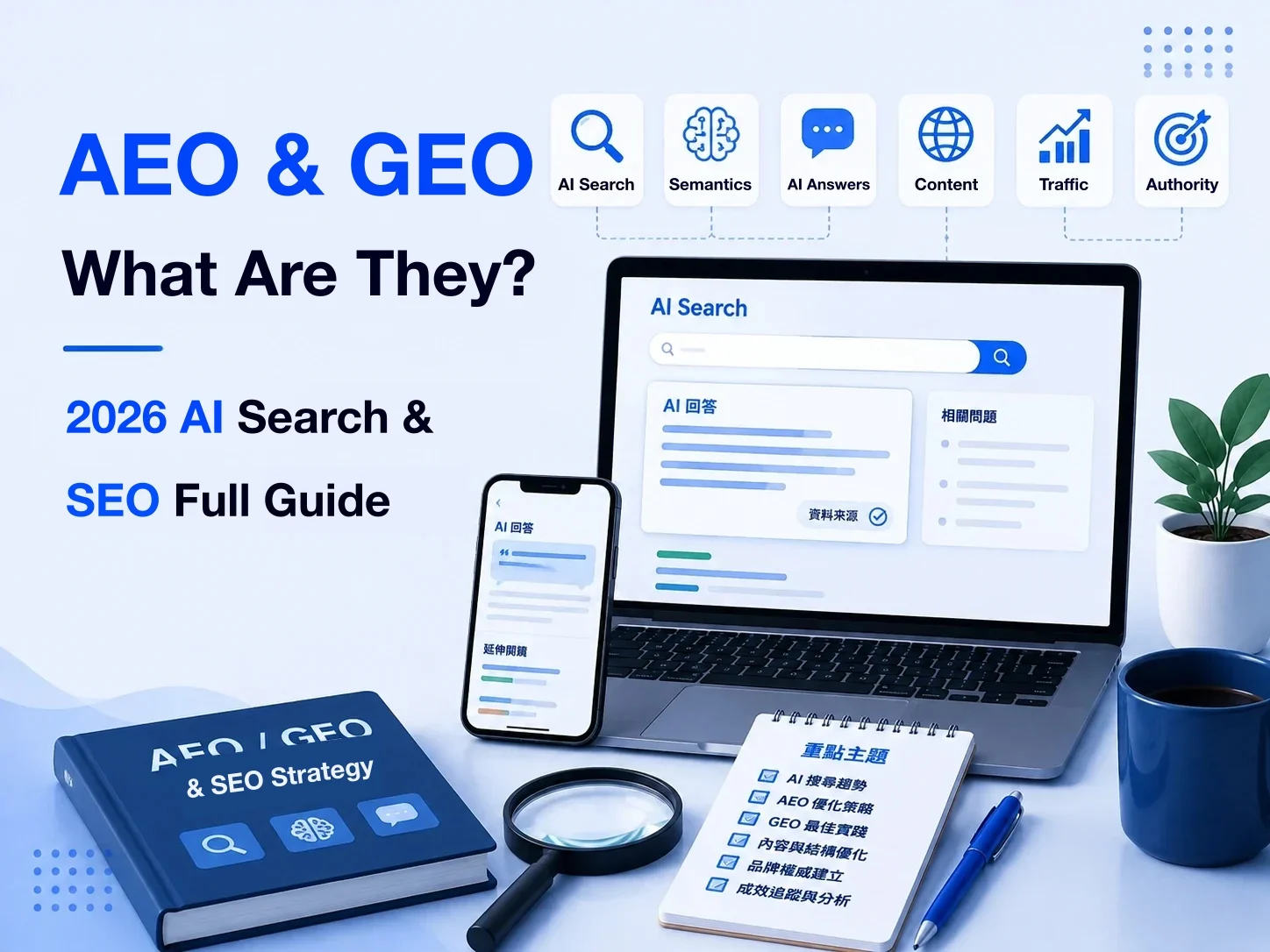
After Google AI Overviews, AI Mode, and generative tools such as ChatGPT, the way people look up information is changing quickly.
When companies did SEO in the past, the goal was usually clear:
Get the site into Google's organic results.
Now people often ask an AI directly, and the AI pulls information from different sources into an answer.
That is why terms such as AEO (answer engine optimization), GEO (generative engine optimization), and AI SEO have started to appear, and many companies are asking:
- Does SEO still work?
- Will AEO and GEO replace SEO?
- Does the company need a separate “AI search optimization” program?
These questions matter, but new marketing labels make them easy to overcomplicate.
At least from what Google has said publicly, existing SEO best practices still apply to generative AI search. AI search changes how results and information are shown. It does not throw out the foundations of search.
What a company actually needs to understand is not which new term will replace SEO. It is this:
As search expands from traditional results into generative AI, how does the company stay findable, understandable, and visible?
This article looks at AEO, GEO, and SEO from that angle, and at the changes a company actually needs in the AI search era.
Key points
- AEO is answer engine optimization. GEO is generative engine optimization.
- AEO, GEO, and SEO overlap heavily. They are not three fully separate systems.
- After AI search arrived, SEO is still an important foundation.
- Companies should move from keyword rankings toward overall search and AI visibility.
- Technical SEO, high-quality content, and a clear site structure still matter.
- First-hand experience, cases, original data, and a professional point of view become more valuable.
- Google Search does not currently require llms.txt or special AI structured data.
- GEO showing up is not a reason to buy a separate GEO service right away.
- AI search results should not be judged only by citations or brand mentions. They still need to connect to traffic, conversions, opportunities, and revenue.
- What a company actually needs is a visibility strategy that covers both traditional search and generative AI search.
What are AEO and GEO?
AEO and GEO are search-optimization ideas that gained attention as generative AI and answer-style search became more common.
They both ask the same question:
When people no longer only click search results, and instead get an answer directly from a search engine or an AI, how does the company’s content get found, understood, and shown?
AEO and GEO are not two new systems meant to replace SEO entirely.
At least by Google’s current definition, optimizing for generative AI search still sits on top of SEO.
What is AEO?
AEO (Answer Engine Optimization) is usually called answer engine optimization.
It focuses on making site content easier to use when a search engine or an answer system responds to a user’s question.
Traditional SEO often treats organic visibility for a query as a main goal. AEO puts more weight on whether the content clearly answers the question the user asked.
For example, a user searches: “How much does a corporate website cost?”
Besides the traditional results, the search engine may also assemble the information into an answer.
AEO therefore pays more attention to:
- A clear answer to the user’s question
- A sound content structure
- Clear headings and paragraphs
- Information that is easy to understand
- Content that is accurate and trustworthy
- Information that is structured and has context
Those practices overlap heavily with good SEO content.
A company does not need to treat AEO as a technique that sits completely outside SEO.
What is GEO?
GEO (Generative Engine Optimization) is usually called generative engine optimization.
It focuses on raising the visibility of the company, the brand, and the content in generative AI search or answers.
A user might ask, for example:
“Which companies in Taiwan build corporate websites?” or “How should a B2B company start SEO?”
A generative AI may take information from different sources and turn it into one complete answer.
At that point the company cares about more than where its own site ranks. It cares about:
- Can the AI understand who we are?
- Could our content become a source for the answer?
- Will the brand show up in related AI search results?
GEO therefore extends search visibility from traditional results into the generative AI environment.
The line between AEO and GEO is not that sharp
In practice, AEO and GEO overlap a great deal.
- AEO puts more weight on making content easy to answer a question.
- GEO puts more weight on giving the content and the brand visibility inside generative AI answers.
When a company actually does the work, it rarely needs three fully separate plans:
an SEO strategy, an AEO strategy, and a GEO strategy.
The foundation all three still share includes:
- Search demand
- A site that can be crawled
- A clear site structure
- High-quality content
- First-hand experience and professional information
- Brand and entity information
- Sound technical SEO
It is more useful to treat AEO and GEO as an expansion of the visibility SEO has to manage after the search environment changed, rather than as new work sitting outside SEO.
The focus used to be traditional organic search. It now also has to include answer-style search and generative AI search.
Further reading: Google Search Central — Generative AI search optimization guide
How do SEO, AEO, and GEO differ?
SEO, AEO, and GEO look at different search environments, but they are not three fully independent methods.
In short:
- SEO: search visibility.
- AEO: whether the content answers the question well.
- GEO: whether the brand and the content can be visible in generative AI search.
The goals differ, but the underlying work on the site, content, technology, and credibility overlaps heavily.
| Item | SEO | AEO | GEO |
|---|---|---|---|
| Name | Search engine optimization | Answer engine optimization | Generative engine optimization |
| Main setting | Traditional search results | Answer-style search | Generative AI search and answers |
| Main goal | Raise organic search visibility | Raise the chance that content becomes the answer | Raise the visibility of the brand and content in AI answers |
| Usual focus | Queries, pages, rankings, traffic | Questions, answers, content structure | Brand, entity, sources, citations, and AI visibility |
SEO is an important foundation for all three
If the site itself has these problems:
- Google cannot crawl it properly
- Pages are not indexed
- The site structure is a mess
- Content quality is weak
- Important information is hard to understand
talking about AEO or GEO on the side will not fix the root problem.
For Google AI search in particular, generative AI search still uses the Google Search index and the core search systems to get information.
The first thing a company still needs is a solid SEO foundation.
AEO puts more weight on “can it answer the question directly?”
AEO can be read as a further demand on how the content is written.
Take SEO fees. One article may only introduce an SEO service. Another answers directly:
- What affects SEO fees?
- What pricing models does SEO use?
- How much budget should a company set aside?
- How do you tell whether an SEO quote is reasonable?
The second piece maps more directly onto the question the user actually asked.
That is not something only AI search needs.
Traditional SEO was already supposed to understand search intent and give a genuinely useful answer, so AEO and high-quality SEO sontent already overlap a great deal.
GEO extends visibility into generative AI
GEO looks one step further.
The company does not only want the site to be found. It also starts to care about this:
When someone asks a generative AI a related question, is there a chance our brand and content appear in the answer?
Besides site content, GEO therefore pays more attention to:
- Whether the brand has clear and consistent information
- Whether the site offers original content
- Whether it has first-hand experience and data
- Whether the content is worth citing from other sources
- Whether an AI system can easily understand the information the company provides
The search strategy then moves past simply tracking “what rank a keyword holds” and toward a broader search and AI visibility.
They do not replace each other. They extend search visibility
So SEO, AEO, and GEO are better understood as:
- SEO builds the search foundation.
- AEO strengthens how well the content answers questions.
- GEO extends visibility further into generative AI search.
They are not: SEO → replaced by AEO → then replaced by GEO.
Search technology and user behavior are changing, but the core capability a company needs to build is still similar:
Let search systems find your information, understand your content, and give people a reason to trust it.
The difference in the AI search era is that this capability has to work across more ways of showing search and answers.
Further reading: Google Search Central — Generative AI search optimization guide
Does SEO still work after AI search?
Yes. SEO is still an important foundation for a company’s search visibility.
AI Overviews, AI Mode, and generative AI are changing how search results are shown. That does not mean the existing search system and the SEO foundation have disappeared.
Google has said clearly that existing SEO best practices still apply to generative AI search.
So instead of asking: “Will AI search make SEO disappear?”
a better question is: “After AI search, how should the goal of SEO expand?”
AI search still has to find information on the web
Generative AI can organize, summarize, and combine information. It still needs sources.
In Google AI search, Google uses its existing search infrastructure and index to find sites and content related to the user’s question.
The site still needs these basics:
- Search systems can crawl the site
- Important pages can be indexed
- The site structure is clear
- Page content is easy to understand
- The content relates to the user’s question
- The site offers information that is credible and useful
That work is already the core of SEO.
If crawling, indexing, and content quality are not in place, adding so-called “GEO tricks” will not replace those foundation problems.
Further reading: Google Search Central — How Google Search works
Traditional search results have not disappeared
AI search is growing quickly, but people do not get information only from generative AI.
Different search needs can still use different kinds of results.
For example: “What is SEO?”
An informational question like this can suit an answer assembled directly by AI.
- But if the user searches:
- “SEO company”
- “ERP system recommendations”
- “CNC machine shop in Taichung”
- “corporate website company”
they may still need to open company sites, compare services, and read cases before they can make a business decision.
For a company, traditional organic results and AI search are not a choice of only one.
What needs managing is the user’s overall visibility across different search experiences.
The goal of SEO is expanding from “rankings” to “search visibility”
When companies talked about SEO, it was easy to pin the result on what rank a keyword holds.
After AI search, that way of measuring is even less enough.
A company now needs to think about these at the same time:
- Does the site keep getting organic search exposure?
- Which search needs can find the company?
- Does the brand appear in related search situations?
- Could the content become a source for an AI answer?
- Does search traffic create potential customers?
- Does AI search create new contact with the brand and the site?
So the goal of SEO should not stop at “rankings.”
A fuller direction becomes building the company’s overall visibility in the search environment.
Generative AI search is an important new part of that environment.
Further reading: How to measure SEO rankings and results
AI makes original experience and professional information more important
Generative AI has sharply lowered the cost of producing ordinary informational content.
A company can now quickly produce a lot of:
- “What is SEO?”
- “What are the steps to build a website?”
- “What should you watch when choosing an ERP?”
This kind of basic content.
Once the web is full of similar information, content that only rearranges existing material has a harder time standing apart.
A company’s own:
- Real project experience
- Customer cases
- First-hand data
- Industry knowledge
- Professional judgment
- Actual tests
- Original research
becomes more important instead.
That information cannot be created just by asking an AI to “rearrange what is already on the web.”
SEO does not lose its value because a new search interface appears
The search environment has always been changing.
Results have added images, maps, featured snippets, shopping results, and video. Generative AI is the next addition.
Each change affects how a company gets search exposure.
What a company still needs to build is useful information that search systems can find, understand, and show to the right people.
So after AI search arrives, a company should not stop SEO.
A more reasonable direction is to keep the core of SEO, and extend the search strategy into AI search visibility.
That is why AEO and GEO fit better as an extension of SEO into a new search environment, not as a replacement for SEO.
Further reading: Google Search Central — Generative AI search optimization guide
How does Google AI search find and cite site content?
To see how a company can raise its visibility in AI search, start from this: Google’s generative AI search is not fully separate from the existing search system.
Google says AI search uses the existing search infrastructure and ranking systems, together with generative AI, to find information related to the user’s question.
For a site to appear in Google’s AI search experience, the first condition is still: Google can find, understand, and use the information on the site.
Further reading: Google Search Central — Generative AI search optimization guide
AI search may split one question into several searches
Traditional search can usually be read as:
The user enters a query → Google returns related results
Generative AI search can go further with what Google calls query fan-out.
When the user asks a more complex question, the system may split it into related sub-questions, run several searches at once, and combine what it finds into an answer.
For example, a user asks:
“We are a B2B manufacturing company. Should we do SEO or Google Ads first?”
That question may actually include:
- Where B2B SEO fits
- The strengths and limits of Google Ads
- The cost of SEO and Google Ads
- A B2B search marketing strategy
- How budget is split at different stages of a company
Generative AI can look for related information from different angles and assemble a fuller answer.
A company should not only ask: “Which keyword do we want to rank for?”
It also needs to ask: “Across the different questions in this topic, what genuinely useful information do we provide?”
AI search still sits on site content that can be crawled
Even when the search interface adds generative AI, the site’s basic technical conditions still matter.
For example:
- Whether Googlebot can access the site
- Whether pages can be indexed
- Whether important content sits on pages that can be read
- Whether robots.txt wrongly blocks important content
- Whether a page has noindex
- Whether internal links help search systems find important pages
These are not new GEO tricks. They are the technical SEO foundation that was already there.
If important content cannot be retrieved by search systems in the first place, adding a separate “AI optimization setting” is unlikely to fix it.
Google AI search looks for site sources that support the answer
One feature of generative AI search is that an answer can point to related sites and sources, so people can look further.
So the opportunity is not only to have the whole site quoted in full by an AI.
A more practical goal is to make some information on the site a useful source when the answer addresses a specific question.
For example, a company may provide:
- First-hand statistics
- Real project experience
- Clear product specifications
- Original research
- A professional comparison
- Complete cases
- Concrete ways of doing the work
That information can be more valuable as a source than content that only rearranges what is already on the web.
There is not always a fixed “AI ranking”
This is where GEO differs a lot from traditional keyword rankings.
Traditional SEO can more easily track what rank a keyword currently holds.
A generative AI answer can be affected by:
- The user’s question
- The context of the question
- Search intent
- Query fan-out
- The sources that can be retrieved
- Judgment by the search system and the model
and other factors.
On the same topic, a different way of asking can lead the AI to different sources.
So a company should not treat GEO as simply: “I want my site to be number one in ChatGPT.”
A more reasonable goal is to raise AI search visibility and the chance of being cited across related topics and questions.
AI search makes “topic completeness” more important
If AI search fans one question out into several related searches, a strategy built on one isolated article becomes even more limited.
If a company wants visibility around “corporate SEO,” it can cover the topic step by step:
What SEO is → SEO keywords → SEO articles → technical SEO → SEO results → SEO fees → SEO companies → SEO vs Google Ads → AI search
These pieces form a complete topic cluster.
The company is not only answering one keyword. It is gradually establishing:
“We have complete and useful information on this topic.”
That was already a sound SEO content strategy. Generative AI search makes this topic-based structure even more worth the attention.
The starting point of AI search optimization is still information worth finding
Once you understand how Google AI search works, one conclusion stands out:
A company does not need to start by hunting for a mysterious “AI search algorithm trick.”
The real starting point is still making the site retrievable by search systems, and offering information worth searching, understanding, and citing.
Technical SEO answers “can it be found?”
Content strategy answers “is there information worth finding?”
AEO and GEO go one step further: when search systems start using generative AI to organize answers, does our information still have enough value and visibility?
How can a company raise its visibility in AI search?
Raising AI search visibility does not start with building a site that is completely different from SEO.
At least from what Google has said publicly, generative AI search still sits on the existing search system and the SEO foundation.
What deserves priority is making the company’s information findable, understandable, trustworthy, and worth citing.
Get the SEO basics right first
The first step of AI search optimization is still a sound search foundation.
That includes:
- Important pages can be crawled and indexed
- The site structure is clear
- Internal links make sense
- Pages have a clear topic
- Important information sits in content search systems can retrieve
- The site offers a sound user experience
If search systems cannot retrieve the site’s information, more AEO or GEO tricks will not fix the root problem.
A company should not skip technical SEO and the site foundation just because AI search has arrived.
Build content around the questions people actually ask
AI search lets people ask fuller questions than a traditional keyword.
In the past they might have searched: “SEO fees”
Now they may ask directly: “We are a small or mid-sized B2B company. How much SEO budget should we set aside each month?”
So content should not only pile information around a single keyword.
What matters more is understanding:
- What problem is the customer actually trying to solve?
- Which questions come up before a decision?
- What comparisons and doubts are there?
- What information is needed before the next step?
Then answer those questions with complete content.
That matches the idea of search intent in SEO. In generative AI search, the questions can simply be more specific and more tied to a situation.
Offer first-hand experience and original information
If an article only rearranges content that is already on the web, it is hard to create a real difference.
What is more worth building is content only the company can provide, for example:
- Real customer cases
- Project experience
- Original data
- Actual tests
- Industry observations
- Professional judgment
- The company’s own methods and process
For example, instead of only writing “How do you choose an SEO company?”
the company can go further and share:
- When we actually run SEO for companies, which problems show up most often?
- Which metrics look good, but never turn into a business result?
- What do companies most often miss when they evaluate an SEO provider?
That first-hand information is what builds the company’s own content value.
Make the content easy to understand
Value is not enough on its own. How it is written also matters.
A company can use:
- A clear H1, H2, and H3 structure
- Paragraphs that answer the question directly
- Tables and lists that mean something
- Clear product and service information
- Consistent brand, author, and company information
- Structured data where it fits
The point is not to “please the AI.” It is to lower the cost for search systems and people to understand the information.
A sound content structure was already a shared foundation for SEO, user experience, and AI search.
Build a complete topic, not a pile of scattered articles
A company does not need to produce hundreds of pieces just because AI search has arrived.
A sounder approach is still to build out the topics that actually have commercial value for the company.
A company that offers SEO services, for example, can build:
SEO basics → Keywords → Content → Technical SEO → Results → Fees → SEO company → Ads comparison → AI search
Link those pieces to each other.
The value of this kind of topic cluster is not just more articles. It is that the company gradually builds deep, complete information in one field.
Build brand information that is clear, consistent, and credible
AI search visibility should not be only about a single article.
The company also needs the brand information on the web to stay consistent.
For example:
- Company name
- Brand name
- Products and services
- Areas of expertise
- Author information
- Company introduction
- Customer cases
- Mentions of the company from credible outside sources
That information helps search systems and people understand:
Who this company is, what it offers, and why this content is worth using as a reference.
So GEO is not only content SEO. It is also starting to cover a fuller picture of brand and entity visibility.
Do not mass-produce low-value content for AI search
Generative AI makes content much faster to produce. Being able to produce a lot does not mean you should publish a lot.
If a company uses AI to produce a lot of content, but adds no new information, experience, or value, and only restates what already exists, more articles will not raise search visibility on their own.
AI is a better fit for helping with:
Research, organizing, planning, editing, and making content production more efficient.
What still decides the value of the content is whether the company can offer information worth reading, and worth showing in search.
The core of AI search optimization is still the value of the information
To raise AI search visibility, a company can start with four basic questions:
- Can search systems find it?
- Is the content understandable?
- Is the information worth trusting?
- What value do we offer that other sites do not?
If those four are not in place, chasing new AEO or GEO tricks usually only treats the surface.
The other way around: if the company already has a sound SEO foundation, expert content, first-hand experience, and a credible brand, a large part of what AI search optimization needs is already done.
What kind of content fits the AI search era better?
The AI search era does not mean a company has to invent a special “AI-only article format.”
What actually changed is this: once generative AI can quickly organize information that is already on the web, the value of simply repeating existing content is falling.
So company content needs to answer one question more clearly: what new, credible information do we offer that is actually worth a reference for people and for search systems?
First-hand experience is worth more than rearranging existing information
A common SEO approach used to be: look up what currently ranks higher, then turn it into a more complete article.
That can still be part of the research. If the result only recombines information that already exists on other sites, the content itself has not added much that is new.
What usually gives a company an edge is its own real experience.
For example:
- Problems that came up while running a project
- The approach that was actually used
- Needs and doubts customers raise often
- Results from actual tests
- What changed before and after the project
- Observations built up by serving one industry over time
That information usually cannot be obtained just by rearranging other sites.
Original data and cases can create a real difference in the information
If a company has its own data, it can gradually turn that into a content asset.
For example: “After we reviewed 50 corporate website projects, these were the five problems we saw most often.”
That carries more than simply writing: “Five common problems on corporate websites.”
It adds a first-hand source.
In the same way, a customer case should not only show screenshots of the site.
A more useful case should explain:
- What problem the customer had
- Why this approach was chosen
- What work was actually done
- What result came out of it
- What the project taught
That content has search, brand, and sales value at the same time.
State the company’s own professional judgment clearly
Company content does not have to stay in a fully neutral encyclopedia voice.
If a question has more than one sound approach, the company should offer a judgment based on its own experience.
For example: “SEO and Google Ads should be done together.”
That is a very common answer.
If the company goes further, from a real business situation:
“If search demand has not been tested yet, a company with a limited budget can use Google Ads first to pick up market signals, then decide which topics are worth a long-term SEO investment.”
The second version includes the company’s own judgment and method.
This kind of content does not only answer “what it is.” It also starts to answer:
“How should you choose when you actually have to decide?”
For a B2B company, this is usually closer to what a potential customer actually needs.
Answer the full question, rather than only inserting keywords
AI search makes it easier for people to ask complete, specific questions that include a situation.
So content planning should also move on from:
“Which keywords should this article include?”
toward:
“When someone is solving this problem, what do they need to know?”
Keyword research still matters, because it shows what the market is searching for.
Keywords should be used to understand the need. They should not limit the content to one fixed search phrase.
Sound content usually covers, in a natural way:
- The basic idea
- Situations where it is used
- How to compare
- Cost
- Strengths and limits
- Conditions for a decision
- Common questions
- The next step
so one article actually finishes the person’s search task.
Make the source and the professional background easy to check
In the AI search era, credibility matters just as much.
A company should make it easy for people to check:
- Who provided the content
- What relevant experience the company has
- Where the data came from
- Which parts come from official sources
- Which parts are the company’s own experience and judgment
- Whether the article is kept up to date
When a source is needed, prefer official documents, original research, and first-hand sources, rather than a long chain of other roundup articles.
That is part of building the company’s professional credibility, as well as SEO.
There is no need to force every piece into an “AI format”
The market may offer all kinds of so-called AI search content tricks, for example asking you to:
- Make every paragraph very short
- Turn every heading into a question
- Add a large FAQ to every article
- Build a separate set of content just for AI
- Split the article into many fixed-format information blocks
Those practices should not be treated as general rules.
A clear content structure does help. The purpose is still to make the information easy to read and understand, not to guess a fixed article template that some generative AI system prefers.
What a company should really avoid is this:
Optimizing for AI at the cost of the reason the content was meant to serve people.
TimTech’s view: the easier AI makes content, the more a company’s own experience matters
One of the largest effects of generative AI is not only a changed search interface. It also makes content much cheaper to produce.
When every company can quickly produce articles such as “What is SEO,” “How do you build a website,” and “How do you do digital marketing,” simply having content is no longer much of an advantage.
What is actually hard to copy is this:
What the company has actually done, what it knows, and the judgment it drew from that experience.
So a content strategy for the AI search era should not only be “use AI to produce more articles.”
What is more worth accumulating is: the company’s own experience, cases, data, methods, and point of view.
That content has a better chance of creating a real difference in search, and it gradually becomes a brand asset the company can keep building.
Do structured data and llms.txt help GEO?
As GEO draws more attention, the market has offered many new technical practices, for example:
- Create an llms.txt file
- Add AI-only markup
- Use special structured data
- Recut the content into a format that is easy for AI to read
Those practices can easily leave a company with this impression:
Without these new technical settings, the site may not appear in AI search.
At least from what Google Search has said officially so far, that is not the case.
What is llms.txt?
llms.txt is a proposed format from recent years. The idea is that a site can use a specific text file to give large language models the site’s content and sources.
In concept it is a bit like: “a site brief written specifically for AI systems to read.”
Some GEO tools and services have started recommending that sites create an llms.txt file, hoping it will raise the chance that AI systems understand or cite the site.
That is not a standard every AI search system follows today.
More importantly, Google has said clearly: Google Search does not use llms.txt.
A company does not need to create llms.txt in order to appear in Google Search or in Google’s generative AI search features.
If a site creates llms.txt because another AI service or system asks for it, that is fine. For Google Search, it does not raise or lower the site’s visibility or ranking.
Structured data still has value, but it is not a GEO shortcut
Structured data can help search engines understand specific information on a page, for example:
- Products
- Organizations
- Events
- Articles
- Breadcrumbs
- Other data types Google supports
So structured data is still one of the important techniques a site can use for SEO.
That does not mean adding more Schema will make the site easier for AI to cite.
Google has said clearly that generative AI search does not need extra structured data, and does not need special Schema.org markup added for it.
A company should use structured data for the content the site actually has, and for the search features Google supports. It should not pile on markup that has no real use, just for GEO.
There is no need to recut content into a format that is “easy for AI to read”
Another common claim is that AI understands short, standalone blocks more easily, so the whole article should be recut.
Google does not currently require that.
Clear headings, paragraphs, and structure already help with:
- People reading the page
- Search systems understanding it
- Accessible use
- Managing the site’s content
So an article should still keep a sound information structure.
A company does not need to split every piece into many very short paragraphs or a fixed format, just for AI.
How long the content should be, and how it should be split, should still follow how much information a person needs in order to understand the topic.
There is also no need to build a separate “AI version” of the content
A company also does not need a second set of pages that say almost the same thing, just for generative AI search.
Google’s search systems can already understand meaning, synonyms, and search intent.
So there is no need to mass-produce pages just because the wording of a question changes, such as:
- “How do you choose an SEO company?”
- “How should you select an SEO company?”
- “Ways to choose an SEO company”
- “Methods for recommending an SEO company”
Pages like these are highly similar.
If the only reason is to cover more AI search questions, a large set of near-duplicate pages can create low-value and duplicate content.
A sounder approach is still: one high-quality piece that actually answers the topic in full.
Do the work that is already known to matter, then watch new technical standards
AI search is still changing quickly.
Different AI platforms may later set new protocols, ways of accessing sites, or content standards. A company should keep watching llms.txt, AI agents, and site protocols.
“Worth watching” and “worth a large investment right now” are two different things.
A more reasonable order of priority, for now, is still:
The site can be crawled and indexed → technical SEO → high-quality original content → clear site and brand information → tracking results → then evaluating new AI search technology.
Do not put a large amount of time into a technique the major search platforms have not adopted, just because the market has a new GEO term.
Especially when the site’s own SEO, content, and brand information are not yet complete, this is usually not the first place to spend.
New technical standards are worth tracking.
A company should first invest in the foundations that are already known to affect search visibility.
Does a company need a separate AEO or GEO agency?
Not necessarily.
AEO and GEO do bring a new search environment and a need to measure results. That does not mean a company must split them into a service that is fully separate from SEO.
At least from the direction Google has published so far, optimizing for generative AI search still sits on the existing SEO foundation.
When a company evaluates an AEO or GEO service, the question that actually needs an answer is not: “Does this company offer a GEO service?”
It is: “What will they actually do for us?”
Further reading:How do you choose an SEO company?
First see what the company is missing now
If the company does not yet have basic SEO in place, for example:
- The site has crawl or index problems
- There is no clear search strategy
- Important product and service pages are thin
- There is no ongoing expert content
- Search results are not tracked
- Brand and company information is incomplete
Building the SEO foundation first is usually more important than buying a separate GEO service.
Those problems also affect how visible the company is in generative AI search.
Look at the actual work, not only the service name
Different providers may not mean the same thing by AEO or GEO.
Some services may include:
- Technical SEO
- Optimizing site content
- Topic research
- Original content production
- Organizing brand information
- Structured data
- Tracking AI search visibility
- Digital PR and outside mentions of the brand
That work can genuinely have value.
Other services may only be:
- Creating an llms.txt file
- Adding a large number of FAQs
- Using so-called AI-only Schema
- Producing a large volume of AI articles
- Offering an opaque AI ranking score
- Claiming they can guarantee a citation in ChatGPT or Google AI
A company should not treat it as a necessary new investment just because the name says “GEO.”
It should come back to:
The actual work, the basis for it, how results are measured, and which business problem it can solve.
Be cautious about “guaranteed AI rankings”
Generative AI search does not have one ranking system that every platform shares and that stays fixed.
Sources, search mechanisms, and how answers are formed also differ across platforms.
So if a provider claims:
- “Guaranteed number one in ChatGPT”
- “Guaranteed to be cited by Google AI”
- “Use our GEO technique and you will definitely appear in the AI answer”
a company should be especially careful.
Google also reminds companies that third-party SEO, AEO, or GEO providers do not have Google’s internal ranking data, and they cannot guarantee search results.
See whether the provider actually understands search and content
If a company does need an outside team for AI search visibility, it is more useful to check whether they can cover the whole job:
- Whether they understand the SEO basics
- Whether they can do technical SEO
- Whether they can study search demand and topics
- Whether they can build content that is actually useful
- Whether they understand the company’s products and customers
- Whether they can handle brand and company information
- Whether they can track search and AI search results
- Whether they adjust the strategy as search platforms change
AI search optimization is not a single technical setting.
It involves the site, search, content, brand, and how results are measured.
TimTech’s view: a company needs a search-visibility strategy, not more service names
From a business point of view, we would not split the work the moment the market starts saying AEO and GEO:
SEO, AEO, GEO
into three budgets and three services that do not talk to each other.
A sounder start is to name the result the company actually wants: when a potential customer searches a question related to us, can the company be found?
In the past, that mostly happened in Google’s organic results.
It is now spreading into AI Overviews, AI Mode, and other generative AI search environments.
What actually needs to be managed is the company’s search visibility as a whole.
SEO is an important part of that foundation. AEO and GEO are the extra considerations that come after the search environment changes.
If the existing SEO team can already keep working on the site, technical issues, content, brand, and tracking, the company may not need a separate “GEO agency.”
The other way around: if the existing team cannot understand the change AI search brings, adding that capability is what actually matters.
How do you measure AI search visibility?
Traditional SEO already has relatively mature ways to measure, for example:
- Impressions
- Clicks
- Click-through rate
- Average position
- Organic search traffic
- Conversions
- Leads
How to measure generative AI search is still developing.
A company should not only ask: “Were we cited by AI?”
It should build a fuller frame for measurement:
AI search visibility → site traffic → conversions → business results
Start with visibility in Google’s AI search
Google has started offering generative AI search performance data in Search Console, so site owners can see how the site performs in AI search experiences.
A company can look at:
- Impressions in generative AI search
- Whether people click through to the site
- Which pages gain AI search visibility
- Which search topics bring impressions
- How AI search results change over time
That means a company will not have to rely only on searching by hand: “Did our brand show up in an AI answer today?”
It can gradually use first-party search data to judge the actual result.
Do not only track whether you were cited
Being cited by AI is useful as a reference. A single citation does not, by itself, equal a business result.
One citation in an AI answer today does not mean:
- Many potential customers saw it
- Users therefore learned the brand
- The site gained more useful traffic
- It ended in inquiries or sales
So “AI citation count” is better as one visibility signal, not the final KPI.
What actually needs ongoing tracking is: did those AI search impressions eventually create a real business impact?
GA4 can go further and show site traffic from AI
Besides Google Search Console, a company can use GA4 to see traffic from different sources.
If someone clicks a source link from a generative AI platform and lands on the site, that can show up as identifiable referral traffic.
A company can then look at:
- How many users AI platforms bring
- Which pages they land on
- Time on site and engagement
- Whether they open contact or booking
- Whether key events such as form submissions happen
- Whether that becomes a qualified lead
That is how AI visibility connects to actual on-site behavior and conversions.
Further reading: Google Analytics: Traffic acquisition report
Different AI platforms need to be understood separately
Google AI search, ChatGPT, and other generative AI platforms are not the same system.
Their:
- Information sources
- How search works
- How citations work
- User behavior
- Analytics data you can get
can all differ.
So a company should not fold every platform into one vague “GEO ranking.”
A sounder approach is to watch the signals each platform actually provides, then combine them into the company’s overall AI search visibility.
Third-party GEO tools can be a reference, but do not treat the score as a real ranking
The market already has many tools that track AI search visibility.
These tools may regularly ask questions of different AI platforms and record:
- Whether the brand appears
- Which competing brands appear
- Whether it was cited
- Which sites became sources
- Brand visibility across different questions
That data can help a company watch trends.
Note that a third-party tool measures the questions and test setup it designed. It does not represent every AI answer real users see.
So this kind of data is better for comparing trends, finding problems, and watching the competitive picture.
It is not a reason to treat an “AI Visibility Score” as the company’s real search ranking.
In the end it still comes back to business results
For a company, the point of AI search optimization should not stop at:
“Getting ChatGPT to mention us.”
The question that matters is whether AI search helps more of the right potential customers learn about the company, and whether that eventually becomes a business result.
AI search impressions
↓
Brand and content visibility
↓
Site traffic
↓
Conversions such as inquiries, bookings, and sign-ups
↓
Qualified leads
↓
↓
Opportunities and revenue
This is very close to how SEO results are measured.
The difference is that a company now needs to extend the sources of search-visibility data from traditional search into generative AI search.
TimTech’s view: do not invent a new KPI that drifts away from business results just because the search format is new
AEO and GEO are still moving quickly, so the market easily produces new metrics:
AI ranking, AI citation rate, brand mention rate, AI visibility score.
Those numbers are worth watching, but a company should not treat a metric as the final result just because it looks new.
For a company, search marketing should still answer:
- Did more of the right customers find us?
- Did it bring useful traffic?
- Did it produce leads?
- Did it turn into opportunities and revenue?
AI search has changed where visibility happens.
It has not changed the fact that a company should still measure marketing investment by whether it returns a business result.
How should SEO and AEO/GEO fit together from here?

A company does not need three fully separate strategies for SEO, AEO, and GEO.
A sounder direction is to build the search foundation with SEO, then extend search visibility into answer-style search and generative AI search.
That means growing from traditional organic search visibility into overall visibility across traditional search and AI search.
Stage 1: Build a complete SEO foundation first
If the company’s search foundation is still incomplete, the priority is still SEO.
That includes:
- Search demand and keyword research
- Site information architecture
- Technical SEO
- Product and service pages
- Expert content
- Internal links
- Structured data
- Search Console and GA4 performance tracking
This work affects traditional search, and it is also an important base for generative AI search to retrieve and understand the site.
So a company does not need to skip SEO and jump straight to so-called “AI optimization” just because GEO appeared.
Stage 2: Raise the information value of the content
Once the SEO foundation is coming together, the next step is not simply publishing more articles. It is raising the information value of the content itself.
A company can gradually add:
- First-hand project experience
- Customer cases
- Original data
- Industry research
- Professional judgment
- Real comparisons
- The company’s own methods and process
The site then does more than rearrange information that already exists in search results. It becomes an original source for some questions.
That helps traditional SEO, and it also fits the content direction AI search needs.
Stage 3: Start managing AI search visibility
Once a company already has a real site and content asset, it can start watching:
- Which content appears in Google AI search
- Which topics gain AI search impressions
- Whether the brand appears in related AI answers
- Which sites become AI citation sources
- Whether AI platforms start sending site traffic
- Whether that traffic converts
At that point AEO and GEO stop being abstract new names. They become part of managing the search results the company already has.
Stage 4: Keep adjusting the search strategy from the data
The search environment will keep changing.
New AI search interfaces, data sources, site protocols, and analytics tools may all appear.
A company does not need to predict every future GEO technique now.
What matters more is a process that can keep being adjusted:
Search demand → build content → gain visibility → measure results → find content gaps → keep optimizing
When the search environment changes, fold the new AI search data and better practices into that same process.
The company then does not have to rebuild a marketing system every time a new search term appears.
TimTech’s view: upgrade from an SEO strategy to a search-visibility strategy
We think the real change AI search brings is not that SEO is about to disappear.
It is that the range of search visibility a company has to manage is getting wider.
Search visibility used to happen mainly in Google’s organic results.
It is now extending into organic results, AI Overviews, AI Mode, and other generative AI search environments.
What fits a company better from here is one complete search visibility strategy.
SEO builds a foundation that can be searched, understood, and trusted.
AEO strengthens the content’s ability to answer questions.
GEO reminds the company to watch brand and content visibility inside generative AI environments.
The three ultimately serve the same thing:
When a potential customer is looking for information and a solution related to the company, give the company a better chance to be found, understood, and then turned into a business opportunity.
AEO and GEO FAQ
What is the difference between AEO and GEO?▼
AEO (answer engine optimization) focuses on whether content is easy for search or answer systems to understand, and whether it can be used to answer a user’s question.
GEO (generative engine optimization) goes further and looks at how visible the company, the brand, and the content are in generative AI search and answers.
In practice the two overlap a great deal, and there is no industry-wide technical standard for AEO or GEO yet.
Will GEO replace SEO?▼
Not for now.
At least from Google’s current official direction, generative AI search still sits on the existing search system and on SEO. The SEO practices already in place still apply.
A sounder way to read it is:
The range of SEO visibility is extending from traditional search results into generative AI search.
So a company should widen its SEO strategy, not stop SEO and switch entirely to GEO.
Conclusion: AI search is changing SEO, not replacing it
AEO and GEO reflect a change in how people look for information.
Companies used to compete mainly for visibility in Google’s organic results. They now also have to deal with AI Overviews, AI Mode, and other generative AI search environments.
That does not mean a company should drop SEO and build a completely different GEO system.
At least from the direction Google has published so far, existing SEO best practices remain an important foundation for generative AI search.
What a company actually needs to do is gradually move the search strategy from: “raise keyword rankings”
and extend it to: “raise the company’s search visibility as a whole”
Do technical SEO, site structure, search demand, expert content, first-hand experience, brand information, and performance tracking well. Then watch, step by step, how the company shows up, gets cited, draws traffic, and produces business results in AI search.
New search technology will keep appearing.
A company does not need to chase every new name and tactic. What matters more is a foundation that can keep adjusting as the search environment changes.
Give the potential customers who actually need you a chance to find, understand, and trust the company, whether they arrive through traditional search or AI search.