Add LINE
TimTech
Book a consultation
Book a consultation
  1. Home
  2. /News
  3. /Website cost: five factors for a realistic budget

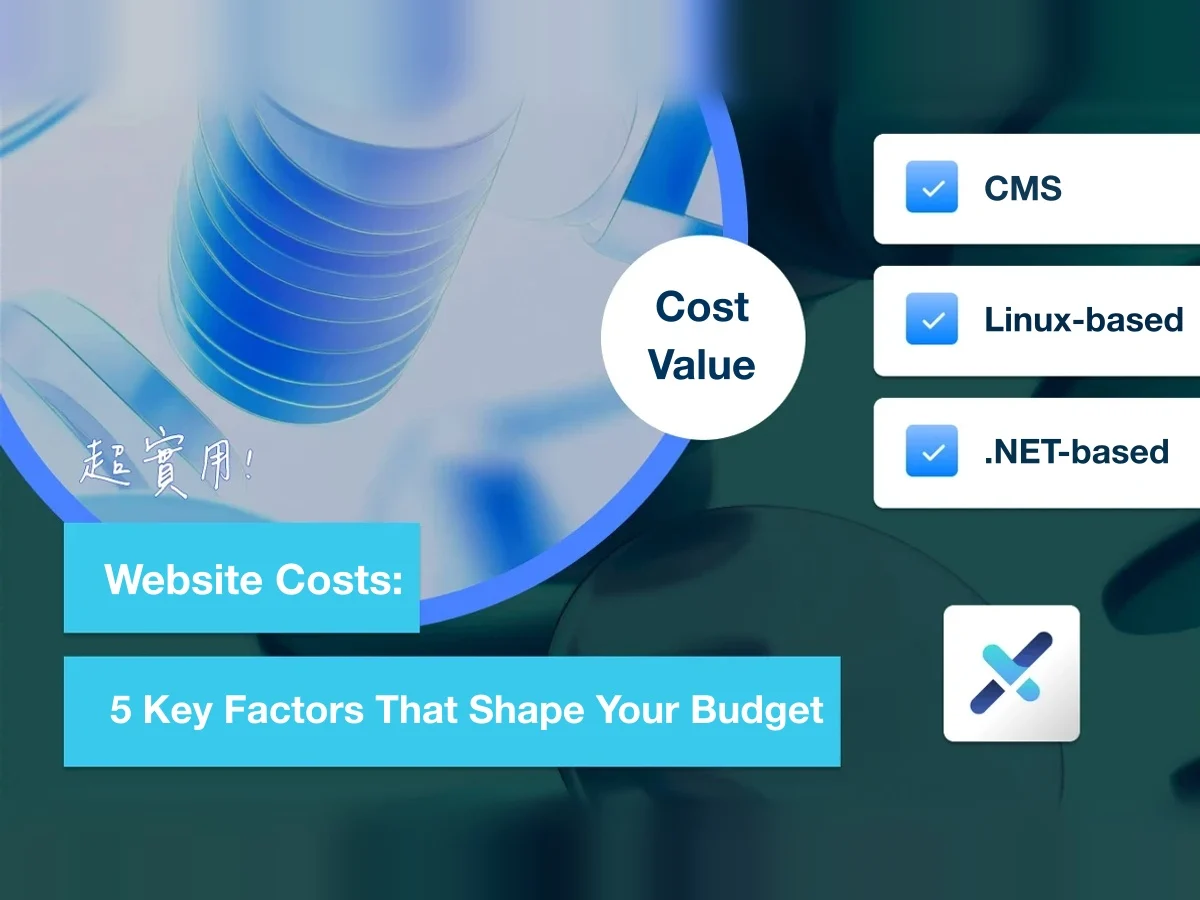
Website cost: five factors for a realistic budget

圖片預留
2025.04.15Updated 2026.10.07
  • Business websites

Summary

A site can present a product, shape how a brand looks, and let people reach you without a visit. Builds vary wildly. What counts as a fair price, what drives it, and how to choose.

Building a website can help businesses or individuals promote products and build their image, letting more people discover the brand online and, in turn, increasing sales and exposure. But there are countless ways and types of websites to build. What counts as a reasonable price? What factors determine the cost of building a website? And how should you choose?

This article lists 5 key factors that affect the price and points you in the right direction, giving you a deeper understanding of building a website and helping you choose the approach that suits you best.

Common ways to build a website

There are countless ways to build a website. Today I'll introduce five common approaches so you can get a basic understanding of website building.

CMS platforms

A CMS (content management system) is a system for managing content. It means web design and content editing are no longer jobs only web engineers can do: ordinary people can also operate and manage a site through a clear, simple interface.

Content management systems are also the most mainstream way to build a website today. Of all the systems available, the biggest by far is WordPress (.org), which I'm sure you've heard of. Next come the more niche Joomla and Drupal.

Website builders

Website builders also let you manage your site simply and conveniently. The biggest difference from a CMS is that you don't have to choose the server, features, and theme for your website yourself from start to finish. You just sign up for an account and you instantly have a website.
Share

On this page

  • Common ways to build a website
  • CMS platforms
  • Website builders
  • Online store platforms
  • Linux-based websites
  • .NET Framework ASP websites
  • 5 factors that affect website development costs
  • The platform you build on
  • Style and design
  • Number of features
  • Content structure
  • Maintenance and updates
  • How should you choose how to build your website?
  • Why? Think about why you want a website
  • How? Plan how to reach your goals
  • What? Choose the right system and features
  • Conclusion: You need a clear picture of your ideal website

TimTech

Ideas, made real.

We help B2B companies turn the website into a long-term asset: a clearer position, search that compounds, and inquiries that actually get handled.

Explore

  • Home
  • News
  • FAQ
  • Cases
  • Contact

Services

  • Website Development
  • Search growth
  • From inquiry to close

Industries

  • Print shops
  • Court-auction leads

Contact

  • Email:service@timtech.tw
  • Address:10F.-2, No. 118, Dazhong S. St., West Dist., Taichung City 403533 , Taiwan
  • LINE:Message us on LINE

© 2026 TimTech. All rights reserved. | Power By TimTech

  • Privacy
  • Terms

Because they're cheap or even free, they're often the choice of people on a budget and students. Common website builders include WordPress (.com), Wix.com, and Weebly.

Online store platforms

Because large online marketplaces take high commissions, more and more people are choosing online store platforms to run their own brands and sell their products. This approach is very similar to a website builder but focuses more on running an online store. You don't need to choose a server or connect shipping and payment features yourself: you can have your own online store through a range of feature plans.

The more common ones in Taiwan today are Shopify, Shopline, 91APP, and WACA. But because these systems are still relatively new in Taiwan, Chinese-language information and tutorials are relatively scarce, with fewer resources than for the previous two.

Linux-based websites

Linux is a free and open-source Unix-like operating system, but this way of building websites is less common now. You'd only need to develop this kind of site yourself for specific needs, such as high interactivity, unique functionality, or an accompanying app.

Because few people use it and WordPress has largely replaced it, and because I'm not very familiar with this approach myself, anyone interested can look into it on their own.

.NET Framework ASP websites

ASP.NET is a development platform provided by the .NET Framework. It's a very self-contained web technology, mostly used for "system-level" website development. The back end is usually connected to a system such as a CRM, an ERP, or an internal management system, and it's mostly used by governments, large enterprises, and banks and financial institutions.

So ordinary shops, companies, or individuals generally won't build their websites this way. I'm not familiar with this approach either, so anyone interested can look into it themselves.

5 factors that affect website development costs

Now that you know the five ways to build a website, let's talk about the 5 key factors that affect the cost. These factors determine the final price of a website, and once you've read through them you'll understand why a website can cost anywhere from NT0toNT0 to NT0toNT200,000.

The platform you build on

Your needs determine what kind of platform you need. In terms of technical complexity, the Linux-based websites and .NET Framework ASP websites mentioned above are the most expensive, with quotes usually starting at NT$100,000.

CMS platforms, website builders, and online store platforms all have lower technical requirements, but they generally have a fixed monthly maintenance cost, anywhere from a few hundred to a few thousand NT dollars, depending mainly on how many features you unlock.

Most people still choose one of the latter three, as they're more cost-effective. But if you want to dig deeper into which is best, you really need to understand your own needs in detail, along with the specific differences between the three, before you can choose.

Style and design

UI (user interface) and UX (user experience) design are getting more and more attention, because they determine how long visitors stay on your website and whether sales close successfully.

Good UI/UX can successfully convey your brand value and the information you want visitors to know. That's why many people hire professional web designers to create attractive layouts, distinctive illustrations, and brand color schemes for their websites. This is the extra "design fee" you'll pay. There's no standard price; it depends entirely on which designer you hire.

Of course, some people want a good-looking site but don't need a distinctive style, so many web developers have had designers create attractive, practical templates. With a certain amount of customization, a template can become a website for your own brand. So if you're not particularly demanding about design, this is usually the recommended way to design your website.

Number of features

The number of features can be discussed from two angles: the ecosystem of the system itself, and the plan you choose.

The system's ecosystem determines how free and flexible your website can be. For example, WordPress has a complete ecosystem: because it's an open system, there are a huge number of plugins to choose from for everything from the admin, themes, templates, SEO, security, and site speed to page editing. It's the very model of a "super" ecosystem.

The other is the plan you choose. Plans with more features and a more open admin can basically deliver any kind of website you want, with prices ranging from a few hundred to a few thousand NT dollars.

Putting these two angles together, it's best to choose a system with a complete ecosystem, and then choose a plan based on how many features you want.

Content structure

A quote for a website's content is usually based on the number of pages at each level and how many levels the structure has in total.

Structural levels are like branches and pages are like leaves: a tree with more branches and more leaves looks bigger. This content structure determines the overall scale of the website and also affects the quote.

So when building your website, you can first decide which content needs to be designed and built by the web team and which content you can learn to produce yourself in the future. This also makes your future website planning more long-term and more effective.

Maintenance and updates

A website isn't something you build once and then forget about; ongoing maintenance and updates are also very important.

Starting with maintenance: the fixed system costs mentioned above are part of maintenance, and website security, site speed, password protection, backups, and spam filtering are all important components too.

An open, flexible admin makes it very easy to change your web content or update the system. You no longer need to go through the website's technical staff, saving a lot of time and money. But this usually works best if someone on your team knows how to manage a website admin.

So before building your website, it's worth thinking ahead about training someone to be responsible for maintaining it after launch, to save on maintenance and update costs later.

How should you choose how to build your website?

Although I've only listed five key factors that affect the price, each one involves many details if you dig deeper, and those details are why website quotes range from NT0toNT0 to NT0toNT200,000.

If you're still not very familiar with the explanations above, I've put together the questions you should think about when building a website, so you can build your ideal website.

Why? Think about why you want a website

Your purpose determines whether the money you spend on the website is worth it.

If you just want to show off a portfolio, the cheapest plan will do. If the website is the face and image of your company, maybe you should put more thought and money into design. If you want to achieve marketing goals, a varied website and highly flexible website features are what you need to focus on.

How? Plan how to reach your goals

Once you have an initial idea of your website, "professional advice" can help you find out more quickly whether your ideal website is feasible, and start planning how to reach your goals.

Common questions include: How will you use the website? How many pages does it need? What features? What impression do you want to give? How many monthly visitors are you aiming for? Once you have concrete answers to these questions, you can move on to the final step: choosing the system and features.

What? Choose the right system and features

There are countless website systems and features, and everyone is used to something different, but there are still a few principles to follow when choosing.

To start, you can choose the most widely used or currently most popular system. Or look at the features commonly used in your region, since there may be differences in Chinese-language learning resources and operation. Finally, you can look at how businesses in the same industry build their websites, which is also a very useful approach.

Conclusion: You need a clear picture of your ideal website

This article covered common ways to build a website, the key factors that affect the price, and finally the order in which to think through your choice, taking you from knowing nothing to having a basic understanding of website building. Of course, there's still a long way to go to find the ideal approach.

But before you start building a website, the most important thing is this: you need to know better than anyone what your ideal website should look like. That's what lets you communicate better with the people building it, and that's the only way to end up with the website you want.

Previous

Google SEO: fourteen optimizations worth understanding

Next

Should you build a website? Fifteen pros and cons

Related articles

  • Redesigning a company website: fifteen things to get right
    Business websites

    2026.08.16

    Redesigning a company website: fifteen things to get right

    When a company site needs a redesign, how to judge that first, and what to watch…

  • What belongs on a company website? Fourteen features, basic and advanced
    Business websites

    2026.08.16

    What belongs on a company website? Fourteen features, basic and advanced

    Common pieces of a company site: content management, product pages, SEO, more th…

  • Company website design: planning, structure, and what to design for
    Business websites

    2026.08.15

    Company website design: planning, structure, and what to design for

    How to design a company site around its goal: information architecture, how peop…